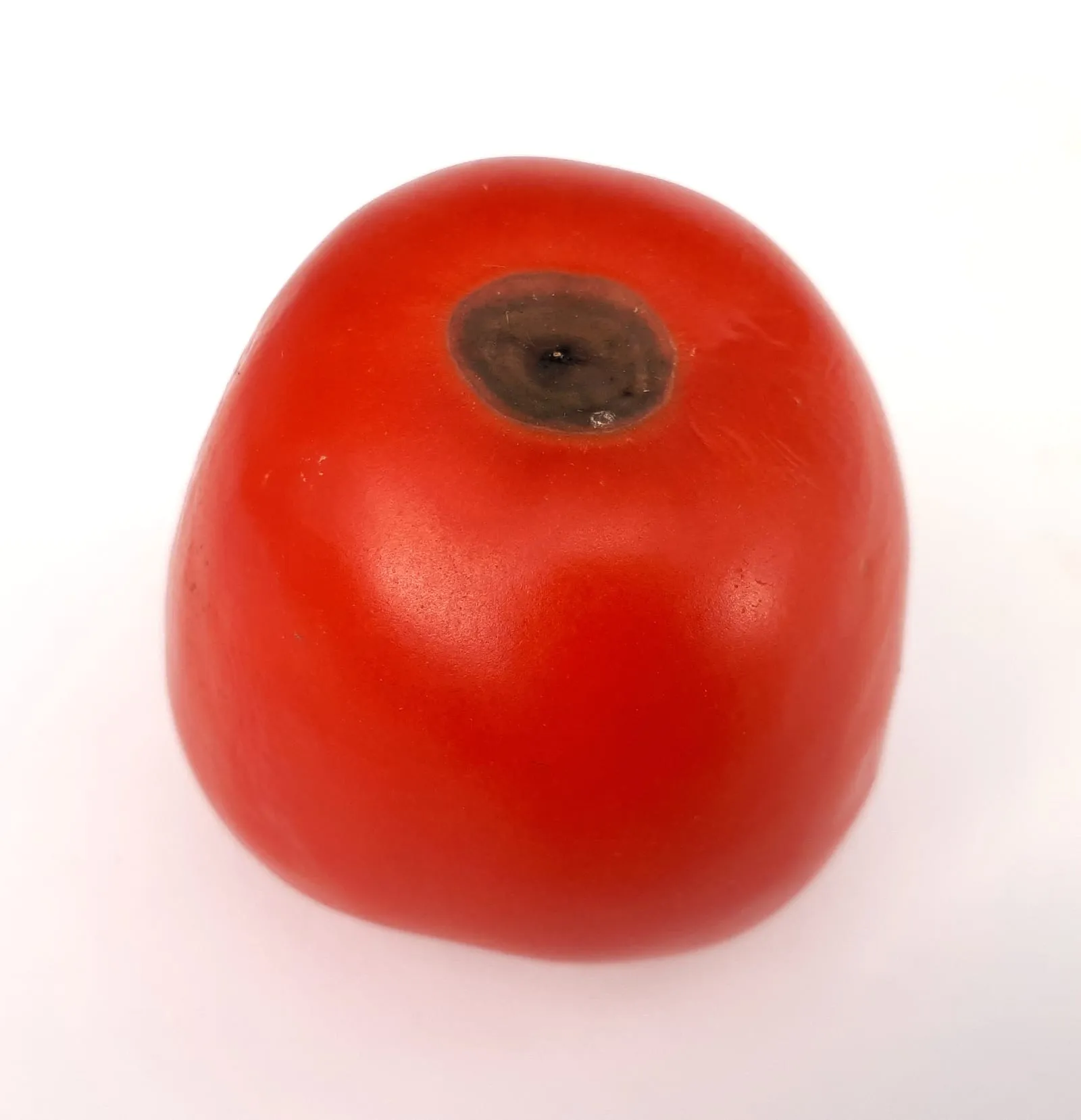
Disease
physiologicalBlossom End Rot
Calcium deficiency physiological disorder
Not a true disease but a calcium-uptake disorder caused by inconsistent soil moisture during fruit development. The dominant cause of damaged first-fruit on home tomato plantings.
- Pathogen type
- Physiological
- Hosts
- 7
- Symptoms
- 4
- Scientific name
- Calcium deficiency physiological disorder
- Resistant varieties
- 0
Biology and conditions
Blossom end rot is not a pathogen. It is a calcium-uptake disorder that develops when fruit tissue at the blossom end (opposite the stem) is starved of calcium during rapid cell division early in fruit development. Calcium is abundant in most garden soils; the problem is translocation, not supply. Water carries calcium from roots into actively growing tissue. When soil moisture fluctuates sharply, the plant prioritizes vegetative growth, and expanding leaves outcompete young fruit for available calcium. The result is localized cell death at the blossom end that turns tissue brown, leathery, and sunken.
Tomatoes are the most frequently affected crop, but the same mechanism damages peppers, watermelons, summer and winter squash, and melons. First fruits of the season carry the highest risk because the plant is in rapid early growth and irrigation habits are still being established. A stretch of dry weather followed by a heavy watering event is a classic trigger. High nitrogen fertility compounds the problem by pushing vegetative growth faster than calcium can be translocated to fruit.
Calcium sprays are widely sold as a remedy, but extension research from land-grant universities consistently shows that foliar calcium applications provide little benefit when the underlying cause is irrigation inconsistency. The most cost-effective control is also the most direct: stable soil moisture throughout the growing season. Mulching to moderate soil temperature swings, combined with drip irrigation on a timer, eliminates the disorder in most home garden situations. Affected early fruits should be removed; later fruits produced under consistent moisture will be normal. No varieties with documented resistance to this disorder are currently listed.
Symptoms
- ▸ Sunken brown to black leathery patch on the blossom end of fruit (opposite the stem)
- ▸ Affected fruit eventually rots
- ▸ First few fruits of the season most often affected; later fruits typically fine
- ▸ Often more severe after a stretch of dry weather followed by heavy watering
IPM controls
- ✓ Maintain consistent soil moisture with mulch and regular irrigation (the most effective control)
- ✓ Test soil pH; supplemental calcium rarely helps because the issue is uptake, not supply
- ✓ Avoid excessive nitrogen fertilizer which encourages rapid growth that outpaces calcium uptake
- ✓ Keep plants evenly watered (drip irrigation on a timer is ideal)
- ✓ Pick affected fruit and continue: later fruits will be normal once moisture is consistent
Affected crops
Image: "Blossom end rot tomato 2017 A", by Fructibus, via Wikimedia Commons, licensed under CC0 Source.

Related