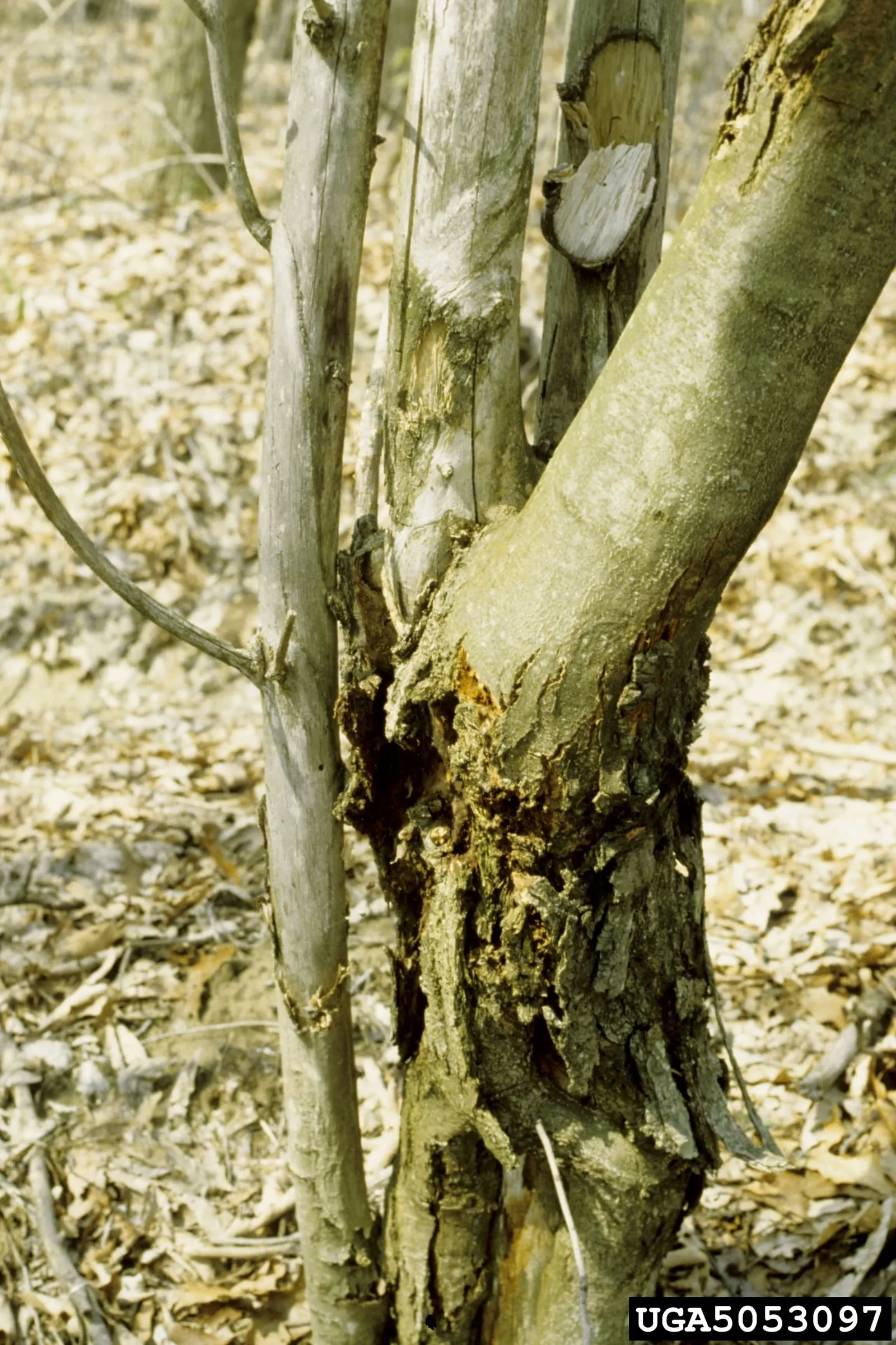
Disease
fungalChestnut Blight
Cryphonectria parasitica
The fungus that destroyed the American chestnut population in the early 20th century. Chinese chestnuts and most modern hybrids are tolerant; American chestnut remains susceptible.
- Pathogen type
- Fungal
- Hosts
- 1
- Symptoms
- 3
- Scientific name
- Cryphonectria parasitica
- Resistant varieties
- 3
Biology and conditions
Cryphonectria parasitica is an ascomycete fungus native to East Asia, introduced to North America in the early 1900s through imported nursery stock. By mid-century it had killed an estimated 3 to 4 billion American chestnut trees (Castanea dentata), effectively eliminating the species as a canopy tree across its native range. The pathogen spreads via airborne conidia and sexual ascospores, entering trees through wounds, bark cracks, or insect galleries. Once inside, it colonizes the cambium and produces oxalic acid, which lowers local pH and kills the surrounding tissue.
Infection progresses as a sunken, orange-brown canker that girdles branches or the main trunk. Wilting foliage above the canker is typically the first visible symptom. During wet weather, orange pustules form on the canker surface as the fungus produces pycnidia and perithecia. Trees rarely die outright; root systems often survive and send up new sprouts, but those sprouts succumb again once they reach canker-susceptible diameter. Warm, humid conditions favor rapid spore dispersal and infection, though the fungus is present wherever susceptible hosts grow throughout the eastern and central United States.
For home growers, the most cost-effective strategy is variety selection from the start. Chinese chestnut (Castanea mollissima) and blight-tolerant hybrids including Dunstan and Sleeping Giant carry strong natural resistance and support productive orchards without ongoing chemical inputs. These varieties are not fully immune but tolerate infection well enough that canker spread rarely threatens the tree's viability. For high-value specimens, mud-pack treatment applied over young cankers and hypovirulent strain biocontrol, where regionally available through state extension programs, have shown moderate efficacy. Neither approach scales to large plantings or substitutes for resistant variety selection.
Symptoms
- ▸ Sunken orange-brown cankers on trunks and branches
- ▸ Wilting and dieback above cankers
- ▸ Orange spore masses on canker surface during wet weather
IPM controls
- ✓ Plant resistant Chinese chestnut or blight-tolerant hybrids (Dunstan, Sleeping Giant)
- ✓ Mud-pack canker treatment for valuable specimens
- ✓ Hypovirulent strain biocontrol where available
- ✓ Avoid wounding trunks during cultivation
Resistant varieties
Selecting a variety with documented resistance is the most effective single decision for low-input management of chestnut blight.
Affected crops
Image: "Cryphonectria parasitica tree", by Joseph OBrien, USDA Forest Service, via Wikimedia Commons, licensed under CC-BY Source.

Related