Disease
bacterialCitrus Greening (HLB)
Candidatus Liberibacter asiaticus
Devastating bacterial disease vectored by the Asian citrus psyllid. Once infected, trees decline progressively over several years and there is no cure. Has destroyed commercial citrus across Florida and threatens production worldwide.
- Pathogen type
- Bacterial
- Hosts
- 4
- Symptoms
- 4
- Scientific name
- Candidatus Liberibacter asiaticus
- Resistant varieties
- 0
Biology and conditions
Citrus greening, formally known as Huanglongbing (HLB), is caused by Candidatus Liberibacter asiaticus, a phloem-limited bacterium that cannot be cultured outside a living host. The pathogen does not spread through soil or direct contact; it depends entirely on a vector, the Asian citrus psyllid (Diaphorina citri), to move between trees. An infected psyllid acquires the bacterium while feeding on diseased tissue and transmits it to healthy trees during subsequent feeding. Once inside the phloem, the bacterium disrupts nutrient and sugar transport progressively throughout the canopy.
Conditions that favor rapid spread include warm, humid climates where psyllid populations build quickly and where infected trees remain standing rather than being removed. The psyllid is established across USDA zones 9 through 11, overlapping closely with the regions where commercial and backyard citrus production is most concentrated in the United States. Florida's citrus industry has lost the majority of its bearing acreage to HLB since the disease was confirmed there in 2005; California and Texas face ongoing containment pressure.
No cure exists once infection is confirmed. Trees decline over several years but remain infectious the entire time, serving as a psyllid reservoir that accelerates spread to neighboring plantings. The most cost-effective strategy is prevention: buying only certified disease-free nursery stock, monitoring for psyllid activity consistently, treating with approved insecticides when threshold populations are detected, and removing confirmed infected trees without delay. No commercially available variety carries confirmed resistance to HLB, though active breeding programs in Florida and California are working toward tolerant germplasm. Reflective mulches offer modest deterrence on young trees but are not a substitute for vector management.
Symptoms
- ▸ blotchy mottled yellowing of leaves that does not match nutrient deficiency patterns
- ▸ lopsided bitter green-tipped fruit
- ▸ premature fruit drop
- ▸ twig dieback
IPM controls
- ✓ Buy only certified disease-free nursery stock
- ✓ Control Asian citrus psyllid populations aggressively with monitoring and approved insecticides
- ✓ Remove and destroy infected trees immediately to limit spread
- ✓ Reflective mulches deter psyllids on young trees
Affected crops
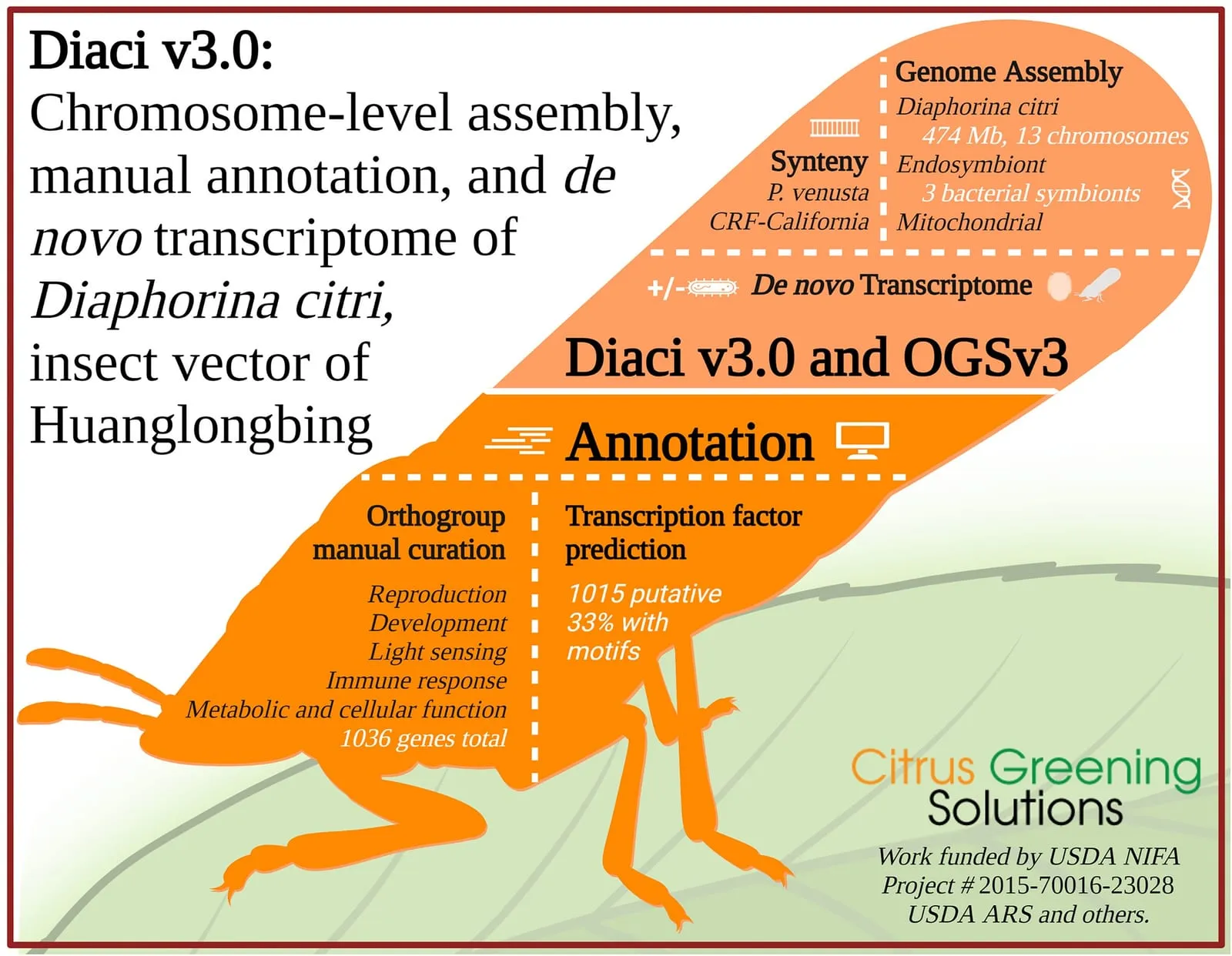
Image: "Summary of the major findings from a multiyear, multi-institutional Diaphorina citri genome assembly project", by Teresa D Shippy, Prashant S Hosmani, Mirella Flores-Gonzalez, Marina Mann, Sherry Miller, Matthew T Weirauch, Chad Vosberg, Crissy Massimino, Will Tank, Lucas de Oliveira, Chang Chen, Stephanie Hoyt, Rebekah Adams, Samuel Adkins, Samuel T Bailey, Xiaoting Chen, Nina Davis, Yesmarie DeLaFlor, Michelle Espino, Kylie Gervais, Rebecca Grace, Douglas Harper, Denisse L Hasan, Maria Hoang, Rachel Holcomb, Margaryta R Jernigan, Melissa Kemp, Bailey Kennedy, Kyle Kercher, Stefan Klaessan, Angela Kruse, Sophia Licata, Andrea Lu, Ron Masse, Anuja Mathew, Sarah Michels, Elizabeth Michels, Alan Neiman, Seantel Norman, Jordan Norus, Yasmin Ortiz, Naftali Panitz, Thomson Paris, Kitty M R Perentesis, Michael Perry, Max Reynolds, Madison M Sena, Blessy Tamayo, Amanda Thate, Sara Vandervoort, Jessica Ventura, Nicholas Weis, Tanner Wise, Robert G Shatters, Michelle Heck, Joshua B Benoit, Wayne B Hunter, Lukas A Mueller, Susan J Brown, Tom D'Elia, Surya Saha,, via Wikimedia Commons, licensed under CC-BY Source.

Related