Disease
bacterialCrown Gall
Agrobacterium tumefaciens
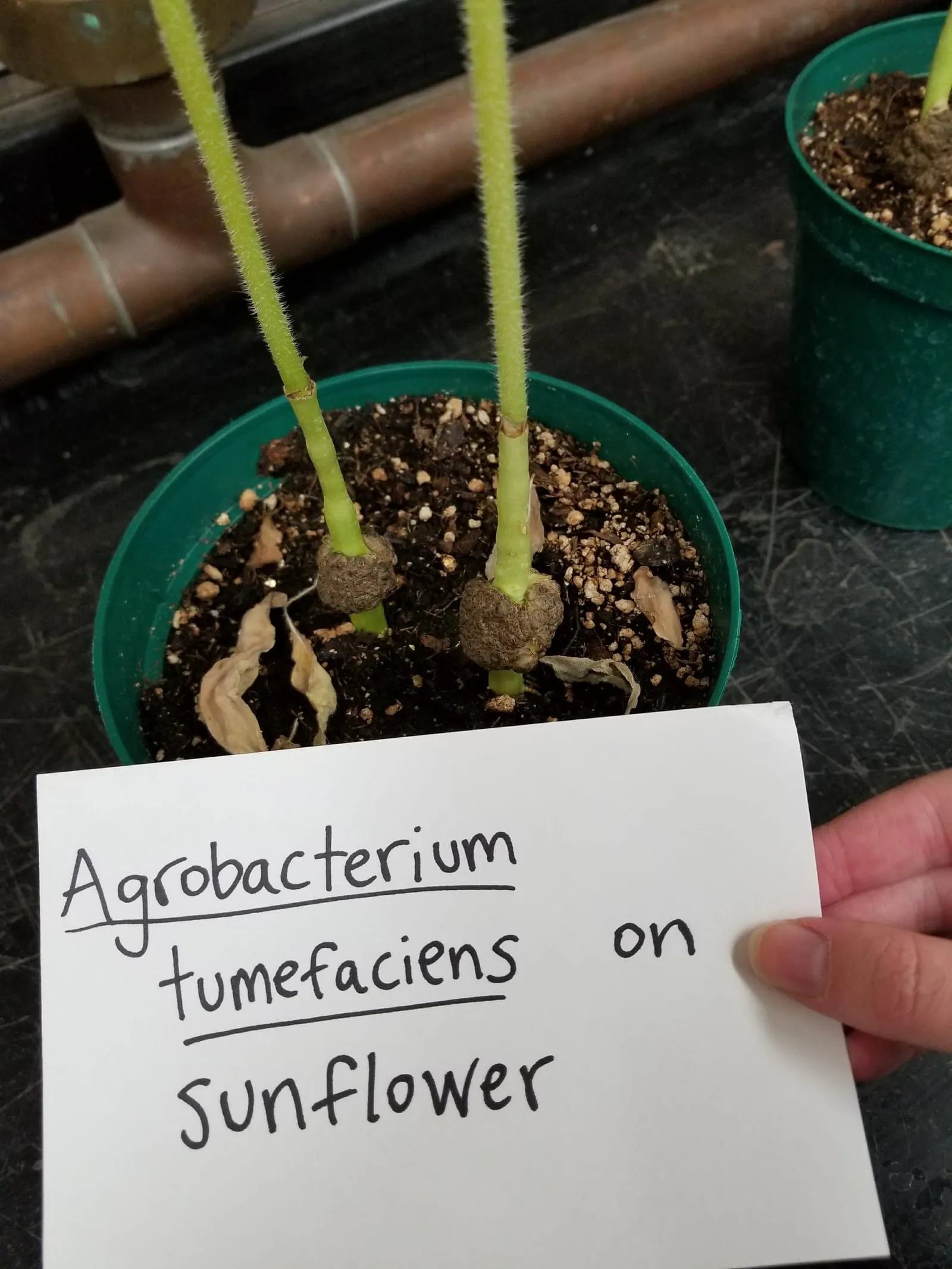
Soil-borne bacterium that enters plants through wounds and induces tumor-like galls on roots, crown, and lower stems. Galls reduce vigor and shorten plant lifespan; on Rubus the disease is often fatal.
- Pathogen type
- Bacterial
- Hosts
- 11
- Symptoms
- 4
- Scientific name
- Agrobacterium tumefaciens
- Resistant varieties
- 0
Biology and conditions
Crown gall is caused by Agrobacterium tumefaciens, a soil-borne bacterium that exploits wound sites to insert a portion of its own DNA into plant cells. That genetic transfer forces the infected tissue to proliferate into characteristic corky, tumor-like galls ranging from roughly 1 to 4 inches in diameter. Galls form most commonly at the crown (the soil line), on lateral roots, and occasionally on lower stem tissue. The bacterium persists in soil for years after infected plant material is removed, surviving saprophytically on decomposing tissue.
Infection requires a wound, whether from transplanting, cultivation equipment, freeze injury, insect feeding, or graft incompatibility reactions. Moist soils and mild temperatures during the planting window increase bacterial activity and the likelihood of successful infection. The disease is widespread wherever susceptible crops are grown in temperate zones.
On tree fruits and stone fruits, established crown gall typically reduces vigor and shortens productive lifespan rather than killing the tree outright. On cane fruits, particularly black raspberry and blackberry, the outcome is more severe: infected plants often decline and die within a few seasons. Highbush blueberry is also susceptible, though gall development on blueberry tends to be slower.
The single most cost-effective control is starting with certified disease-free nursery stock. No rescue treatment reverses existing galls. For bare-root plantings, preplant dip with Galltrol-A (a biocontrol formulation of Agrobacterium radiobacter K84) has documented efficacy in reducing new infections when applied before planting in known-infested ground. No crown gall resistant rootstocks or scion varieties are identified in current data for this crop set.
Symptoms
- ▸ Rough corky galls (1-4 inches) at or just below the soil line
- ▸ Galls on roots when plants are dug
- ▸ Stunted growth and reduced yield
- ▸ Premature decline on cane fruits and grafted fruit trees
IPM controls
- ✓ Source certified disease-free nursery stock (the single most important control)
- ✓ Avoid mechanical injury to roots and crown
- ✓ Galltrol-A biocontrol (Agrobacterium radiobacter K84) protects bare-root plants at planting
- ✓ Crop rotation away from infested ground for 3-5 years
- ✓ Remove and destroy infected plants; do not replant susceptible species in same hole
Affected crops
Image: "Crown Gall of Sunflower", by Lkazen, via Wikimedia Commons, licensed under CC-BY Source.

Related