Disease
fungalEastern Filbert Blight
Anisogramma anomala
Native fungal disease of American hazelnut that devastates European hazelnut plantings, the limiting factor for commercial hazelnut culture in the East.
- Pathogen type
- Fungal
- Hosts
- 1
- Symptoms
- 3
- Scientific name
- Anisogramma anomala
- Resistant varieties
- 4
Biology and conditions
Anisogramma anomala is a fungal pathogen native to the eastern United States, where it co-evolved with American hazelnut (Corylus americana). American hazelnut tolerates the fungus with little visible consequence. European hazelnut (Corylus avellana), the species grown commercially for nut production, has no such tolerance. Infection is typically fatal to the tree over a 5 to 10 year timeline, making Eastern Filbert Blight the primary reason commercial hazelnut production in the eastern US remained marginal for decades.
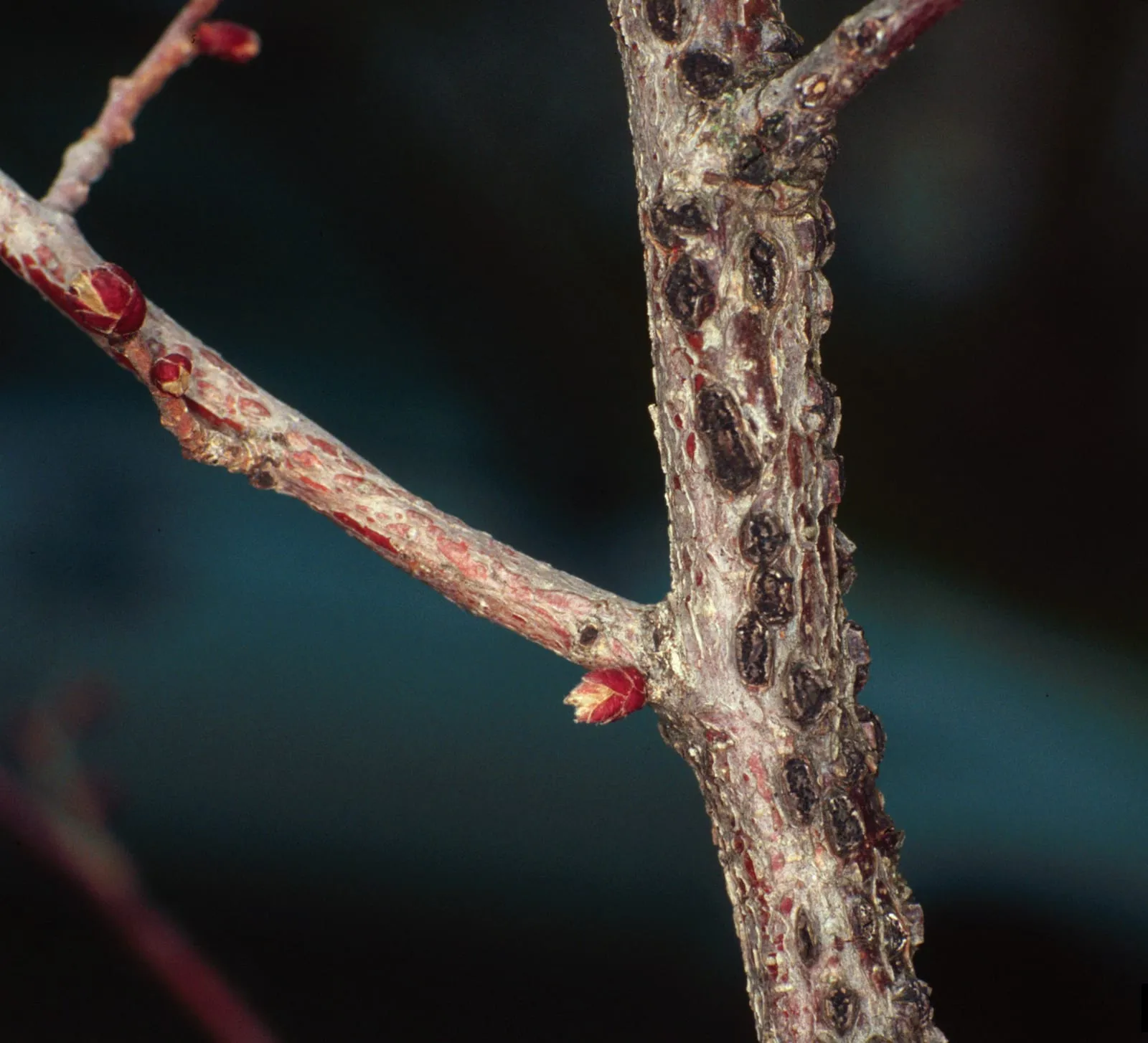
The disease cycle begins when spores released from mature stromata (football-shaped black fruiting bodies embedded in infected bark) are dispersed by rain splash and wind during wet spring conditions. Infection occurs through young green bark; the fungus then colonizes internally through a latent period before stromata erupt through the bark surface in subsequent growing seasons. By the time symptoms are visible, the infection is often one to two years old. Warm, humid spring weather accelerates spore release, and proximity to wild or unmanaged American hazelnut provides a persistent inoculum source that fungicide programs cannot eliminate.
Management centers almost entirely on variety selection. No spray program is reliably cost-effective against Eastern Filbert Blight in small-scale eastern plantings; the infection window is long and complete coverage of a mature canopy is difficult to achieve. The Oregon State University hazelnut breeding program has released Jefferson, Yamhill, and Theta, all carrying resistance developed through American hazelnut genetics. These are the only European-type cultivars currently recommended for eastern plantings. Pruning infected wood 2 to 3 feet below visible stromata can slow disease progression in early-stage infections but is not a substitute for starting with resistant stock.
Symptoms
- ▸ Football-shaped black stromata in rows along infected branches
- ▸ Branch dieback above stromata
- ▸ Whole-tree decline over 5-10 years on susceptible varieties
IPM controls
- ✓ Plant resistant cultivars (Jefferson, Yamhill, Theta) only
- ✓ Native American hazelnut and most hybrids tolerate the disease
- ✓ Prune out infected wood 2-3 feet below visible stromata
- ✓ Avoid planting susceptible European cultivars in Eastern US
Resistant varieties
Selecting a variety with documented resistance is the most effective single decision for low-input management of eastern filbert blight.
Affected crops
Image: "Anisogramma anomala", by Joseph O'Brien, USDA Forest Service, via Wikimedia Commons, licensed under CC-BY Source.

Related