Disease
fungalElderberry Rust
Puccinia sambuci
Two-host rust alternating between elderberry and sedges, causing leaf spots and shoot distortion in spring.
- Pathogen type
- Fungal
- Hosts
- 1
- Symptoms
- 3
- Scientific name
- Puccinia sambuci
- Resistant varieties
- 0
Biology and conditions
Elderberry rust is caused by Puccinia sambuci, a fungal pathogen that requires two distinct host plants to complete its life cycle. Elderberry (Sambucus spp.) serves as the primary host for one stage; sedges (Carex spp. and related genera) serve as the alternate host. Without sedges in the vicinity, the fungus cannot persist through the full cycle, which is the practical leverage point for management.
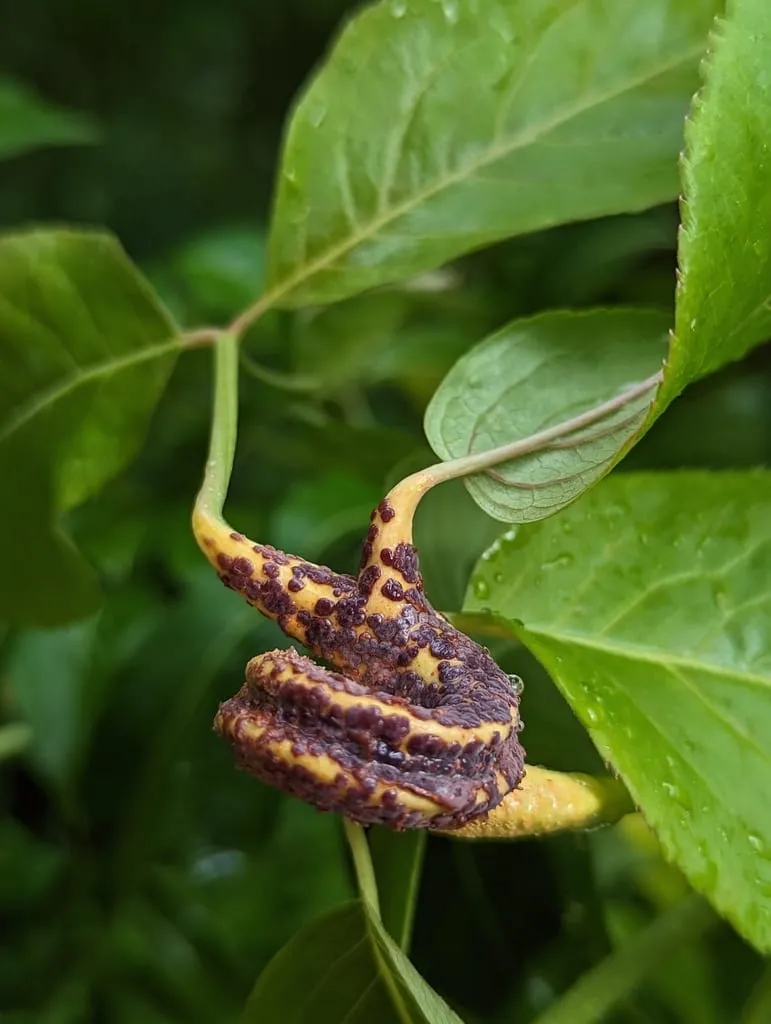
Infections appear in spring, typically following warm, humid conditions that allow airborne spores to land and germinate on young leaf tissue and emerging shoots. Symptoms begin as yellow-orange spots on leaves and shoots, and in heavier cases the pathogen causes visible swelling and distortion of young growth. Distorted shoots rarely recover their normal form and typically produce fewer flowers, reducing fruit set for that season.
The disease is most prevalent in wet spring seasons, particularly in sites with poor airflow, proximity to wetland edges where sedges grow, and plantings that have not been pruned to open the canopy. Elderberry in low-lying or riparian settings carries higher exposure risk.
Management rarely needs to be aggressive. Light infections are seldom yield-limiting, and elderberry plants generally tolerate the cosmetic damage without serious long-term effect. The most cost-effective approach combines annual pruning to improve canopy airflow, removal of sedges within practical distance of the planting, and cleanup of fallen leaf debris in autumn. No elderberry varieties with documented resistance to P. sambuci have been identified in published extension literature.
Symptoms
- ▸ Yellow-orange spots on elderberry leaves and shoots
- ▸ Distorted swollen shoots
- ▸ Reduced flowering and fruit set
IPM controls
- ✓ Sanitation of fallen leaves
- ✓ Remove sedges from immediate vicinity if practical
- ✓ Tolerate light infections (rarely yield-limiting)
- ✓ Improve airflow through annual pruning
Affected crops
Image: "Puccinia sambuci", by no rights reserved, via iNaturalist, licensed under CC0 Source.
Related