Disease
fungalPecan Scab
Venturia effusa
The most damaging pecan disease in the humid Southeast, causing leaf and nut lesions that reduce yield and kernel quality.
- Pathogen type
- Fungal
- Hosts
- 1
- Symptoms
- 3
- Scientific name
- Venturia effusa
- Resistant varieties
- 3
Biology and conditions
Venturia effusa infects pecan at every stage of foliar and fruit development, but it does its most significant damage during the window between bud break and shell hardening. The fungus overwinters in infected shucks and lesions on twigs, then releases conidia as temperatures climb and canopy surfaces stay wet. Warm, humid conditions from late spring through midsummer create near-continuous infection pressure across the Southeast, the region where scab is responsible for more yield loss than any other pecan disease.
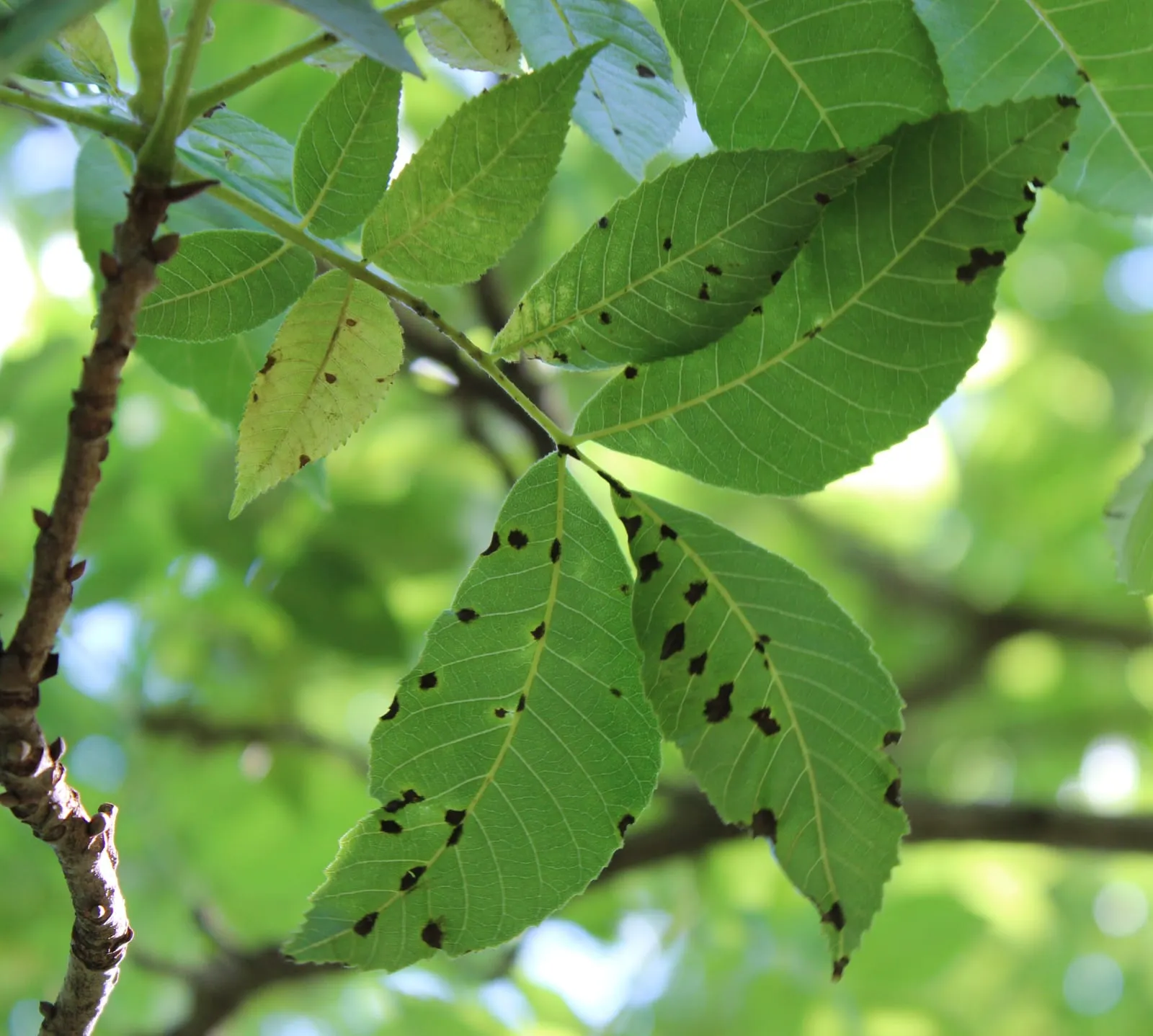
Initial lesions appear as small olive-black spots on the lower leaf surface and on expanding shuck tissue. As infections multiply and coalesce, shucks blacken and shrivel prematurely, cutting off nutrient flow to the kernel. Nuts from heavily infected shucks drop before harvest or reach maturity with reduced kernel fill, which lowers both weight and grade. The economic threshold on susceptible varieties in high-humidity climates is low: even moderate infection pressure during the critical early-nut stage translates directly to yield loss.
Commercial management depends on a timed fungicide program from leaf-out through shell hardening. The earliest applications carry the most leverage; once shuck tissue is heavily colonized, options narrow and efficacy drops. Missing the first one or two cover sprays is the most common cause of season-long failures.
For smaller plantings, variety selection is the more practical and durable strategy. Kanza, Elliott, and Pawnee carry meaningful scab resistance across the southern range and will complete a growing season without a multi-spray program in moderate-pressure years. Pruning to open canopy airflow and eliminating overhead irrigation reduce the leaf wetness periods that favor infection, though in persistently humid climates these practices extend the protection of resistant varieties rather than substitute for it.
Symptoms
- ▸ Olive-black spots on leaves and nut shucks
- ▸ Premature shuck blackening and shriveling
- ▸ Nut drop and reduced kernel fill
IPM controls
- ✓ Plant resistant varieties (Kanza, Elliott, Pawnee for the southern range)
- ✓ Fungicide program from leaf-out through shell hardening (commercial only)
- ✓ Prune for airflow
- ✓ Avoid overhead irrigation
Resistant varieties
Selecting a variety with documented resistance is the most effective single decision for low-input management of pecan scab.
Affected crops
Image: "Pecan scab", by Sealox, via Wikimedia Commons, licensed under CC-BY Source.

Related