Disease
fungalPowdery Mildew
Podosphaera leucotricha
Surface-feeding fungal disease that distorts new growth and reduces yields.
- Pathogen type
- Fungal
- Hosts
- 1
- Symptoms
- 3
- Scientific name
- Podosphaera leucotricha
- Resistant varieties
- 2
Biology and conditions
Powdery mildew (Podosphaera leucotricha) is an obligate fungal pathogen, meaning it requires living host tissue to complete its life cycle. Unlike most fungal diseases, it thrives in warm, dry conditions with moderate humidity rather than in wet weather. Infection risk peaks when daytime temperatures run between 65 and 80 degrees Fahrenheit, nights are cool, and relative humidity is high but rain is absent. Free moisture on leaf surfaces actually inhibits spore germination, which makes powdery mildew behave differently from diseases like apple scab.
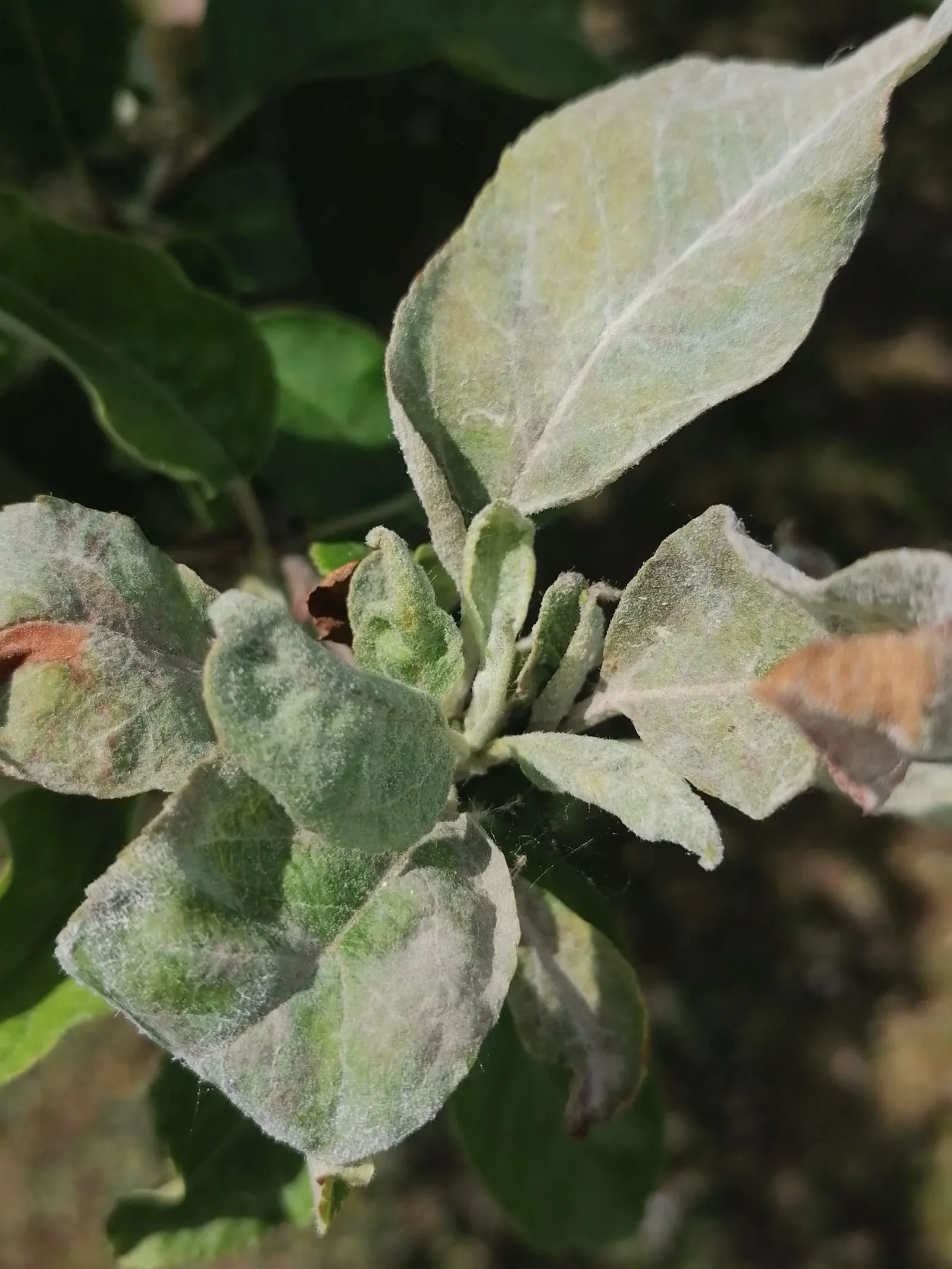
The fungus overwinters as dormant mycelium in infected buds. In spring, those buds push out already-colonized shoots, which then release conidia to spread the disease. The characteristic white, powdery coating is a dense mat of fungal growth on the surface of leaves and young shoots. Infected tissue distorts as it expands, and heavily infected flower buds produce poor-quality fruitlets or fail to set fruit entirely.
Management is most cost-effective when it starts at green tip and continues through terminal bud set in early summer, targeting the period when susceptible new growth is actively expanding. Sulfur and potassium bicarbonate are effective low-input options; both disrupt the surface environment the fungus needs to sporulate. Pruning to open canopy structure reduces the humid microclimate that favors infection. Avoiding excessive nitrogen is also important, since soft, fast-growing shoots are the most susceptible tissue.
Variety selection offers the most durable long-term control. Liberty and Williams Pride carry resistance to powdery mildew and reduce or eliminate the need for fungicide coverage on that disease specifically.
Symptoms
- ▸ White powdery growth on shoots and leaves
- ▸ Distorted new growth
- ▸ Reduced flower bud quality
IPM controls
- ✓ Resistant varieties
- ✓ Sulfur or potassium bicarbonate sprays
- ✓ Pruning for airflow
- ✓ Avoid excessive nitrogen
Resistant varieties
Selecting a variety with documented resistance is the most effective single decision for low-input management of powdery mildew.
Affected crops
Image: "Ruhland, Ortrander Str. bei Hausnr. 13e, Apfelbaum am Waldrand, Apfelmehltau, Frühling, 01", by Wilhelm Zimmerling PAR, via Wikimedia Commons, licensed under CC-BY Source.

Related