Disease
fungalThousand Cankers Disease
Geosmithia morbida (vectored by Pityophthorus juglandis)
Fatal disease of black walnut caused by a fungus vectored by the walnut twig beetle. Spreading eastward from the western US, devastating native black walnut stands.
- Pathogen type
- Fungal
- Hosts
- 1
- Symptoms
- 4
- Scientific name
- Geosmithia morbida (vectored by Pityophthorus juglandis)
- Resistant varieties
- 0
Biology and conditions
Thousand Cankers Disease is a fatal complex involving two organisms working in tandem: the walnut twig beetle (Pityophthorus juglandis) and the fungus Geosmithia morbida. The beetle bores into small-diameter branches to lay eggs, introducing fungal spores in the process. Each entry point triggers a small canker in the cambium. Individually, these lesions cause minimal damage. The problem is cumulative: beetle populations can reach high densities in stressed trees, creating hundreds or thousands of cankers on a single tree. As cankers coalesce and girdle branches, dieback advances from the crown downward. Whole-tree death typically follows within 3 to 5 years of symptom onset.
The disease originated in the western United States, where native black walnut populations are sparse and the beetle was historically less damaging. Eastern black walnut (Juglans nigra), which dominates native stands from the mid-Atlantic through the Midwest, appears particularly susceptible. Confirmed cases have been documented in Pennsylvania, Virginia, Tennessee, Ohio, and other eastern states, and the range continues to expand eastward.
Hot, dry summers favor beetle reproduction and tree stress simultaneously, creating conditions for rapid canopy decline. Drought-stressed trees mount weaker defensive responses to beetle boring and fungal colonization, accelerating the timeline from first symptoms to death.
No effective chemical or biological treatment exists once a tree is symptomatic. The most cost-effective strategy is prevention: keeping black walnut trees well-watered during drought, avoiding unnecessary bark wounds, and eliminating the movement of black walnut firewood or wood products across state lines (the primary long-distance spread vector). Once a tree shows symptoms, early removal and burning (or on-site chipping with debris buried) limits beetle emergence and reduces spread to neighboring trees. No Juglans nigra varieties with confirmed resistance have been identified.
Symptoms
- ▸ Yellowing and thinning canopy
- ▸ Tiny pinhole beetle entry points on branches
- ▸ Coalescing dark cankers under bark when scratched
- ▸ Branch dieback progressing to whole-tree death over 3-5 years
IPM controls
- ✓ No effective treatment once symptomatic; prompt removal and burning of infected trees
- ✓ Avoid moving black walnut firewood across regions (the primary spread vector)
- ✓ Maintain tree vigor (drought-stressed trees are more susceptible)
- ✓ Report suspected cases to state forestry departments
Affected crops
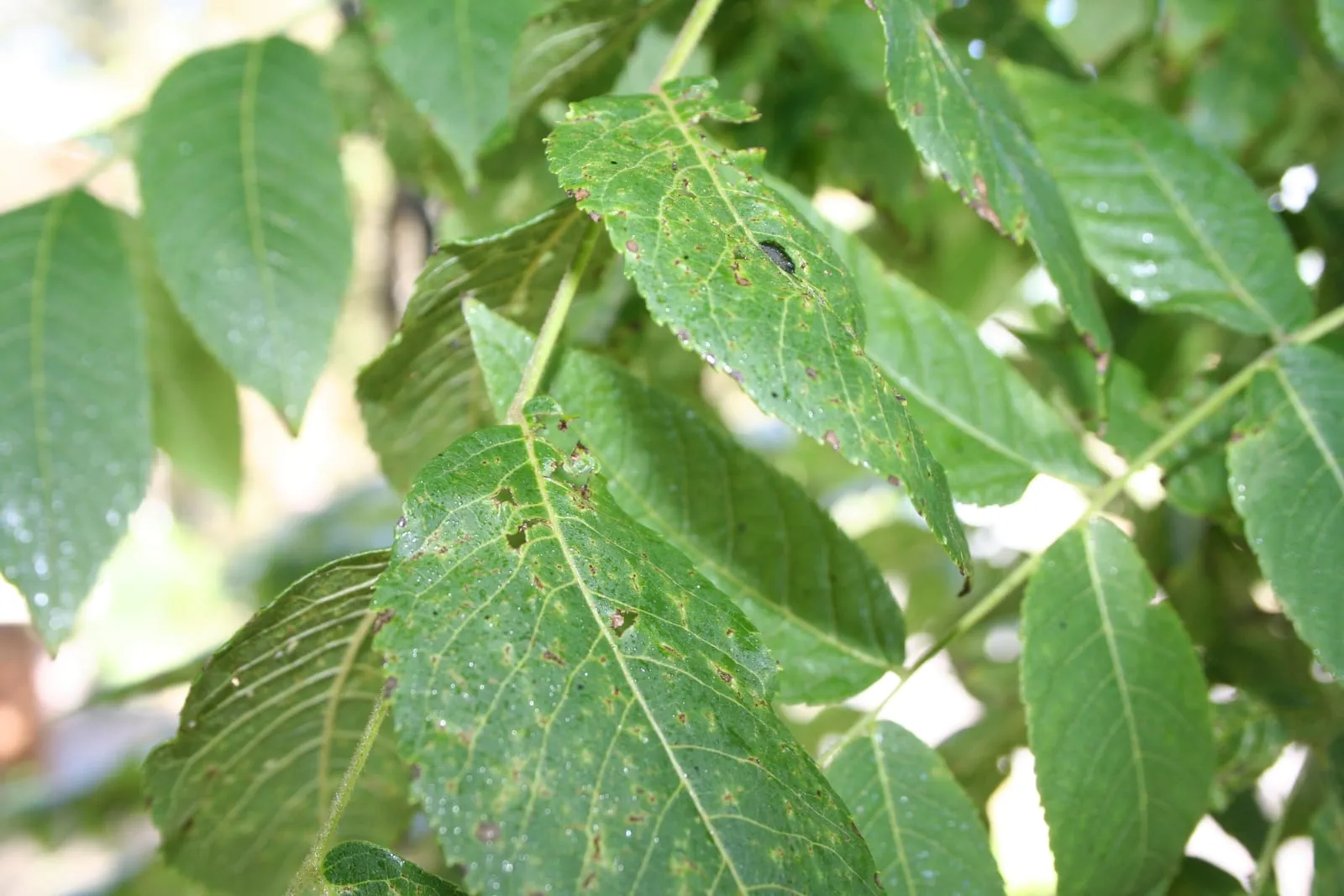
Image: "Black Walnut Leaves", by Jeffrey Beall, via Wikimedia Commons, licensed under CC-BY Source.

Related