Grafting pair
good compatibilityFuyu
on Diospyros virginiana seedling rootstock
- Compatibility
- Good
- Tree size
- Standard
- Mature height
- 15–20 ft
- Crop
- Asian Persimmon
Compatibility and disease notes
Asian persimmon scions on American persimmon rootstock can show delayed graft incompatibility (5-10 year window). Choose carefully grown nursery stock.
Overview
Fuyu on Diospyros virginiana seedling is a standard-size combination suited to home orchardists and small-scale growers in the Southeast, Mid-Atlantic, and South-Central United States, where American persimmon grows natively and its seedling rootstock is widely available from regional nurseries. Grafted trees reach 15 to 20 feet at maturity. The native rootstock tolerates heavy clay soils, periodic drought, and moderate soil pH variation, giving Fuyu access to sites where less-adapted rootstocks often struggle.
The primary caution with this pairing is delayed graft incompatibility. Unlike incompatibility that shows up at the union within the first growing season, the Asian-on-American persimmon combination can appear fully functional for 5 to 10 years before the union begins to fail. This window makes rootstock selection critical: carefully grown nursery stock with documented parentage reduces but does not eliminate the risk. The California Rare Fruit Growers Persimmon guide covers this combination and notes that Fuyu's popularity in home orchards has made it one of the more common persimmon grafts attempted outside California. Growers in the Southeast benefit from the rootstock's proven cold hardiness and resistance to the region's heavier soils, but should plan for the possibility of long-term incompatibility when siting and spacing trees.
Best regions
Step-by-step grafting guide
Timing: Graft in late winter to early spring, just as the rootstock shows swelling buds but before active shoot growth begins. In the Southeast and Mid-Atlantic, this typically falls in late February through mid-March. Grafting into fully dormant wood reduces callus formation; grafting after significant bud break risks pushing growth before the union has knitted. Scion wood should be collected during full dormancy, December through January, stored in damp paper towels inside a sealed plastic bag, and refrigerated at 34 to 38 degrees Fahrenheit until grafting day.
Technique: Cleft grafting is well-suited to persimmon, particularly when rootstock caliper is larger than the scion. Cut the rootstock cleanly 8 to 12 inches above soil level, then split the stub 1.5 to 2 inches deep with a grafting knife or stout blade. Select scion pieces with two or three healthy buds and pencil-diameter caliper. Taper the base of each scion piece into a long wedge, 1.5 to 2 inches, using smooth single-pass cuts. Insert one scion on each side of the cleft, aligning the cambium on at least one edge of each. Persimmon tissue desiccates quickly at cut surfaces, so work without delay. Seal all exposed cut surfaces immediately with grafting wax or parafilm, then wrap the union with budding rubber or grafting tape.
Success criteria: New growth from scion buds within 3 to 5 weeks indicates a successful take. Leave both scions in place until one clearly dominates, then remove the weaker by cutting, not pulling. Do not remove tape until the union has fully calloused, typically 6 to 8 weeks post-graft.
Common failure modes
The most consequential failure mode for this combination is delayed graft incompatibility. The union may look and function normally for 5 to 10 years before developing a visible constriction or crease at the graft line as Asian scion and American rootstock tissues fail to maintain adequate vascular connection. Trees showing this symptom can decline rapidly during drought or a heavy fruit year. There is no corrective action once incompatibility is expressed; replacement is the only option. Sourcing from nurseries that maintain scion-rootstock records is the best available mitigation.
Rootstock suckering is a persistent secondary problem. D. virginiana produces vigorous suckers from the root system that are difficult to distinguish from scion growth in the first season. Any growth originating below the graft union should be removed promptly; suckers left unchecked will outcompete the scion within one or two seasons.
Poor union formation from cambium misalignment is the third common failure. Persimmon is more sensitive to cut-surface drying than apple or pear, so any delay between making the wedge cuts and sealing the union increases failure risk.
Sources
Related
Related grafts
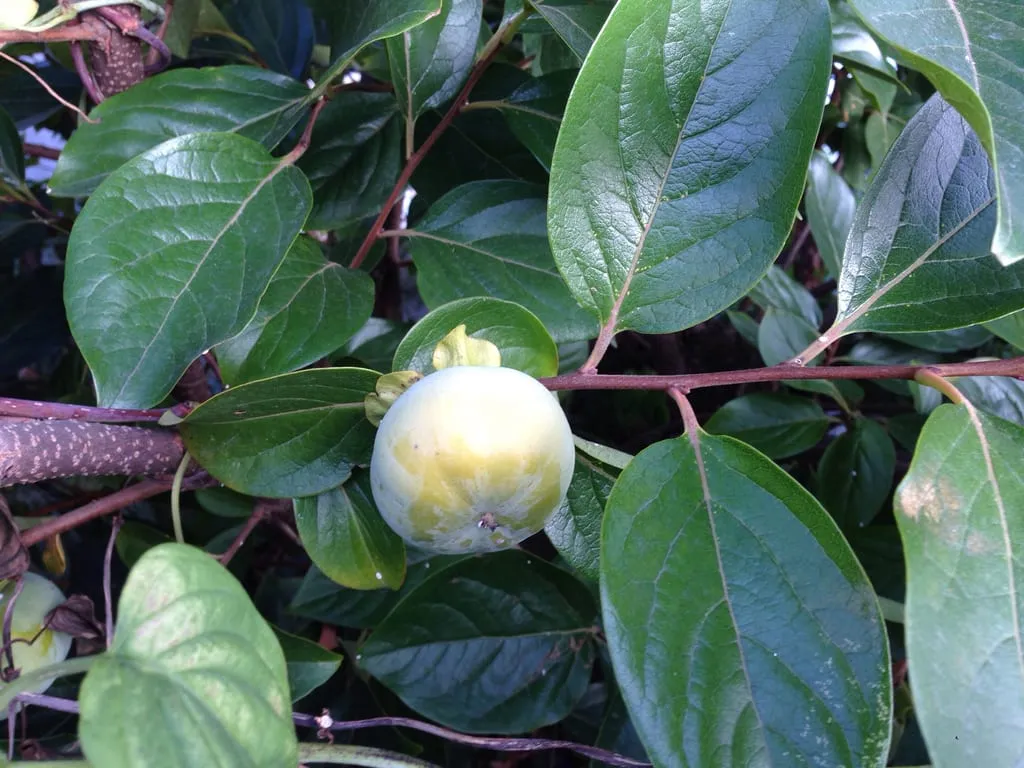
Image: "Japanese Persimmon", by Kim, via iNaturalist, licensed under CC-BY. Source.