Grafting pair
good compatibilitySanta Rosa
on Myrobalan rootstock
- Compatibility
- Good
- Tree size
- Standard
- Mature height
- 15–20 ft
- Crop
- Japanese Plum
Compatibility and disease notes
Santa Rosa on Myrobalan is broadly adapted. Bacterial spot pressure in humid southeastern conditions can limit fruit quality.
Overview
Santa Rosa on Myrobalan is one of the more broadly adapted Japanese plum combinations available, suited to a wide range of soil types and growing conditions. Myrobalan (Prunus cerasifera) rootstocks produce full-size trees, typically 15 to 20 feet at maturity, and tolerate wet or heavy clay soils that would stress less vigorous alternatives. The combination is well established across California, the Mid-Atlantic, and the Southwest, where Myrobalan's vigor matches Santa Rosa's productive, precocious habit.
According to UC Davis Plum Rootstocks, Myrobalan seedling rootstocks are noted for adaptability to heavy soils and reliable compatibility with Japanese plum scions. That compatibility holds broadly for Santa Rosa, which tends to form a strong union and reach bearing age without unusual delay.
Growers in humid southeastern climates should account for bacterial spot pressure (Xanthomonas arboricola pv. pruni), which can reduce fruit quality and marketability in wet summers. Disease management in those regions typically requires a spray program timed to petal fall and early fruit development. Home orchardists and small-scale commercial growers planting on diverse or difficult soils tend to choose this combination for its predictability and Santa Rosa's reputation for heavy, early-season crops.
Best regions
Step-by-step grafting guide
Graft Santa Rosa onto Myrobalan rootstock in late winter to early spring, after the rootstock breaks dormancy and bark slips freely but before the scion extends new growth. In most regions this falls between late February and early April. California coastal growers may graft as early as mid-February; Mid-Atlantic growers typically wait until mid-March, when nighttime temperatures are consistently above 35°F.
Scion collection: Collect dormant scion wood in late January or early February, before any bud swell. Choose pencil-thick wood from vigorous prior-season growth. Wrap in damp paper towel, seal in a plastic bag, and store at 34 to 38°F until grafting time. Do not allow scion wood to warm or dry out before use.
Technique: Whip-and-tongue is preferred when scion and rootstock are similar in diameter (3/8 to 3/4 inch). For larger rootstock stems, use a cleft graft instead.
Tools needed: - Sharp grafting knife, clean and properly honed - Grafting tape or budding strips - Grafting wax or parafilm - Pruning shears for trimming scion sticks
Whip-and-tongue procedure: Cut matching long diagonal slices (roughly 1.5 inches) on both scion and rootstock. Make the interlocking tongue cuts, then join so that at least one side of the cambium layers aligns. Wrap tightly with grafting tape from the bottom of the union upward, overlapping each pass. Cover all exposed wood with grafting wax to prevent desiccation.
Success criteria: Bud swell and push within 3 to 5 weeks. A callused union without blackening or soft tissue at the joint. Cut or loosen wraps after 6 to 8 weeks to prevent girdling.
Common failure modes
Cambium misalignment is the most common cause of whip-and-tongue failure. The cambium layers on scion and rootstock must contact each other on at least one edge for callus to bridge the wound. Centering the two pieces by eye rather than aligning an edge precisely is a frequent error, especially when working quickly.
Scion desiccation before union establishment is the second most common failure. Loosely applied tape or skipped grafting wax allows cut surfaces to dry faster than the cambium can callus. In warm or dry conditions this can kill the union within days of grafting.
Myrobalan suckering is a persistent management problem that continues well past the first growing season. Myrobalan rootstocks are vigorous sucker producers; suckers left in place will outcompete the scion and can eventually dominate the tree. Remove them flush with the root as soon as they appear.
In humid regions, bacterial spot entering through graft wounds or tender new growth can stall first-year establishment. Grafting just before extended wet periods increases this risk. Keeping wounds fully covered and timing grafts to dry weather windows reduces exposure.
Sources
Frequently asked questions
- Is Santa Rosa compatible with Myrobalan rootstock?
Compatibility is rated good. Santa Rosa, a Japanese plum, forms a reliable union with Myrobalan and reaches bearing age without unusual delay. UC Davis rootstock trials list Myrobalan as broadly adapted to Japanese plum scions across diverse soil types.
- How large will a Santa Rosa tree on Myrobalan grow?
Expect a full-size tree reaching 15 to 20 feet at maturity. Myrobalan is a standard-vigor rootstock and does not restrict tree size the way semi-dwarfing or dwarfing rootstocks do. Plan spacing and pruning management accordingly.
- When is the best time to graft Santa Rosa onto Myrobalan?
Late winter to early spring, timed to when the rootstock breaks dormancy and bark slips but scion buds have not yet pushed. This is typically late February to early April depending on region. Scion wood collected in January or early February and stored cold can be held until conditions are right.
- Does bacterial spot affect this combination?
Santa Rosa is susceptible to bacterial spot (Xanthomonas arboricola pv. pruni), and Myrobalan rootstock does not confer resistance. Growers in humid southeastern regions and the Mid-Atlantic face the highest pressure. A spray program timed to petal fall and early fruit development is standard management in those climates.
- Will Myrobalan produce suckers below the graft union?
Yes. Myrobalan is a prolific suckerer. Suckers must be removed flush with the root throughout the growing season. Left unchecked, they will outcompete the Santa Rosa scion and redirect the tree's energy into rootstock growth.
+−
+−
+−
+−
+−
Related
Related grafts
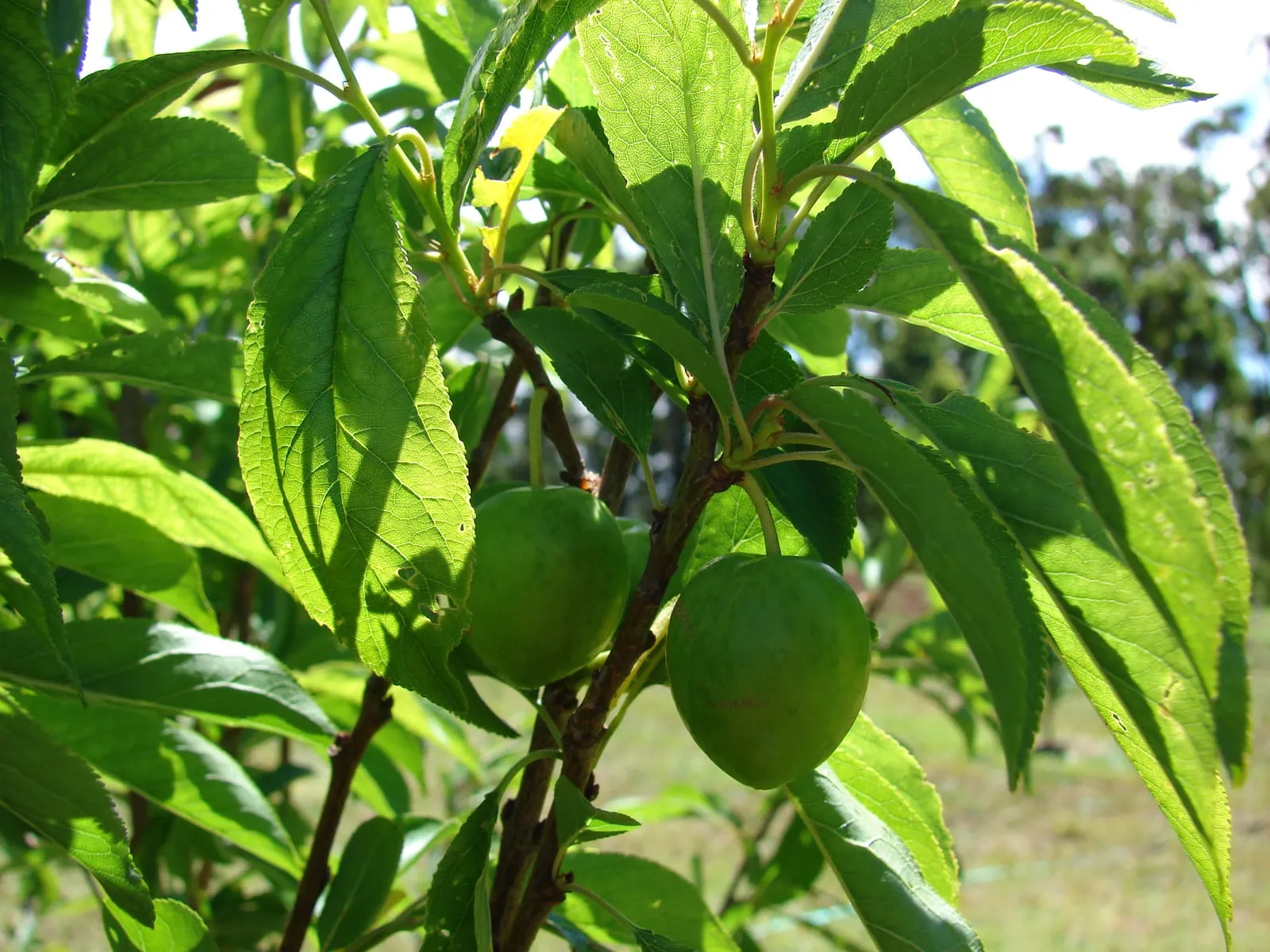
Image: "Starr 080405-3957 Prunus salicina", by Forest & Kim Starr, via Wikimedia Commons, licensed under CC-BY. Source.
