Pest
Cabbage Looper
Trichoplusia ni
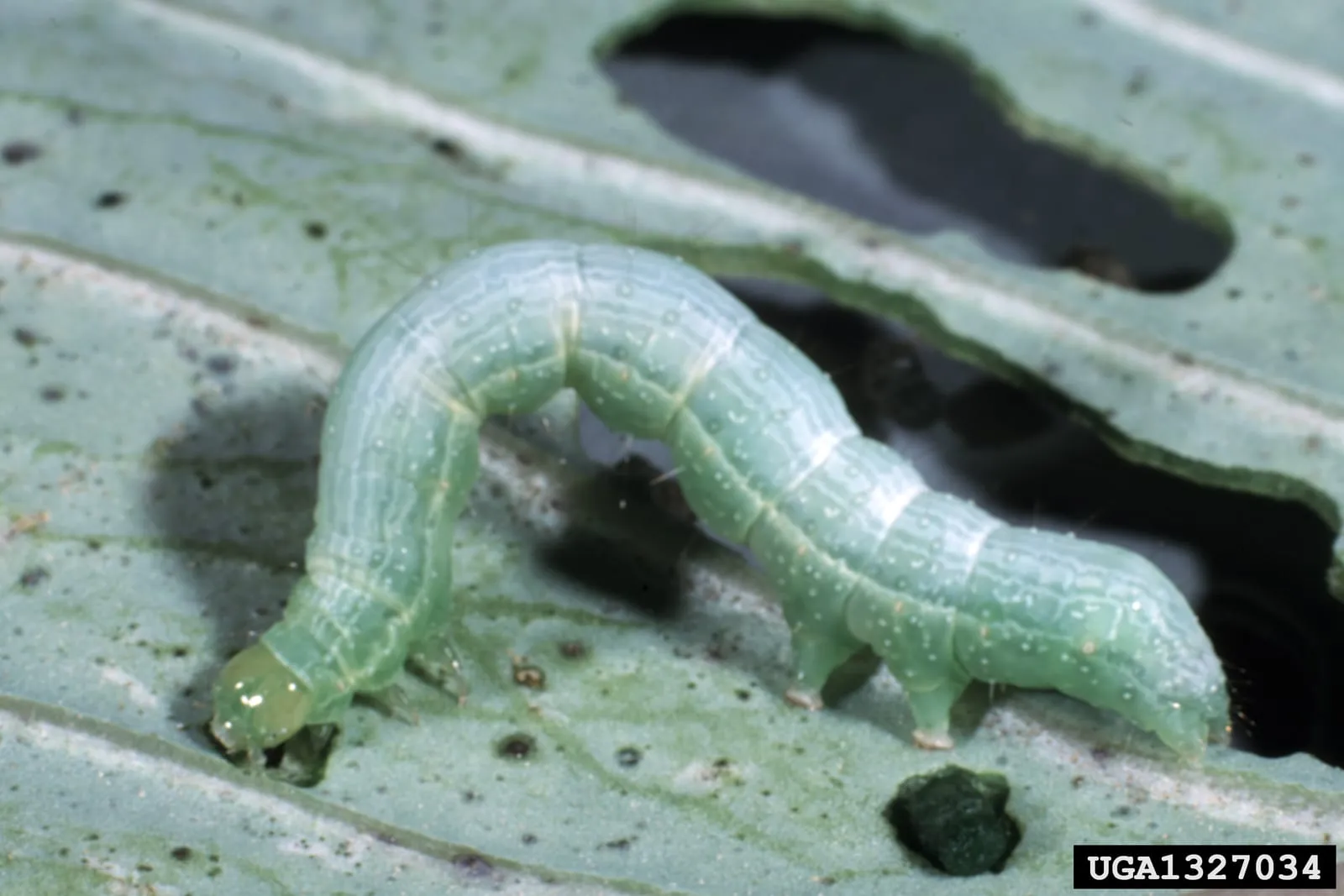
Pale green caterpillars that arch their backs (loop) when crawling. Defoliate brassicas and lettuce, contaminate harvested heads. Adults are mottled gray-brown moths.
- Scientific name
- Trichoplusia ni
- Hosts
- 8
- Identification signs
- 4
- Controls
- 4
Biology and lifecycle
The cabbage looper (Trichoplusia ni) is a polyphagous moth whose larvae account for the bulk of visible damage to brassica crops and lettuce. Adults are mottled gray-brown moths that lay flat, dome-shaped eggs singly on leaf surfaces, usually on the upper side. Eggs hatch in 3 to 7 days depending on ambient temperature. Newly hatched larvae skeletonize leaf tissue; as they grow through five instars over 2 to 4 weeks, they cut through leaves entirely, leaving the ragged irregular holes that are the most recognizable symptom.
Damage is most severe during instars 3 through 5, when larvae are large enough to penetrate forming heads and contaminate harvested cabbage and lettuce with frass. Ironically, large larvae are also harder to kill, which makes timing the critical variable in any management program.
Flight activity peaks in late spring and again in late summer across most of the U.S. The species overwinters reliably only in warmer climates (roughly zone 7 and warmer); northern populations arrive through seasonal migration rather than local overwintering. In southern states, three or more generations per year are common, extending the pressure window considerably.
The most cost-effective intervention is Bacillus thuringiensis var. kurstaki (Bt) applied while larvae are under half an inch long. At that size, a single well-timed application achieves high mortality with negligible off-target impact. Floating row cover installed before adult flight, combined with pheromone trap monitoring to identify peak emergence, can eliminate the need for any spray program in most seasons. Hand-picking is practical at garden scale for larger larvae. Synthetic insecticides remain a fallback for high-pressure seasons when the Bt window is missed.
Signs to watch for
- ▸ Ragged irregular holes in leaves
- ▸ Looping motion when caterpillars crawl
- ▸ Frass deposits in lettuce or cabbage heads
- ▸ Pale green caterpillars with white side stripes
IPM controls
- ✓ Bt spray on small larvae (most effective when caterpillars are under 1/2 inch)
- ✓ Floating row cover during peak adult flight
- ✓ Pheromone traps for monitoring adult populations
- ✓ Hand-pick larger larvae
Affected crops
Image: "Trichoplusia ni larva", by Alton N. Sparks, Jr., University of Georgia, United States, via Wikimedia Commons, licensed under CC-BY Source.

Related