Pest
Colorado Potato Beetle
Leptinotarsa decemlineata
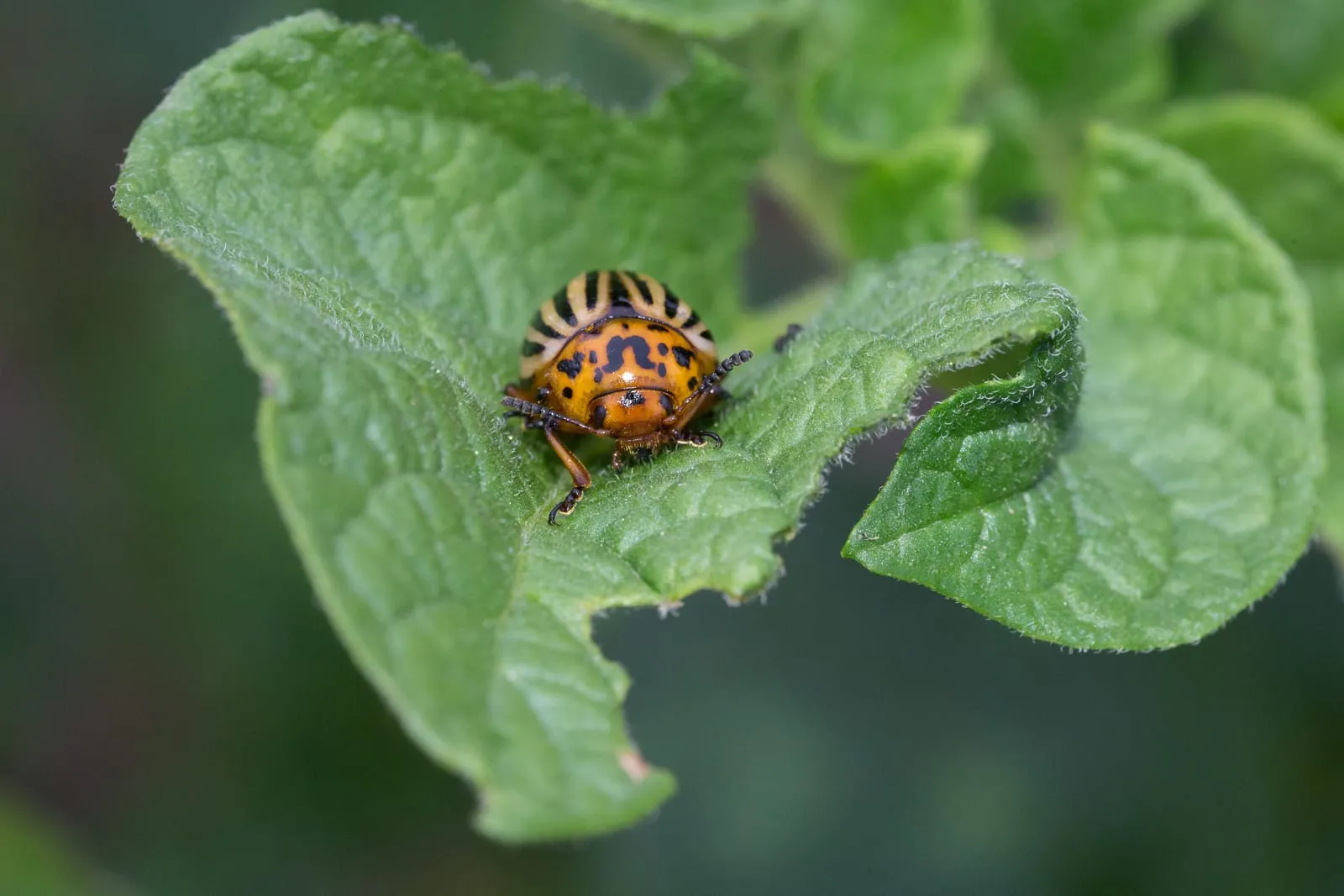
Yellow-and-black-striped beetle and red-orange humpbacked larvae that defoliate potato and eggplant. Capable of destroying a planting in days during peak feeding.
- Scientific name
- Leptinotarsa decemlineata
- Hosts
- 3
- Identification signs
- 4
- Controls
- 5
Biology and lifecycle
Colorado Potato Beetle (Leptinotarsa decemlineata) overwinters as adults in the soil, often within or near the previous season's Solanaceae beds. They emerge in spring when soil temperatures warm, which can range from March in warmer southern zones to late May in colder northern regions. After a brief feeding period, adults mate and lay compact yellow-orange egg clusters on leaf undersides, typically in batches of 10 to 30 eggs.
Larvae hatch within a few days to two weeks depending on temperature and pass through four instars before pupating in the soil. The full egg-to-adult cycle takes roughly three to five weeks under warm conditions, allowing two or more generations per season across much of the continental United States. Third and fourth instar larvae do the most damage, consuming foliage at a rate that can skeletonize plants within days during peak season. A planting that looks healthy in the morning can be stripped by afternoon when a large cohort reaches late-instar feeding together.
The most cost-effective control window is early. Targeting newly hatched first-instar larvae before they reach the voracious late instars pays off more than any reactive spray program. Hand-picking adults and crushing egg clusters daily during egg-laying reduces the next generation before it starts. For small larvae that escape manual control, Bt (San Diego strain, which is specific to this beetle) and spinosad are the IPM-preferred options; both work best on instars one and two. Conventional insecticides are available, but resistance has been documented in populations across the northeast, mid-Atlantic, and midwest, making rotation of modes of action important when sprays are necessary.
Signs to watch for
- ▸ Striped adult beetles on foliage
- ▸ Bright orange-red larvae feeding in groups
- ▸ Yellow-orange egg clusters on leaf undersides
- ▸ Skeletonized foliage
IPM controls
- ✓ Hand-pick adults and crush egg clusters daily during peak
- ✓ Spinosad or Bt (San Diego strain) on small larvae
- ✓ Crop rotation to a non-Solanaceae bed (beetles overwinter in soil)
- ✓ Straw mulch reduces movement between plants
- ✓ Encourage parasitic stink bugs and tachinid flies
Affected crops
Image: "Doryphore Verrières 2", by Hélène Rival, via Wikimedia Commons, licensed under CC-BY Source.

Related