Pest
Currant Borer
Synanthedon tipuliformis
Clearwing moth whose larvae tunnel inside currant and gooseberry canes, hollowing them out.
- Scientific name
- Synanthedon tipuliformis
- Hosts
- 4
- Identification signs
- 3
- Controls
- 4
Biology and lifecycle
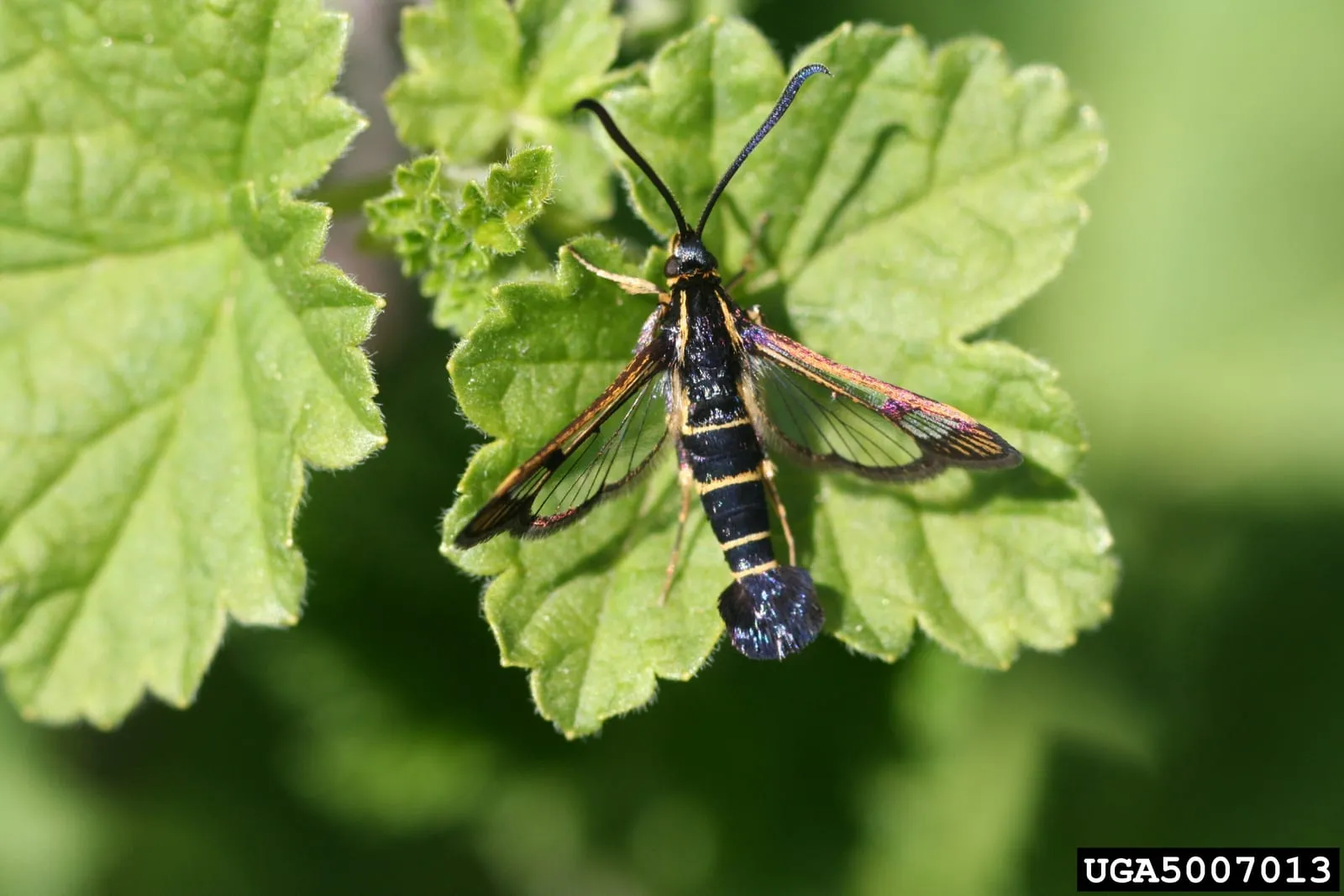
Currant borer (Synanthedon tipuliformis) is a clearwing moth that mimics small wasps in appearance, a convergent trait that offers it some protection from predators and causes growers to occasionally misidentify it on first encounter. Adults emerge in late spring to early summer, typically May through June depending on latitude and local degree-day accumulation, and lay eggs on the bark of currant and gooseberry canes. Larvae hatch and bore directly into the cane, spending most of their development tunneling downward through the pith toward the crown.
The larval stage is where damage accumulates. A single larva can hollow a cane from tip to crown over one growing season, leaving frass-packed tunnels visible when the cane is cut. Wilting or dying canes in midsummer are the most common first symptom; by that point, larvae are already well established inside and chemical intervention is ineffective.
The most cost-effective control window is dormant pruning. Canes older than three to four years harbor the highest borer populations. Systematic renewal pruning, holding no cane older than three years, removes infested wood before adults emerge the following spring. Cut prunings well below any visible frass, then destroy or burn them on-site to eliminate overwintering larvae.
Pheromone traps are useful for confirming adult flight timing and assessing pressure but function as monitoring tools, not population controls. Targeted insecticide applications against newly hatched larvae at adult flight peak are available and can reduce establishment in heavily managed plantings; they are seldom necessary where renewal pruning is practiced consistently. In lightly infested blocks with acceptable yields, tolerance is a reasonable approach.
Signs to watch for
- ▸ Wilting or dying canes during summer
- ▸ Hollow canes when cut, with frass inside
- ▸ Adult moths resembling small wasps in early summer
IPM controls
- ✓ Prune out and burn infested canes during dormant season
- ✓ Replace canes older than 4 years on a rotation
- ✓ Pheromone trap monitoring
- ✓ Tolerate as part of routine renewal pruning
Affected crops
Image: "Synanthedon tipuliformis 01", by Whitney Cranshaw, Colorado State University, Bugwood.org, via Wikimedia Commons, licensed under CC-BY Source.

Related