Pest
Flea Beetle
Multiple species (Chrysomelidae)
Tiny black or bronze jumping beetles that put hundreds of small holes in seedling leaves. Most damaging on direct-seeded brassicas and young eggplant.
- Scientific name
- Multiple species (Chrysomelidae)
- Hosts
- 17
- Identification signs
- 3
- Controls
- 5
Biology and lifecycle
Flea beetles (family Chrysomelidae) encompass dozens of species, but vegetable growers typically encounter a handful of key players: the striped flea beetle (Phyllotreta striolata), crucifer flea beetle (Phyllotreta cruciferae), and potato flea beetle (Epitrix cucumeris), among others. Adults overwinter in soil, woodland edges, and crop debris near garden beds, then emerge as soil temperatures climb above roughly 50°F in spring. That timing aligns closely with direct-seeded brassica germination and eggplant transplant season, which explains why seedlings bear the brunt of early-season pressure.
Adults are the primary damage agents. They chew dozens to hundreds of tiny round holes through leaf tissue, producing the characteristic shotgun appearance. Severe infestations can defoliate or kill seedlings outright, particularly eggplant, arugula, and direct-seeded radish. Larvae feed on roots and root hairs belowground but rarely cause significant damage in garden-scale plantings.
The most cost-effective control window is at establishment. Floating row cover installed at seeding or transplant, before adults arrive, prevents colonization without any inputs. Trap crops of fast-germinating mustard or radish sown along bed edges can concentrate adults away from the main planting. Kaolin clay (Surround WP) creates a physical barrier and irritant that reduces feeding; reapplication is needed after rain. Plants that reach four to six true leaves generally outgrow flea beetle pressure faster than populations can build, so delaying transplant by one to two weeks is a low-cost strategy where timing permits. Beneficial nematodes (Steinernema and Heterorhabditis species) applied to moist soil target larvae but have no effect on adults and are most warranted where larval root feeding compounds stress on perennial or long-season crops.
Signs to watch for
- ▸ Many tiny round shotholes in leaves giving 'shotgun' appearance
- ▸ Stunted seedlings
- ▸ Beetles jumping when disturbed
IPM controls
- ✓ Floating row cover at seeding or transplant
- ✓ Trap crops with mustard or radish along field edges
- ✓ Kaolin clay (Surround) on susceptible plants
- ✓ Beneficial nematodes for larval stage in soil
- ✓ Delay planting until plants are larger and can outgrow damage
Affected crops
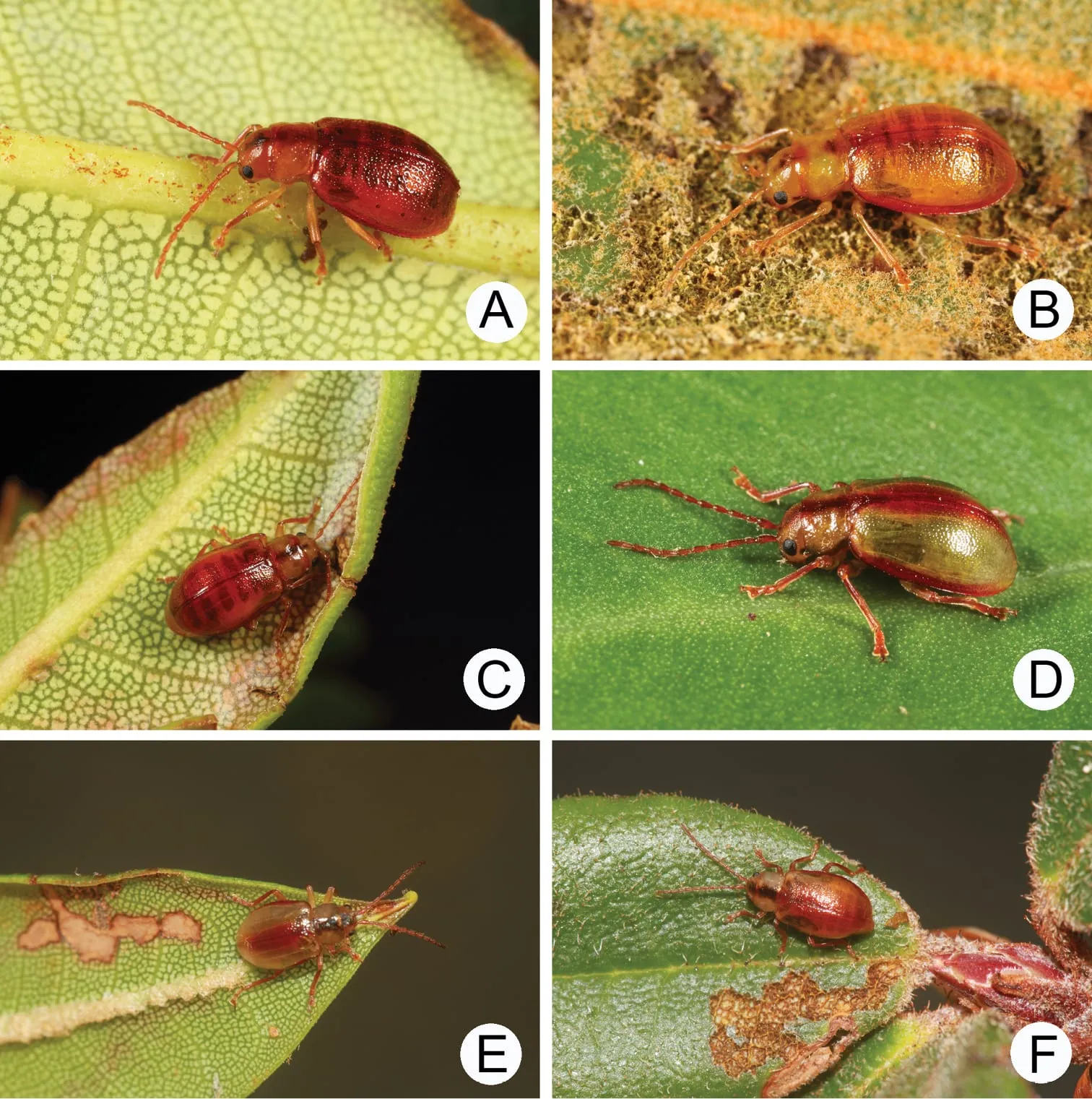
Image: "Lochmaea (10.3897-zookeys.856.30838) Figure 10", by Lee C-F (2019) The genus Lochmaea Weise, 1883 in Taiwan: results of taxonomic expeditions by citizen scientists (Coleoptera, Chrysomelidae, Galerucinae). In: Schmitt M, Chaboo CS, Biondi M (Eds) Research on Chrysomelidae 8. ZooKeys 856: 75-100. https://doi.org/10.3897/zookeys.856.30838, via Wikimedia Commons, licensed under CC-BY Source.
_Figure_10.jpg)
Related