Pest
Mealybug
Pseudococcidae spp.
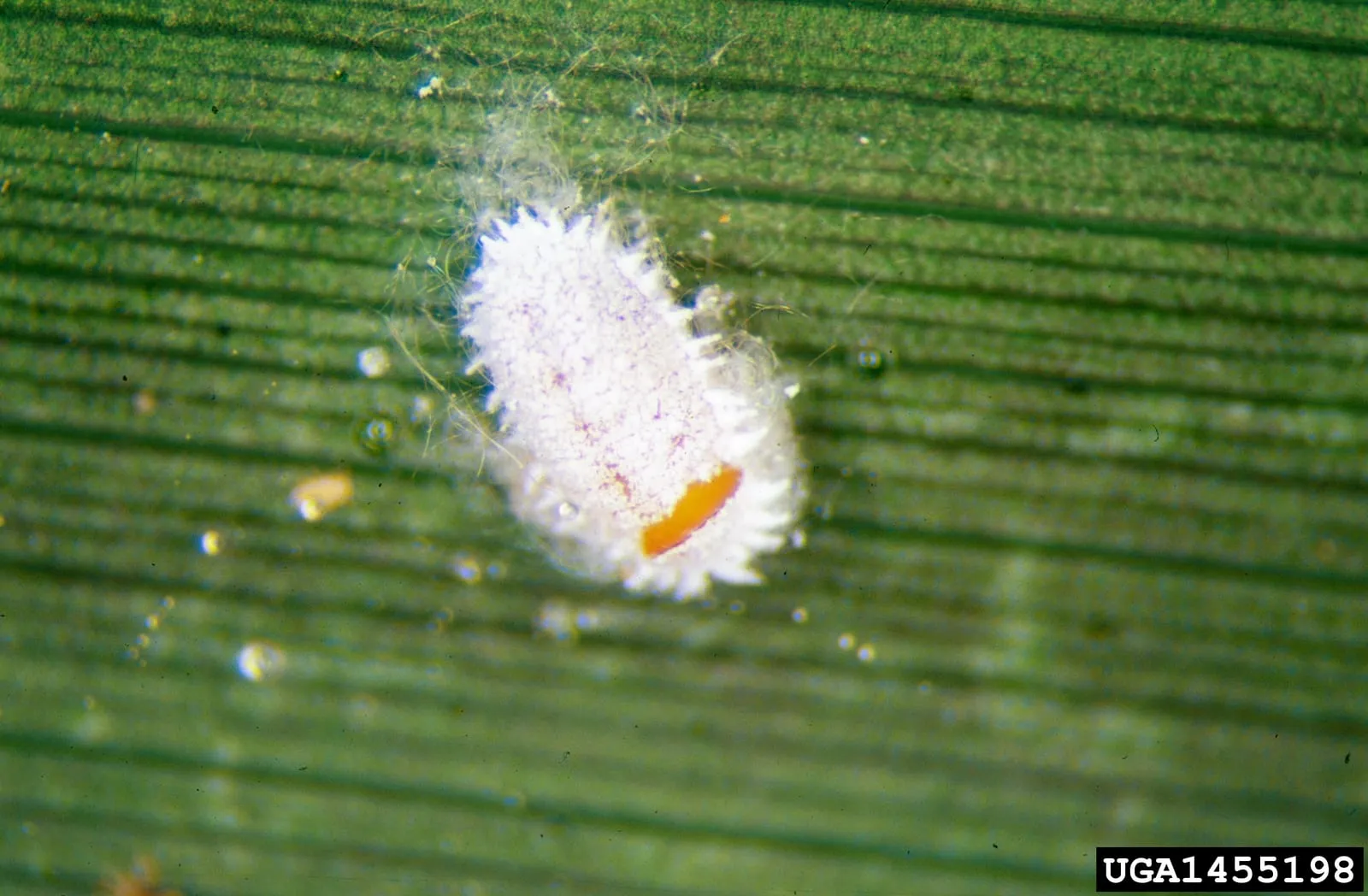
Soft white waxy insects that cluster at leaf joints, fruit stems, and root crowns. Honeydew secretion supports sooty mold; root mealybugs cause decline that mimics drought.
- Scientific name
- Pseudococcidae spp.
- Hosts
- 12
- Identification signs
- 3
- Controls
- 4
Biology and lifecycle
Mealybugs (family Pseudococcidae) are soft-bodied, wax-coated insects that feed by piercing plant tissue and extracting phloem sap. Females lay 100 to 600 eggs in a dense cottony egg sac, typically deposited at leaf axils, fruit stems, bark crevices, and root crowns. Eggs hatch into mobile first-instar crawlers, the most vulnerable stage and the primary target for any control effort. Crawlers disperse by walking or wind, settle into sheltered feeding sites, and begin secreting the waxy coating that protects them from contact sprays. Multiple overlapping generations occur throughout the warm season in subtropical and tropical climates; populations peak when temperatures stay between 70 and 90 F.
The feeding damage is two-part. Direct sap removal weakens shoots and distorts new growth, but the more persistent problem is honeydew, a sugary excretion that coats foliage and fruit and supports sooty mold fungal colonies. Ants actively farm mealybugs and exclude natural enemies; managing ant access to affected trees is often the first lever worth pulling.
For root-feeding species, early detection is difficult because wilting mimics drought stress. Soil drenches with approved insecticidal soap solutions, combined with light root zone disturbance, can reach colonies that foliar applications cannot.
The highest-leverage control window is targeting crawlers before wax develops, typically in spring and again in late summer. Repeated strong water sprays physically dislodge colonies on accessible foliage and are worth doing before reaching for insecticides. Cryptolaemus montrouzieri, the mealybug destroyer beetle, provides effective biocontrol in enclosed or semi-enclosed growing environments. Broad-spectrum sprays should be a last resort given their tendency to eliminate the natural enemy complex that otherwise keeps mealybug pressure moderate.
Signs to watch for
- ▸ cottony white masses at stem joints
- ▸ honeydew and ant trails
- ▸ wilting despite adequate water
IPM controls
- ✓ Strong water spray to dislodge colonies on accessible foliage
- ✓ Insecticidal soap or neem oil for repeated applications
- ✓ Cryptolaemus lady beetles released as biocontrol in greenhouses
- ✓ Disturb root zone and apply soil drench for root mealybugs
Affected crops
Image: "Planococcus citri 1455198", by Whitney Cranshaw, Colorado State University, United States, via Wikimedia Commons, licensed under CC-BY Source.

Related