Pest
Navel Orangeworm
Amyelois transitella
Moth whose larvae infest mummified almonds and continue feeding into the new crop. The dominant almond pest in California, also a vector for Aspergillus aflatoxin contamination.
- Scientific name
- Amyelois transitella
- Hosts
- 1
- Identification signs
- 3
- Controls
- 4
Biology and lifecycle
Navel orangeworm (Amyelois transitella) completes two to four generations per year in California's Central Valley, the core of its range. Overwintering larvae shelter inside mummified nuts left on the tree or on the ground from the prior harvest. Adults begin emerging in early spring, with the first-generation flight typically peaking March through April. Subsequent generations accelerate as temperatures climb, with the most economically damaging flight timed around hull split in late July through August, when cracked hulls expose kernels to larval entry.
The damage window is narrow but consequential. Larvae entering almonds at hull split contaminate kernels with frass and, more critically, facilitate colonization by Aspergillus fungi that produce aflatoxin. California almond lots must meet federal aflatoxin limits; heavily infested orchards can fail food safety thresholds entirely.
The single most cost-effective intervention is winter sanitation. Removing or destroying all mummy nuts before March eliminates the overwintering population before adults emerge, breaking the cycle at its lowest-density point. UC Cooperative Extension research consistently identifies mummy removal, completed by late February, as the highest-return practice available to almond growers.
For orchards with established populations, pheromone-based mating disruption dispensers deployed before first adult flight reduce mating success across the season without insecticide pressure. Targeted spray applications are most effective at early hull split, when larvae are actively attempting entry; applications timed too early or too late provide substantially less control. Prompt harvest at hull split further reduces the exposure window and is one of the more reliable cultural controls in an integrated program.
Signs to watch for
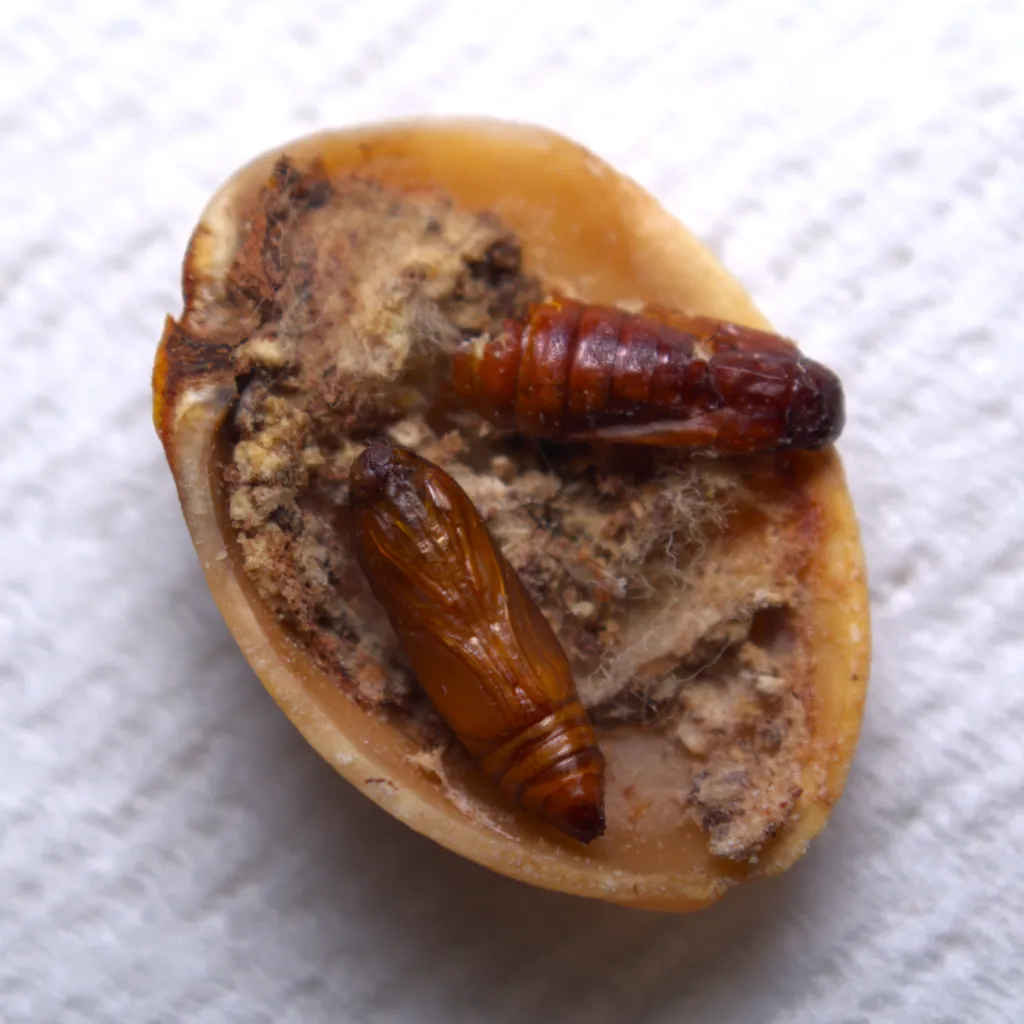
- ▸ Webbing and frass in almond shells
- ▸ Tunneled kernels with frass
- ▸ Mummy nuts in tree crotches and on ground harboring overwintering larvae
IPM controls
- ✓ Winter sanitation: remove all mummy nuts before March (the single most effective control)
- ✓ Pheromone-based mating disruption
- ✓ Targeted sprays at peak flight (early hull split)
- ✓ Prompt harvest at hull split before larval entry
Affected crops
Image: "Navel Orangeworm Moth", by Nick Abbate, via iNaturalist, licensed under CC-BY Source.
Related