Pest
Pecan Weevil
Curculio caryae
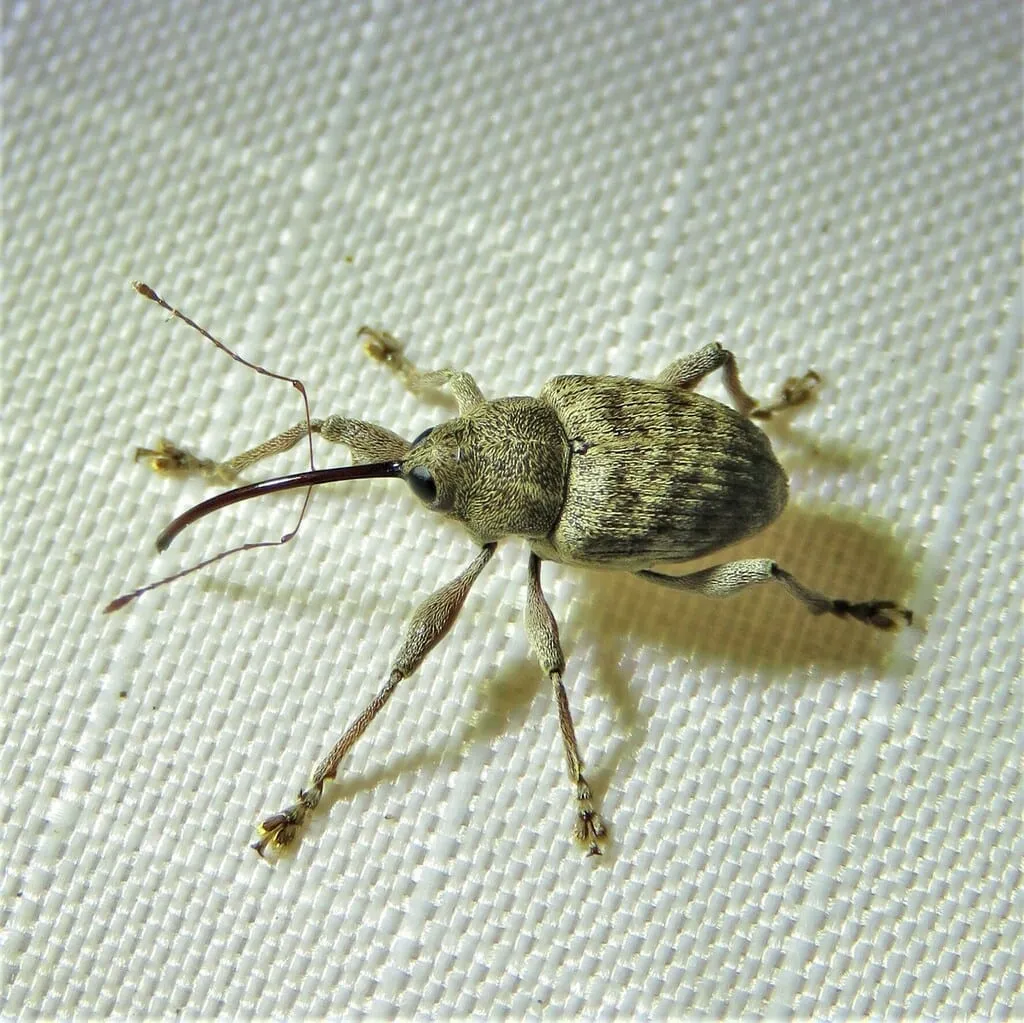
The most damaging pecan pest east of the Rockies. Adults emerge from soil in late summer, feed on developing nuts, and lay eggs inside ripening kernels.
- Scientific name
- Curculio caryae
- Hosts
- 1
- Identification signs
- 3
- Controls
- 4
Biology and lifecycle
Pecan weevil (Curculio caryae) is the most economically damaging pecan pest east of the Rocky Mountains. The lifecycle spans two to three years and spends most of that time underground. Adults overwinter as pupae in the soil, then emerge in late July through September when soil temperatures rise and rains soften the ground enough for them to push to the surface.
Damage occurs in two distinct windows. In the water stage (roughly mid-August), adults puncture the soft shuck to feed, triggering premature nut drop before kernels have a chance to develop. Later, as nuts near maturity, females bore into the shuck and lay eggs directly inside the kernel. The resulting C-shaped larvae consume the nutmeat entirely before exiting through a small exit hole, entering the soil, and beginning the cycle again. A single female can infest dozens of nuts across a season.
The most cost-effective control window is the adult emergence period, before females begin laying eggs. Trunk-banded burlap traps provide early detection and help track emergence intensity. Degree-day models keyed to local soil temperature give a more precise spray timing than calendar dates alone, since emergence can shift by two to three weeks depending on summer rainfall and temperature.
IPM-friendly first steps include prompt collection and removal of all fallen nuts, which removes larvae before they can re-enter the soil. Heavy organic mulch under the canopy can disrupt larval movement. Where populations are high, targeted insecticide applications timed to first adult emergence remain the most reliable intervention; a second application seven to ten days later is often warranted in heavily infested orchards.
Signs to watch for
- ▸ Small punctures in nut shucks during August-September
- ▸ Premature nut drop (water-stage damage)
- ▸ C-shaped grub larvae visible when nuts are cracked at harvest
IPM controls
- ✓ Trunk-banded burlap traps for adult monitoring
- ✓ Targeted sprays at first emergence (track with degree days)
- ✓ Prompt collection and destruction of fallen nuts to break the cycle
- ✓ Heavy mulch under canopy to disrupt larval entry into soil
Affected crops
Image: "Pecan weevil", by Annika Lindqvist, via iNaturalist, licensed under CC-BY Source.
Related