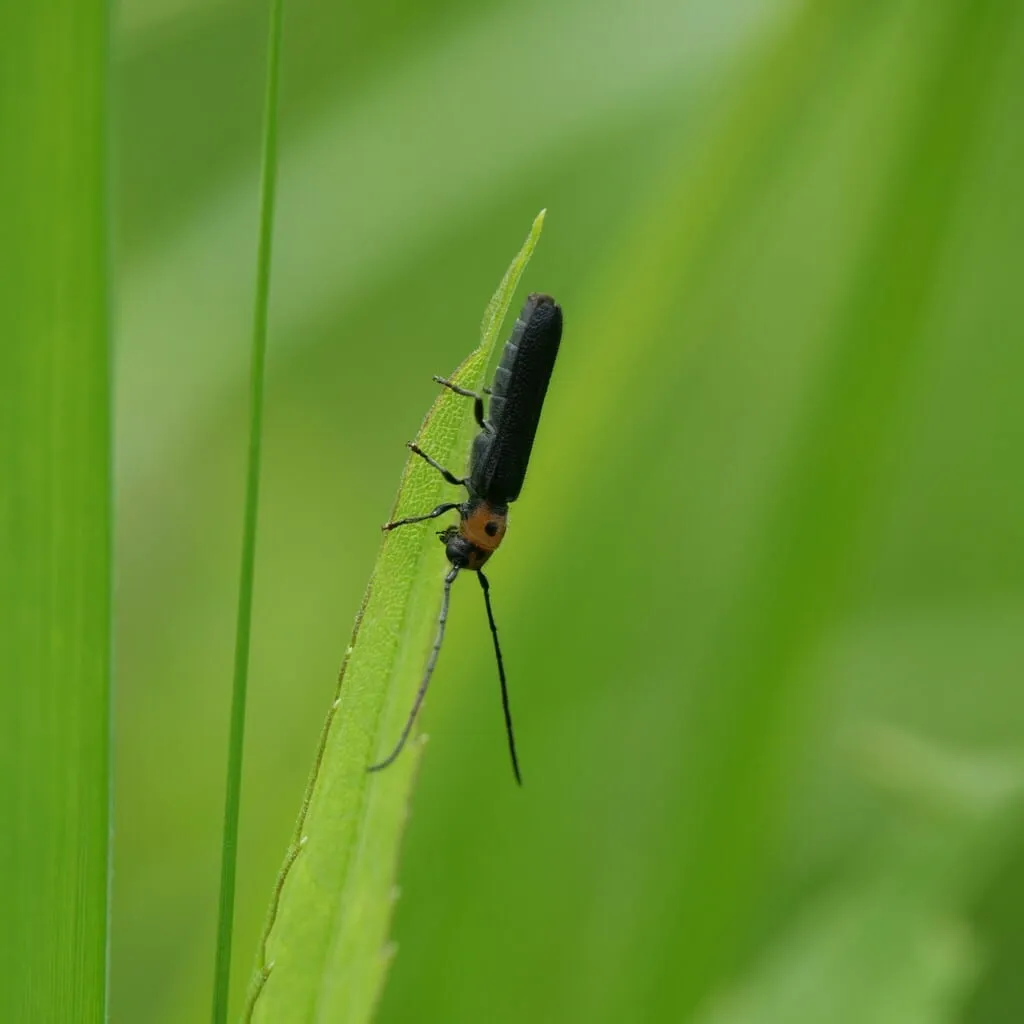
Pest
Raspberry Cane Borer
Oberea bimaculata
Long-horned beetle whose larvae girdle and tunnel into bramble canes, causing characteristic wilted shoot tips.
- Scientific name
- Oberea bimaculata
- Hosts
- 4
- Identification signs
- 3
- Controls
- 4
Biology and lifecycle
Raspberry cane borer (Oberea bimaculata) is a long-horned beetle native to eastern North America whose damage unfolds across two growing seasons, making early detection the most important management lever available.
Adults emerge in late spring through midsummer, typically June and July, and begin ovipositing shortly after. The female bites two parallel rings of punctures into the tip of a green cane, lays a single egg between them, and moves on. Within days, the shoot tip above the girdling rings wilts and collapses. This drooping tip is the most reliable early indicator and the point at which intervention is most effective. The larva hatches and begins tunneling downward inside the cane, feeding through the first season and overwintering well below the original puncture site. In the second year, tunneling continues toward the crown, causing cane dieback that can look like winter injury or Phytophthora root rot on a casual inspection.
The most cost-effective control window is during summer scouting, when wilted tips are fresh and the larva is still in the upper cane. Pruning at least six inches below the puncture rings and destroying the prunings (not composting them) removes the overwintering larva before it can complete development. Scouting every 7 to 10 days from late June through July catches new strikes while the window is open. Parasitoid wasps provide modest natural suppression; maintaining hedgerow habitat and avoiding broad-spectrum insecticides during bloom supports those populations.
Chemical applications are rarely justified in home plantings. Where adult pressure is historically high, a targeted pyrethroid applied to cane tips at adult emergence is sometimes used, but timing is difficult and mechanical removal remains more reliable.
Signs to watch for
- ▸ Two parallel rings of punctures around cane tips with wilted shoot above
- ▸ Larval tunneling inside canes
- ▸ Cane dieback in second year
IPM controls
- ✓ Prune wilted tips 6 inches below the punctures and destroy
- ✓ Inspect canes during summer for girdling
- ✓ Remove and burn affected canes during dormant pruning
- ✓ Encourage parasitoid wasps
Affected crops
Image: "Raspberry Cane Borer", by Alexandria Szakacs, via iNaturalist, licensed under CC-BY Source.
Related