Pest
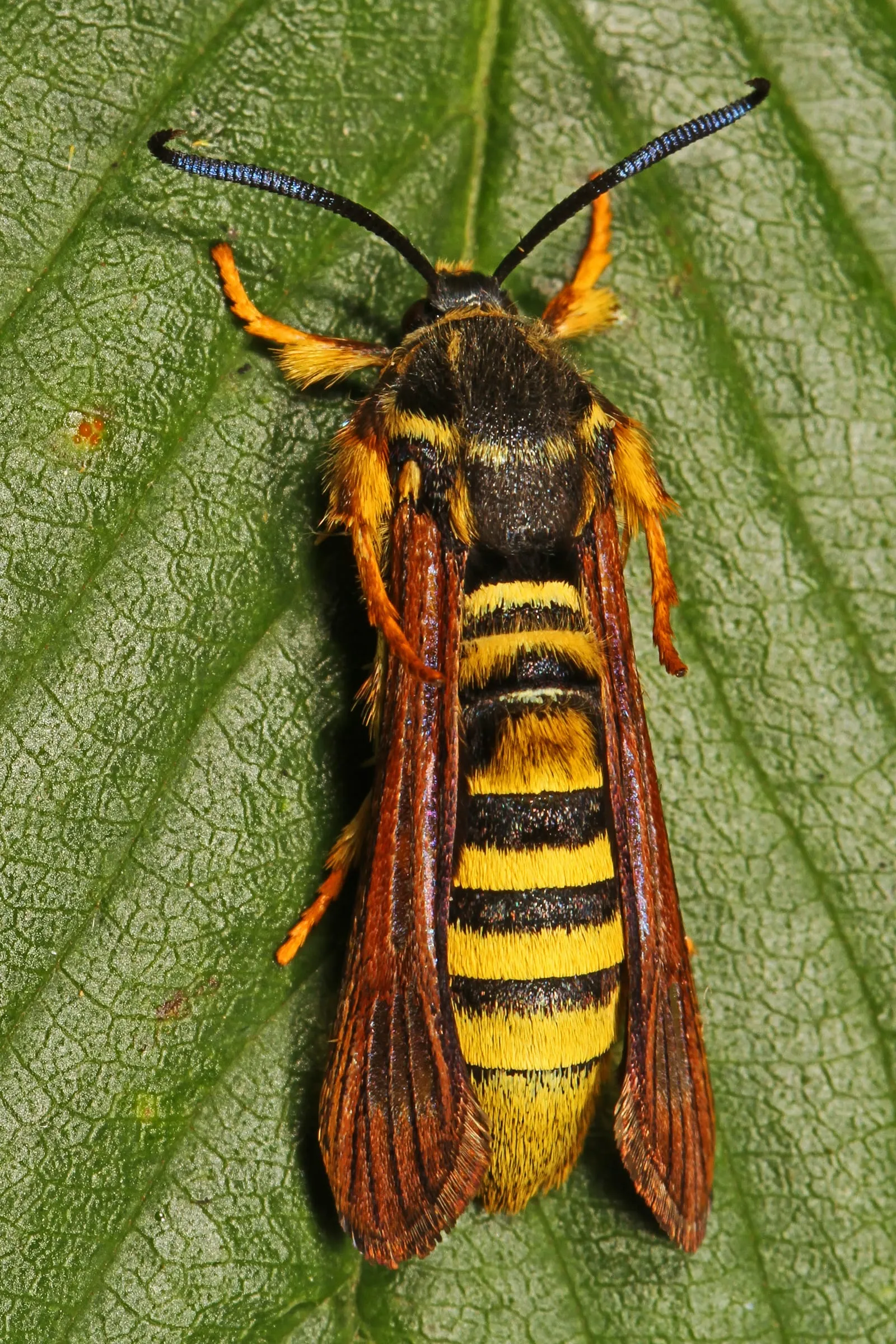
Raspberry Crown Borer
Pennisetia marginata
Clearwing moth whose larvae feed in the crown and lower canes of raspberries, often killing entire plants over two years.
- Scientific name
- Pennisetia marginata
- Hosts
- 3
- Identification signs
- 3
- Controls
- 4
Biology and lifecycle
The two-year life cycle of raspberry crown borer is what makes it persistently damaging and difficult to control. Adult moths, which closely resemble yellow jacket wasps, emerge in late summer and lay eggs on raspberry foliage. Newly hatched larvae migrate down to the soil surface and overwinter before boring into the crown in their first full season. By their second year, larvae have moved deeper into the crown and base of canes, where feeding disrupts the vascular tissue that sustains the planting.
The most visible damage, wilting and collapsing canes during summer, typically signals second-year larvae already well established in the crown. By that point, physical removal of infested crowns is the only reliable option. Excavating the crown and inspecting for reddish frass and larval tunneling confirms the diagnosis and identifies which stools to discard.
The most cost-effective control window is late summer, timed to coincide with adult flight and egg hatch, before larvae reach the protected crown tissue. Targeted sprays applied at the crown and base of canes during this window can intercept newly hatched larvae. Pheromone traps are available and useful for timing applications accurately rather than relying on calendar dates, which shift with local conditions and season.
For long-term management, replacing plantings on a 6 to 8 year cycle and sourcing certified clean nursery stock reduces reintroduction risk. Fields with a documented history of infestation should be rested before replanting. No single intervention eliminates the pest reliably; a combination of sanitation, replacement scheduling, and well-timed intervention is the practical standard approach.
Signs to watch for
- ▸ Wilting and dieback of canes during summer
- ▸ Larval tunnels in crown when excavated
- ▸ Reddish frass at crown level
IPM controls
- ✓ Remove and destroy infested crowns
- ✓ Targeted sprays at adult flight (late summer)
- ✓ Replace plantings on a 6-8 year cycle
- ✓ Source clean nursery stock
Affected crops
Image: "Raspberry Crown Borer - Pennisetia marginatum, Meadowood Farm SRMA, Mason Neck, Virginia", by Judy Gallagher, via Wikimedia Commons, licensed under CC-BY Source.

Related