Pest
San Jose Scale
Quadraspidiotus perniciosus
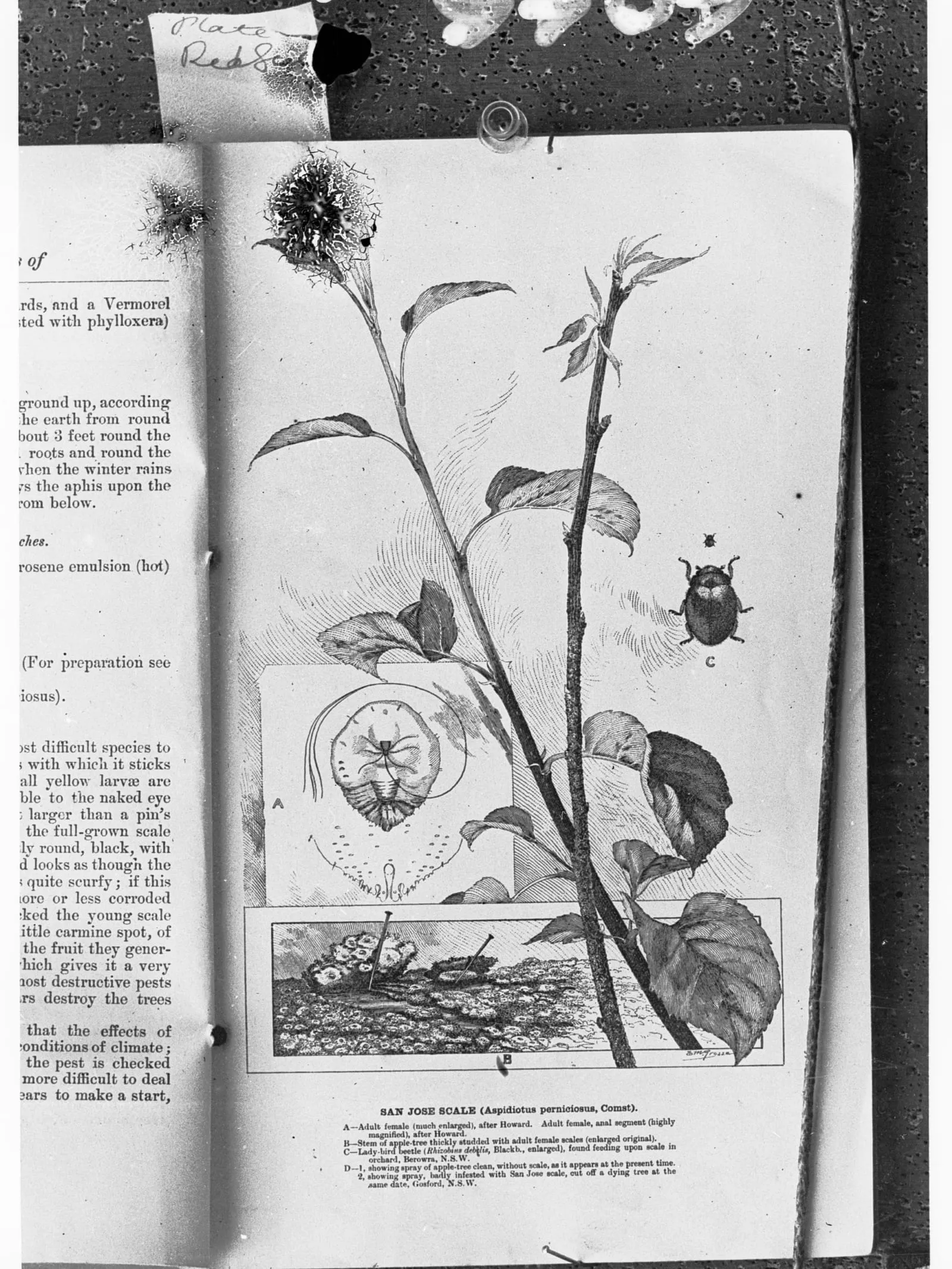
Tiny armored scale insect that encrusts bark, branches, and fruit. Heavy infestations weaken trees and produce red haloed spots on fruit at harvest. Persistent year-over-year if not controlled.
- Scientific name
- Quadraspidiotus perniciosus
- Hosts
- 10
- Identification signs
- 4
- Controls
- 4
Biology and lifecycle
San Jose scale (Quadraspidiotus perniciosus) overwinters as a partially developed nymph, called the black cap stage, beneath a gray-black waxy covering fused to bark. Development resumes in late winter as temperatures accumulate. First-generation crawlers, the only mobile stage in the lifecycle, emerge when roughly 300 to 350 degree days (base 50°F) accumulate after biofix, which typically falls in late May to early June across most temperate fruit-growing regions. Timing shifts by a week or more depending on zone and elevation.
Crawlers disperse across the canopy, settle on bark, branches, and developing fruitlets, and begin secreting their own protective armor within days of settlement. Once armored, they are nearly impervious to contact sprays. A second generation follows in midsummer. Heavy populations sustained through two full generations produce the distinctive red-haloed injury visible at harvest and, in severe cases, trigger branch dieback.
The most cost-effective single intervention is a thorough dormant oil application during late winter, before bud swell. At the labeled rate, oil physically smothers overwintering scales when populations are dense and confined to bark. Sites that keep broad-spectrum spray programs light tend to maintain stronger populations of twice-stabbed lady beetles (Chilocorus stigma) and parasitoid wasps, both of which suppress scale year-over-year. Letting these natural enemies work is a genuine long-term strategy, not just a footnote.
Where dormant oil alone proves insufficient, a targeted contact insecticide applied precisely at crawler emergence provides a second control window before scales settle and armor up. Confirming emergence timing with degree day models or sticky tape traps is worthwhile; spraying too early or too late misses the window entirely.
Signs to watch for
- ▸ Tiny gray-black bumps on bark, often forming crusty patches
- ▸ Red 'halo' rings on fruit where scales fed during development
- ▸ Branch dieback in heavy infestations
- ▸ Yellowing leaves above affected branches
IPM controls
- ✓ Dormant oil spray during late winter (the foundation control; smothers overwintering scales)
- ✓ Targeted insecticide at crawler emergence (track with degree days, typically late May to early June)
- ✓ Prune out and destroy heavily infested branches
- ✓ Encourage twice-stabbed lady beetle and parasitoid wasps
Affected crops
Image: "The San Jose Scale - page from the Agricultural Gazette of New South Wales showing San Jose Scale", by State Government Photographer, via Wikimedia Commons, licensed under CC0 Source.
.jpg)
Related