Pest
Scale Insect
Coccoidea spp.
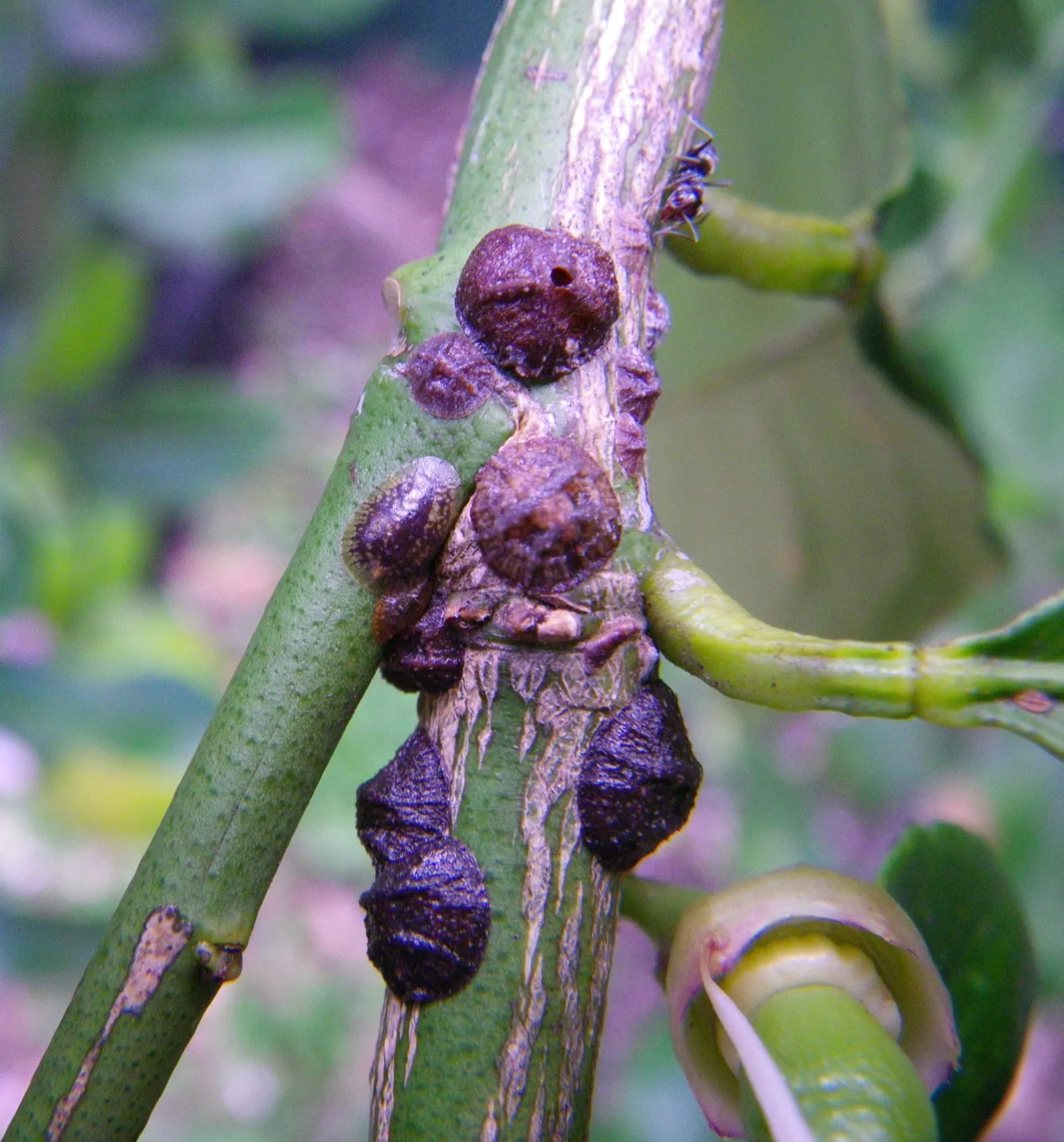
Sap-sucking insects that attach to bark, leaves, and fruit, secreting honeydew that fuels sooty mold. Heavy infestations weaken trees and cause leaf yellowing.
- Scientific name
- Coccoidea spp.
- Hosts
- 10
- Identification signs
- 4
- Controls
- 4
Biology and lifecycle
Scale insects (Coccoidea spp.) are among the most persistent sap-feeding pests on tropical and subtropical fruit crops. The group includes armored scales and soft scales, both of which attach firmly to bark, leaf undersides, and fruit surfaces, feeding continuously on plant fluids. Armored scales secrete a hard waxy shell that protects them from contact sprays; soft scales produce honeydew that coats surfaces and fuels secondary sooty mold infections.
The lifecycle runs through several nymph stages, with first-instar crawlers being the most mobile and most vulnerable to treatment. Crawlers emerge in flushes that loosely track warm-season growth cycles, though in subtropical zones with mild winters, populations can cycle nearly year-round. Once crawlers settle and begin forming their protective cover, chemical intervention becomes substantially less effective. This makes the crawler window, typically two to four weeks after hatch begins, the highest-leverage control opportunity.
For most home orchards, the most cost-effective approach starts with biological controls. Lady beetles, lacewing larvae, and parasitic wasps (particularly chalcid wasps) can hold scale populations below damaging thresholds when broad-spectrum insecticide use is minimized. Horticultural oil applied thoroughly in late winter or early spring, before new growth hardens and before the season's first crawler flush, smothers overwintering scales and eggs without disrupting beneficial insect populations. Pruning out heavily encrusted branches reduces the overwintering reservoir and improves spray penetration on remaining wood. Reserve systemic or contact insecticides for severe infestations where biological and cultural controls have failed, and choose products with low impact on beneficial insects where possible.
Signs to watch for
- ▸ raised bumps on branches and leaf undersides
- ▸ sticky honeydew
- ▸ black sooty mold
- ▸ yellowing leaves
IPM controls
- ✓ Horticultural oil thoroughly applied in early spring before new growth
- ✓ Encourage natural predators like lady beetles and parasitic wasps
- ✓ Prune out heavily infested branches
- ✓ Avoid broad-spectrum insecticides that disrupt biological control
Affected crops
Image: "Saissetia oleae", by Toby Hudson, via Wikimedia Commons, licensed under CC-BY Source.

Related