Pest
Spotted Lanternfly
Lycorma delicatula
Invasive planthopper from Asia first detected in Pennsylvania 2014, now spreading through the Eastern US. Direct feeding weakens trees; honeydew supports sooty mold and reduces fruit quality.
- Scientific name
- Lycorma delicatula
- Hosts
- 6
- Identification signs
- 5
- Controls
- 5
Biology and lifecycle
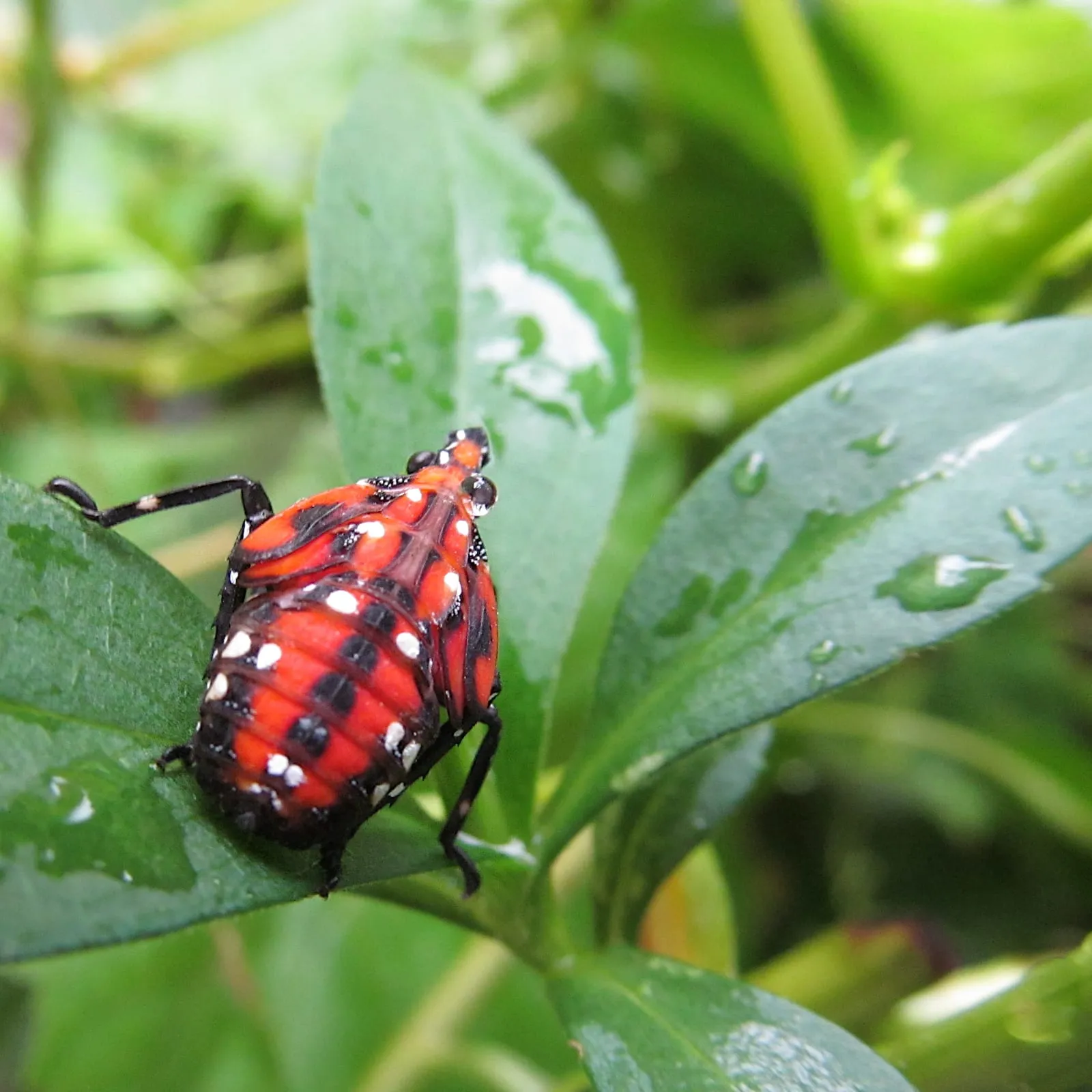
Lycorma delicatula completes one generation per year. Eggs overwinter in masses that resemble dried mud or smeared gray putty on bark, stone, metal, and outdoor equipment. Each mass contains 30 to 50 eggs. Nymphs hatch in late April through May and progress through four instars over roughly eight weeks. Early instars are black with white spots; fourth-instar nymphs are red with black and white markings. Adults emerge in July and August and remain active through the first hard frost.
Feeding damage accumulates across both nymph and adult stages, but late-summer adult aggregations on orchard trees cause the most concentrated harm. Adults pierce bark and phloem of apple, pear, peach, plum, cherry, and blueberry, depleting carbohydrate reserves going into dormancy. Excreted honeydew coats foliage and fruit, fostering sooty mold that reduces fruit quality and marketability regardless of whether the fruit itself is directly damaged.
The most cost-effective control window is egg mass removal from October through early May, before hatch. Scraping and destroying masses eliminates the problem at minimum input cost. Sticky trunk band traps (inverted to prevent beneficial insect bycatch) intercept climbing nymphs and reduce adult pressure before populations peak. Neither method is sufficient at high density, but both reduce load before insecticides become necessary.
In areas where spotted lanternfly is newly detected, reporting sightings to the state department of agriculture is a practical contribution to quarantine enforcement, which slows spread by restricting movement of outdoor goods carrying egg masses. Targeting nearby Tree-of-Heaven (Ailanthus altissima), the preferred reproductive host, with herbicide or girdling is a landscape-level strategy worth coordinating with neighbors in orchard situations. First detected in Pennsylvania in 2014, the pest has since expanded across much of the Eastern US, and its range continues to shift westward.
Signs to watch for
- ▸ Distinctive black-spotted gray adults with red hindwings (visible when they jump or fly)
- ▸ Black or gray nymphs (early instars) or red-and-black nymphs (late instars)
- ▸ Sticky honeydew on trunks and surrounding foliage
- ▸ Sooty mold on honeydew
- ▸ Egg masses (smudged gray, mud-like) on smooth bark and outdoor surfaces
IPM controls
- ✓ Scrape and destroy egg masses October through May (each contains 30-50 eggs)
- ✓ Trunk traps with sticky bands inverted to catch climbing nymphs
- ✓ Targeted insecticide treatment of nearby Tree-of-Heaven (Ailanthus) host trees
- ✓ Report sightings to state agriculture department in newly-infested areas (quarantine programs)
- ✓ Tolerate light populations on landscape trees if not affecting orchard crops
Affected crops
Image: "Spotted Lanternfly (Lycorma delicatula) late-stage nymph in Pittsburgh, 2022-07-23, 03", by Cbaile19, via Wikimedia Commons, licensed under CC0 Source.
_late-stage_nymph_in_Pittsburgh,_2022-07-23,_03.jpg)
Related