Pest
Squash Vine Borer
Melittia cucurbitae
Day-flying clearwing moth whose larvae bore into squash stems at the base and hollow them out, causing sudden wilting and plant death. The dominant squash killer east of the Rockies.
- Scientific name
- Melittia cucurbitae
- Hosts
- 3
- Identification signs
- 3
- Controls
- 5
Biology and lifecycle
Squash vine borer (Melittia cucurbitae) is a clearwing moth that mimics a wasp in coloration and flight pattern, active during daylight hours rather than at night. Adults emerge in late spring to early summer and lay flat, reddish-brown eggs singly at or near the base of squash stems. Eggs hatch within roughly a week, and the larvae immediately bore into the stem rather than feeding on leaf surfaces. All meaningful damage occurs underground or at the soil line: one or two larvae can hollow a main stem within days, cutting off water and nutrient flow. The result is sudden collapse that looks like drought stress but does not respond to watering. Once a stem is hollowed, the plant rarely recovers.
Across the Mid-Atlantic and most of the eastern U.S., first moth emergence typically runs late June into July, with a single generation per year. The deep South may see a partial second flight. Timing and geography make a significant difference; local extension records for first flight dates are more reliable than calendar rules alone.
The highest-leverage control window is before eggs hatch. Wrapping stem bases with foil or fabric collars physically blocks egg-laying access. Succession planting or deliberate delay of transplant timing can shift the vulnerable stage past the main emergence period. Planting Cucurbita moschata varieties such as butternut squash or Tromboncino is the most durable resistance strategy in high-pressure regions.
If larvae are already inside the stem, injecting Bacillus thuringiensis (Bt) directly into the entry hole at first sign of frass can limit further damage. Pyrethroid or spinosad sprays targeted at the stem base during egg-hatch are a fallback option, but require precise timing and repeated coverage to be effective.
Signs to watch for
- ▸ Sudden wilting of vines, often after watering
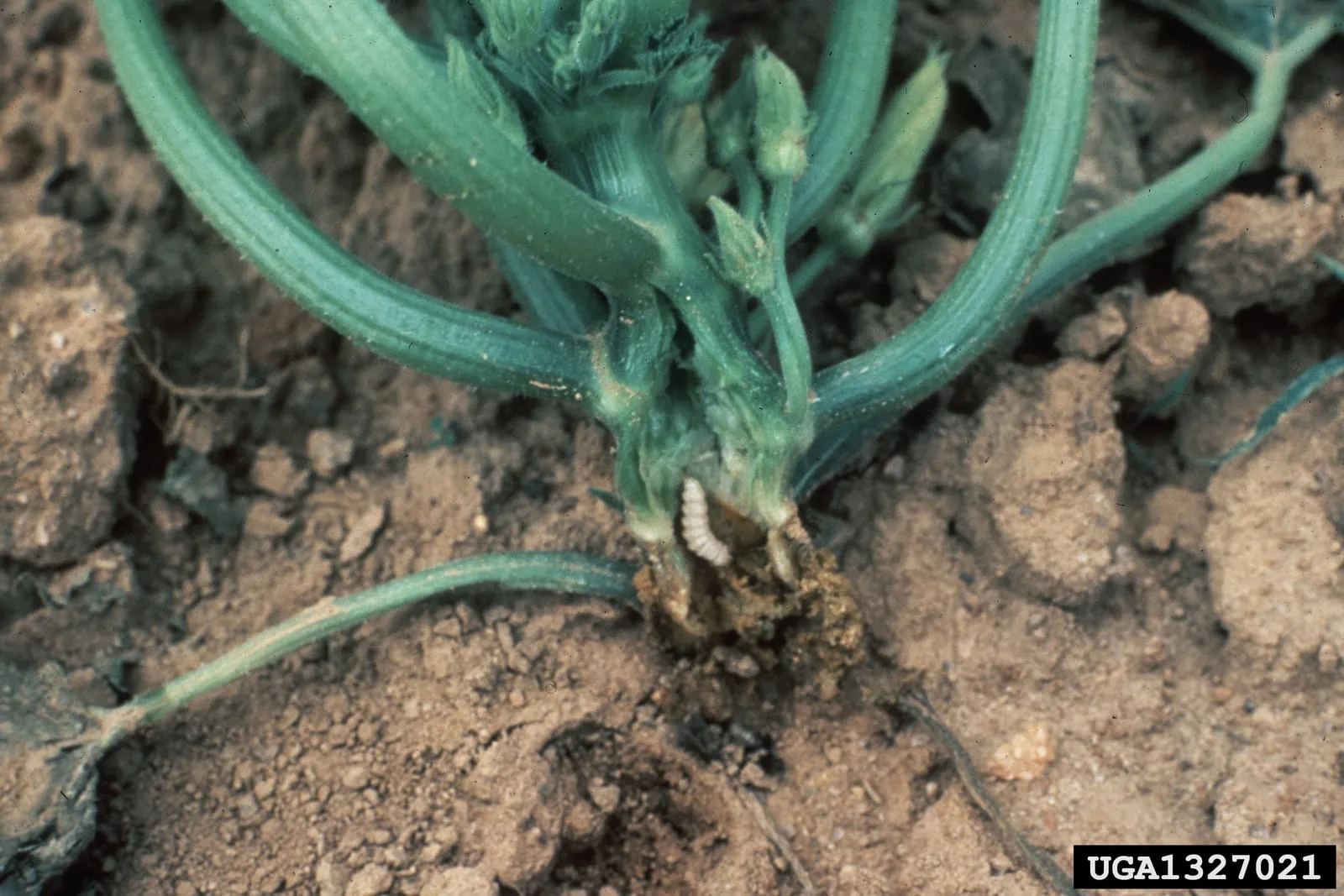
- ▸ Sawdust-like frass at the base of stems
- ▸ Hollowed stems near the soil line, often with a visible exit hole
IPM controls
- ✓ Wrap stems with foil collars at the base before egg-laying begins
- ✓ Inject Bt directly into stems with a syringe at first sign of damage
- ✓ Time plantings to dodge first moth emergence (typically late June in the Mid-Atlantic)
- ✓ Plant Cucurbita moschata varieties (butternut, Tromboncino) which are resistant
- ✓ Bury vines along their length so they root at nodes and survive damage to the main stem
Affected crops
Image: "Melittia cucurbitae damage1", by Alton N. Sparks, Jr., University of Georgia, Bugwood.org, via Wikimedia Commons, licensed under CC-BY Source.

Related