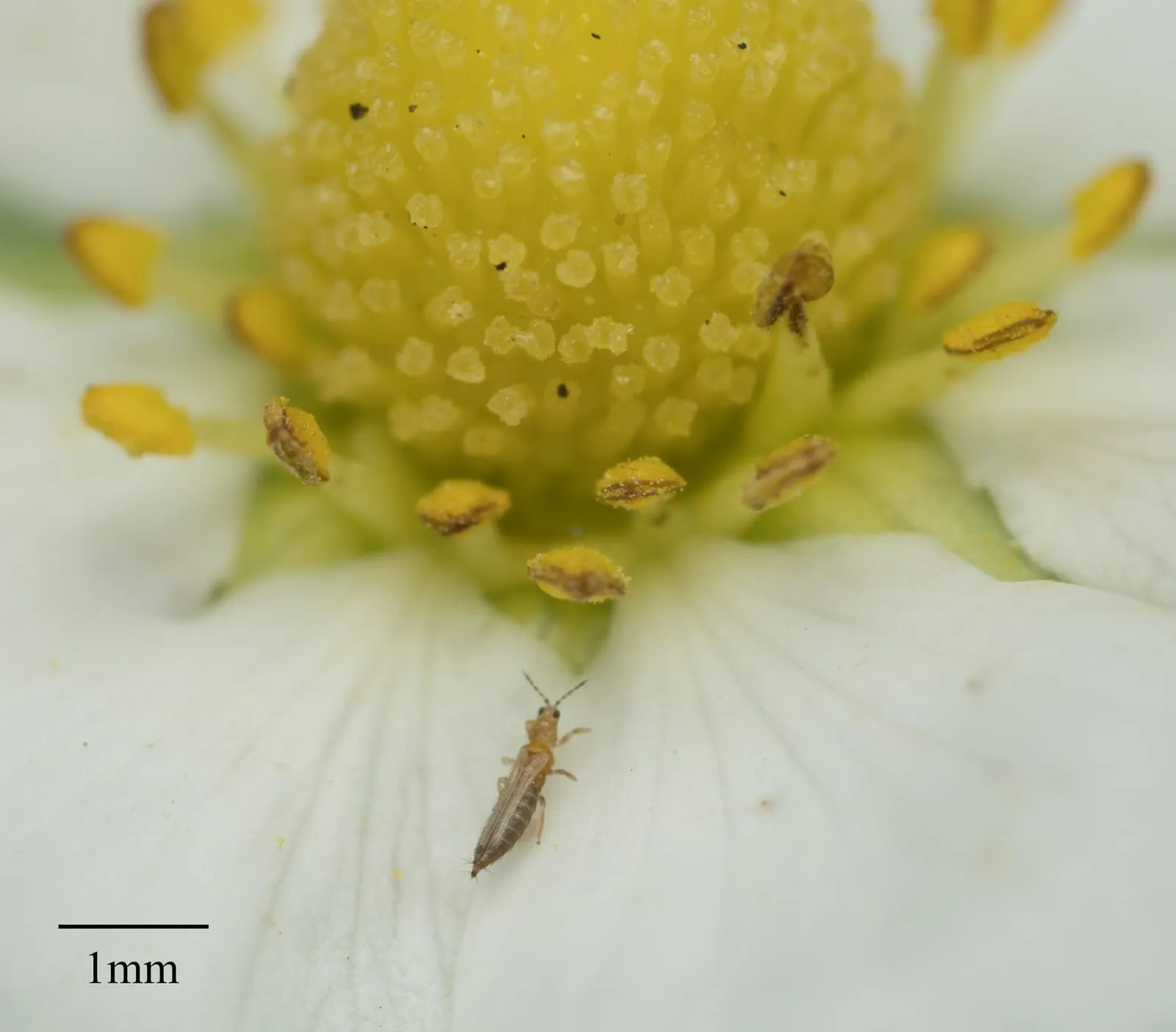
Pest
Western Flower Thrips
Frankliniella occidentalis
Tiny slender insect that rasps leaf and flower surfaces. The primary vector for Tomato Spotted Wilt Virus and Iris Yellow Spot Virus, which makes it more damaging through disease transmission than direct feeding.
- Scientific name
- Frankliniella occidentalis
- Hosts
- 10
- Identification signs
- 4
- Controls
- 5
Biology and lifecycle
Western flower thrips (Frankliniella occidentalis) completes its life cycle in as few as 10 to 14 days under warm conditions (above 80°F), which allows populations to build rapidly during summer. Eggs are inserted into plant tissue, hatch into two larval instars that feed on leaf and flower surfaces, then drop to the soil to pupate. Adults emerge winged and disperse readily, making field-to-field spread a constant concern.
Direct feeding causes silvery streaking, stippling, and distorted new growth, but the more consequential damage comes from virus transmission. First-instar larvae that feed on infected plant material acquire Tomato Spotted Wilt Virus (TSWV) or Iris Yellow Spot Virus; once they mature into adults, they transmit those viruses to every subsequent host they visit. A single infested transplant introduced into a field can serve as the inoculum source for widespread viral spread within weeks.
The most cost-effective control window is early, before flowering begins and before populations peak. Blue sticky traps are more attractive to adults than yellow traps and give a reliable early warning. Reflective mulches disrupts host-finding by incoming winged adults and are worth deploying at transplant time, not after populations are already established. Where biological controls are practical, minute pirate bugs (Orius spp.) and predatory mites (Amblyseius spp.) suppress thrips in protected culture and can provide meaningful field suppression when populations of natural enemies are preserved. Spinosad, a microbially derived insecticide compatible with most IPM programs, is effective during peak adult flight but requires good spray coverage on flower tissue. Removing weed hosts, particularly Russian thistle and pigweed, at field margins reduces the reservoir population that reinfests crops throughout the season.
Signs to watch for
- ▸ Silvery streaks and stippling on leaves and flower petals
- ▸ Distorted new growth
- ▸ Tiny dark fecal spots
- ▸ Russeting and bronzing on fruit
IPM controls
- ✓ Blue sticky traps for monitoring (more attractive to thrips than yellow)
- ✓ Reflective mulches deter winged adults
- ✓ Spinosad spray during peak flight
- ✓ Encourage minute pirate bugs and predatory mites (Amblyseius)
- ✓ Remove weed hosts at field edges; Russian thistle and pigweed support populations
Affected crops
Image: "Frankliniella occidentalis 14827630", by Jesse Rorabaugh, via Wikimedia Commons, licensed under CC0 Source.

Related