Pest
Walnut Caterpillar
Datana integerrima
Gregarious caterpillar that feeds in dense colonies on walnut and pecan foliage, capable of defoliating entire branches in days.
- Scientific name
- Datana integerrima
- Hosts
- 3
- Identification signs
- 3
- Controls
- 4
Biology and lifecycle
Walnut caterpillar (Datana integerrima) is a native moth whose larvae feed exclusively on walnut and pecan foliage, often in numbers large enough to strip entire scaffold limbs within a week. Adults lay egg masses on the undersides of leaflets in late spring through early summer; eggs hatch into colonies of 50 to 100 or more larvae that feed together throughout their development.
The caterpillars pass through five instars over roughly four to six weeks. Early instars scrape leaf tissue, leaving a characteristic skeletonized appearance. By the third instar, larvae consume leaf material entirely and the defoliation becomes conspicuous. A single tree can support multiple egg masses and multiple generations in warm years, though one generation per season is most common in the northern part of the range (zones 4 through 6) and two are possible in the South.
The most reliable control window is the early-instar stage, when colonies are dense, caterpillars are small, and Bacillus thuringiensis (Bt) sprays are most effective. Because the larvae aggregate, hand removal is also practical at any point they descend to trunk bark during their communal molts, a behavior that concentrates hundreds of caterpillars in one place. On mature, well-established trees, light to moderate infestations rarely cause lasting harm; a tree that retains most of its canopy will recover without intervention. Reserve sprays for young trees, repeated defoliation in the same season, or when multiple large colonies are present simultaneously. Parasitoid wasps and tachinid flies provide meaningful natural suppression and should be factored into any spray decision.
Signs to watch for
- ▸ Tight clusters of dark hairy caterpillars on branches
- ▸ Skeletonized leaves followed by complete defoliation of affected limbs
- ▸ Mass molting on trunks (caterpillars descend to shed skin)
IPM controls
- ✓ Hand removal of clustered caterpillars during molt on trunks
- ✓ Bt (Bacillus thuringiensis) sprays on young larvae
- ✓ Tolerate light infestations on mature trees (rarely fatal)
- ✓ Encourage parasitoid wasps and tachinid flies
Affected crops
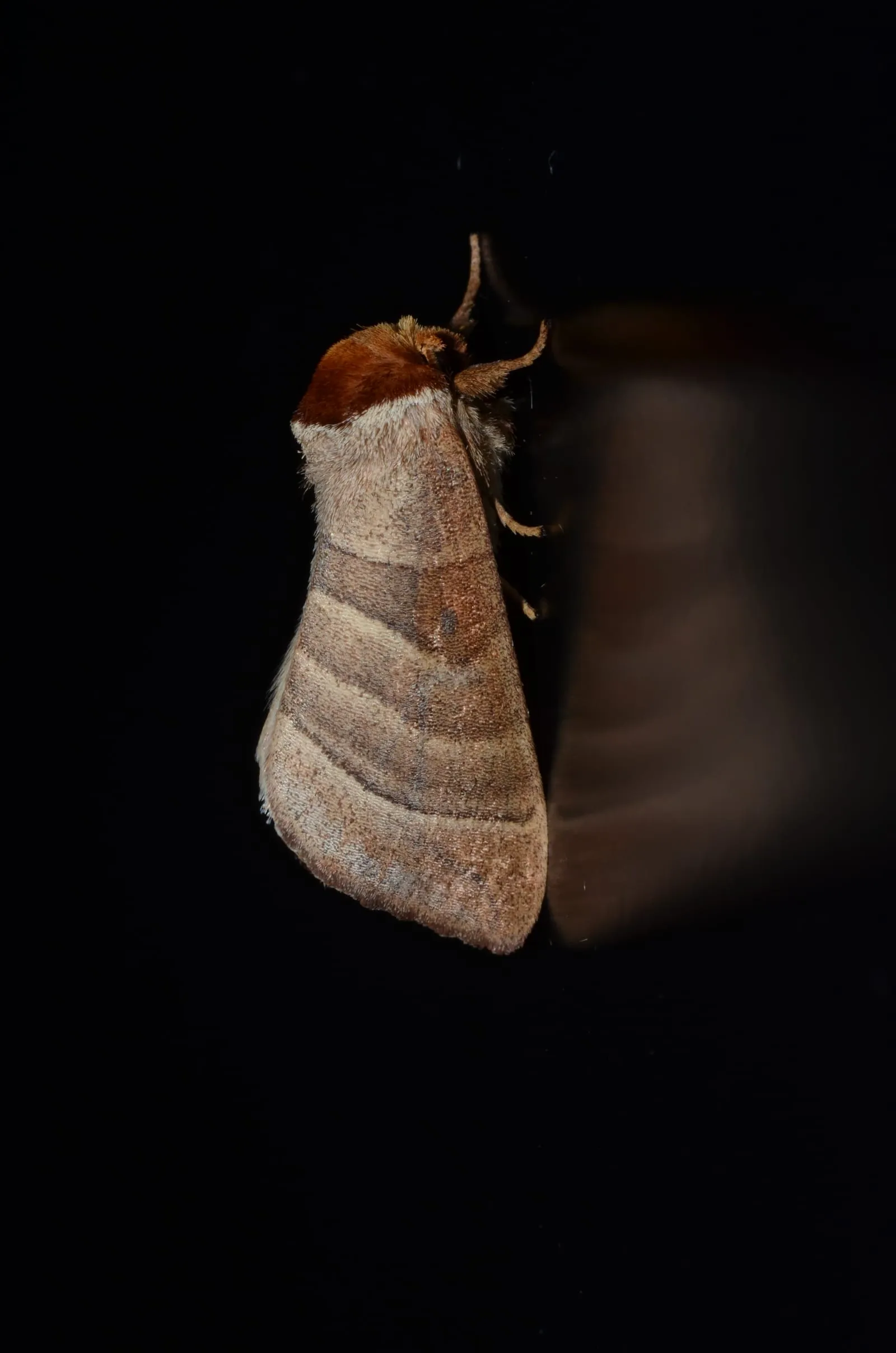
Image: "- 7907 – Datana integerrima – Walnut Caterpillar Moth (18885365043)", by Andy Reago & Chrissy McClarren, via Wikimedia Commons, licensed under CC-BY Source.
.jpg)
Related