Pest
Walnut Husk Fly
Rhagoletis completa
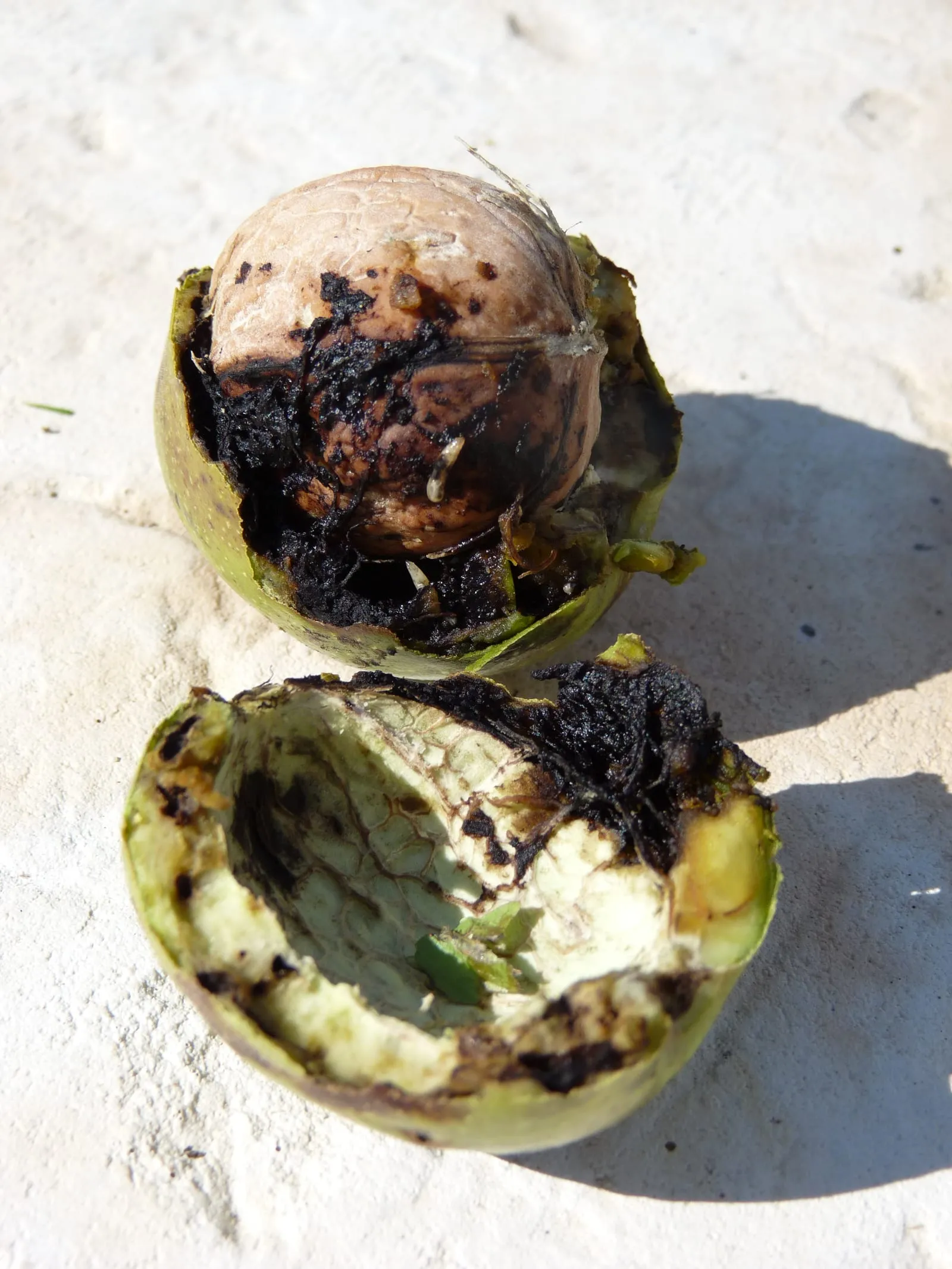
Tephritid fly whose larvae develop inside walnut husks, causing dark staining of the shell and reduced kernel quality.
- Scientific name
- Rhagoletis completa
- Hosts
- 2
- Identification signs
- 3
- Controls
- 4
Biology and lifecycle
Walnut husk fly (Rhagoletis completa) is a tephritid fly native to the American Southwest that has expanded into most commercial and backyard walnut-growing regions. Adults overwinter as pupae in the soil beneath host trees, emerging in mid-summer, typically late June through July depending on accumulated heat units and local climate. After emergence, adults require 10 to 14 days of feeding and maturation before females begin laying eggs.
Females puncture the green husk with their ovipositor and deposit eggs just beneath the surface. Larvae hatch within a few days and feed inside the husk tissue for three to five weeks. The larvae do not penetrate the shell, but the combination of tunneling, secondary bacterial invasion, and accelerated husk breakdown causes the dark staining that marks the shell and, in heavy infestations, affects kernel color and flavor.
Damage peaks in mid-August through September on early-maturing varieties. Late-maturing trees may escape the heaviest pressure in low-population years, though this is not reliable.
The most cost-effective management window is the adult flight period, before significant egg laying begins. Yellow sticky traps baited with ammonium carbonate or torula yeast are the standard monitoring tool. First consistent trap catch, generally mid-July to early August, signals that protective measures are warranted. A single well-timed application of spinosad or a kaolin clay barrier at this point is more effective than reactive sprays applied after larvae are already established. Prompt harvest as hulls begin to split is the most practical non-chemical option; larvae cannot complete development once the husk is disrupted. Removing or burying fallen nuts and spent hulls reduces the overwintering pupal load for the following season.
Signs to watch for
- ▸ Soft dark spots on hulls in late summer
- ▸ Black-stained shells after husk removal
- ▸ Maggots in the husk when split open
IPM controls
- ✓ Yellow sticky traps with ammonium baits for monitoring
- ✓ Targeted spray at first catch in mid-July to early August
- ✓ Prompt harvest as hulls split
- ✓ Sanitation of fallen nuts and infested hulls
Affected crops
Image: "Rhagoletis completa in walnut-01", by Walpole, via Wikimedia Commons, licensed under CC-BY Source.

Related