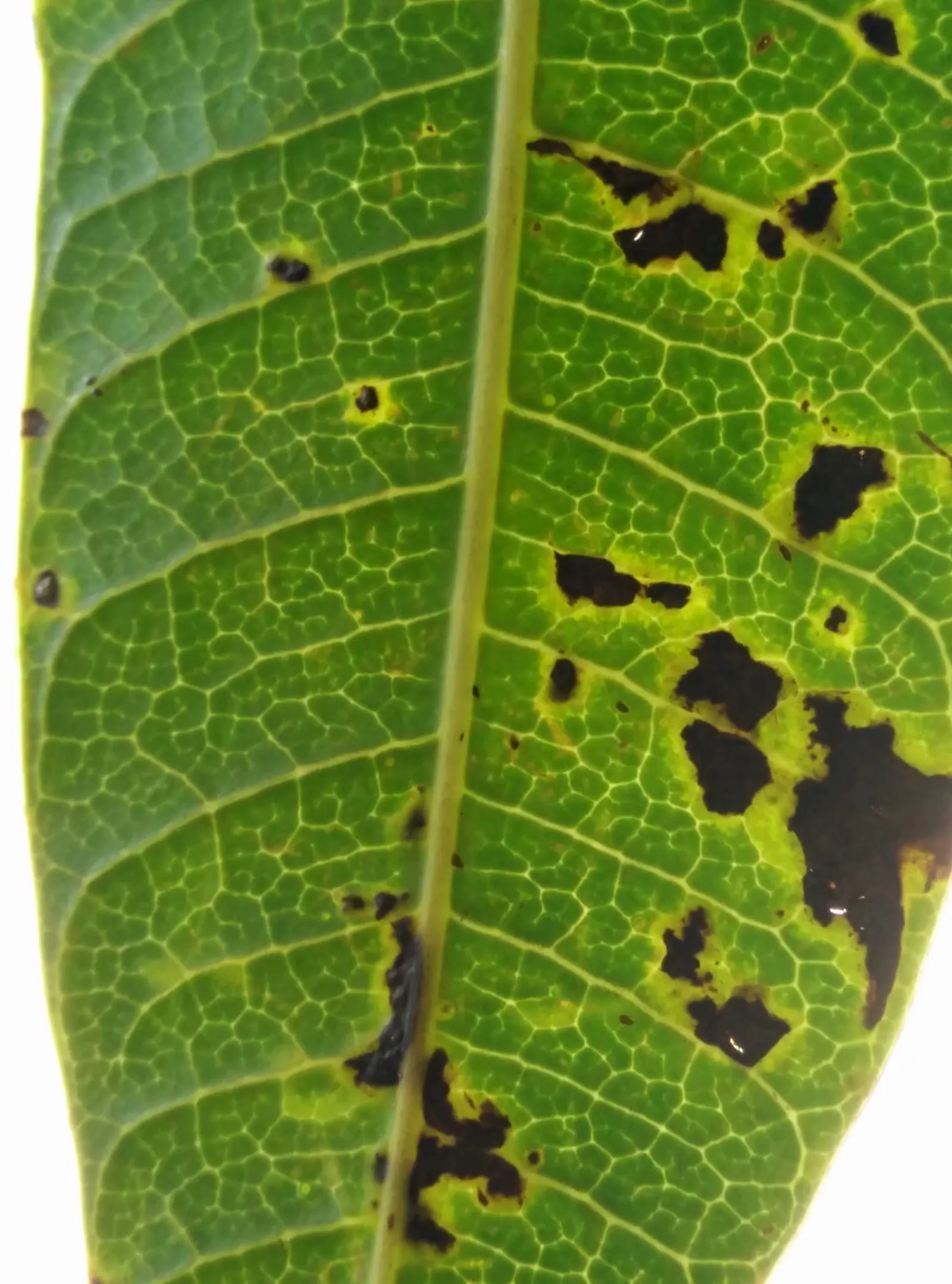
Disease
bacterialCitrus Canker
Xanthomonas citri
Bacterial disease producing raised corky lesions on leaves, twigs, and fruit. Spread by wind-driven rain and contaminated tools. Quarantine-regulated in many areas.
- Pathogen type
- Bacterial
- Hosts
- 4
- Symptoms
- 3
- Scientific name
- Xanthomonas citri
- Resistant varieties
- 0
Biology and conditions
Citrus canker is caused by the bacterium Xanthomonas citri, which colonizes young leaf tissue, green twigs, and developing fruit, producing the disease's signature raised, corky tan lesions ringed by water-soaked margins and yellow halos. Unlike many fungal pathogens, this bacterium does not require an extended wet period to infect; wind-driven rain events are sufficient to disperse bacterial cells from infected tissue to nearby healthy growth, particularly new flushes. Warm temperatures combined with high humidity accelerate colonization, making spring and summer the highest-risk periods across subtropical and tropical growing regions.
All four commonly grown citrus types, lemon, orange, lime, and grapefruit, are susceptible. Lemons and limes carry the highest susceptibility and tend to show more severe defoliation and twig dieback under heavy canker pressure. Some orange selections show moderate tolerance, though "resistant" in this context means reduced severity, not immunity.
In parts of Florida and Texas, citrus canker is classified as a quarantine pest. Confirmed infections can trigger mandatory tree removal orders under state plant health programs. Growers in those states should verify current regulations with their state department of agriculture before planting or relocating citrus material.
The most cost-effective management combines two low-overhead practices: eliminating overhead irrigation to remove the primary splash-spread mechanism, and sanitizing pruning tools with 70 percent alcohol or a 10 percent bleach solution between trees. Copper-based bactericides applied preventively before wet weather provide additional protection but require consistent timing to be effective. Remove and destroy infected tissue rather than composting it.
Symptoms
- ▸ raised corky tan lesions surrounded by yellow halos on leaves and fruit
- ▸ premature defoliation
- ▸ twig dieback in severe cases
IPM controls
- ✓ Plant resistant varieties where available; lemons and limes are highly susceptible
- ✓ Avoid overhead irrigation; rain splashes spread bacteria
- ✓ Copper-based bactericides applied preventively during wet weather
- ✓ Sanitize pruning tools between trees with 70 percent alcohol or 10 percent bleach
Affected crops
Image: "Bacterial black spot of mango caused by Xanthomonas citri pv. mangiferae indicae (34846737063)", by Scot Nelson, via Wikimedia Commons, licensed under CC0 Source.
.jpg)
Related