Grafting pair
excellent compatibilityKieffer
on Pyrus calleryana rootstock
- Compatibility
- Excellent
- Tree size
- Standard
- Mature height
- 20–30 ft
- Crop
- Pear
Compatibility and disease notes
P. calleryana provides fire-blight tolerance and adaptation to southern soils. Avoid in regions where Callery pear is invasive.
Overview
Kieffer on Pyrus calleryana is a well-established combination for the Southeast, Gulf Coast, and Lower Midwest, where shallow clay soils and summer humidity challenge standard European pear rootstocks. P. calleryana contributes fire-blight tolerance and strong adaptation to wet, poorly drained sites where other common rootstocks would struggle. The resulting tree reaches 20 to 30 feet at maturity, behaving as a full-standard tree that warrants 20 to 25 feet between trees at planting.
Kieffer itself carries above-average fire-blight resistance among common pear varieties, so the combination provides two layers of disease defense at a time when fire blight pressure in southern orchards routinely runs high. NC State Pear Production identifies Kieffer as a primary recommended variety for North Carolina growing conditions, with P. calleryana noted as a well-suited rootstock for heavier soils.
One regional constraint applies: Callery pear is designated invasive in several mid-Atlantic and Midwestern states. Growers in those areas should verify local regulations before planting or source sterile-fruited rootstock selections where available.
Best regions
Step-by-step grafting guide
The most reliable grafting window falls in late winter to early spring, after the rootstock breaks dormancy but while scion wood is still fully dormant. In the Southeast, this typically lands between late February and late March depending on elevation and local weather. Collect scion wood in January or early February from the previous season's growth, when the wood is fully hardened; store refrigerated in damp paper towels inside a sealed bag until grafting day.
For bench grafting on dormant rootstock liners, whip-and-tongue grafting works well when scion and rootstock diameters are closely matched (3/8 to 5/8 inch). Cut both pieces at a matching 45-degree angle, then add a tongue cut parallel to the grain on each face to interlock them. Cambium alignment on at least one side is the minimum success criterion; aligning both sides doubles the callus contact area and meaningfully improves take rates.
For field grafting onto established P. calleryana rootstock where diameter mismatch is likely, cleft grafting in early spring is more forgiving. Split the rootstock stub cleanly, insert two scion wedges at the cambium layer on opposite sides of the cleft, and seal immediately with parafilm or grafting wax. Leave both scion pieces in place until one shows active growth, then remove the weaker after 6 weeks.
Wrap all grafts with parafilm or budding tape and seal with grafting wax to exclude air and moisture. Label with scion variety and date. Expect callus bridging within 3 to 5 weeks under warm conditions; swelling buds on the scion are the primary success indicator.
Common failure modes
The three most common failure points with this combination are delayed union breakdown, aggressive rootstock suckering, and inadequate cambium contact during grafting.
Delayed incompatibility is uncommon but documented in some Kieffer grafts: initial union formation looks sound but the tree fails at the graft junction 3 to 8 years after planting, often signaled by bark cracking or a pronounced step in diameter at the union. Annual inspection of the graft zone catches this early.
P. calleryana suckers aggressively, especially after root disturbance from cultivation or mowing. Suckers must be removed at the root origin as soon as they appear; cutting at soil level leaves latent buds that reshoot within weeks. Left unmanaged, rootstock suckers can overtake the scion over several seasons and revert the planting to wild Callery pear.
Poor cambium contact during grafting is the most common cause of early failure. Whip-and-tongue cuts that slip before wrapping, or cleft grafts seated too far toward center rather than at the cambium margin, produce weak callus bridges that fail under the weight of the first summer's flush of growth.
Sources
Related
Related grafts
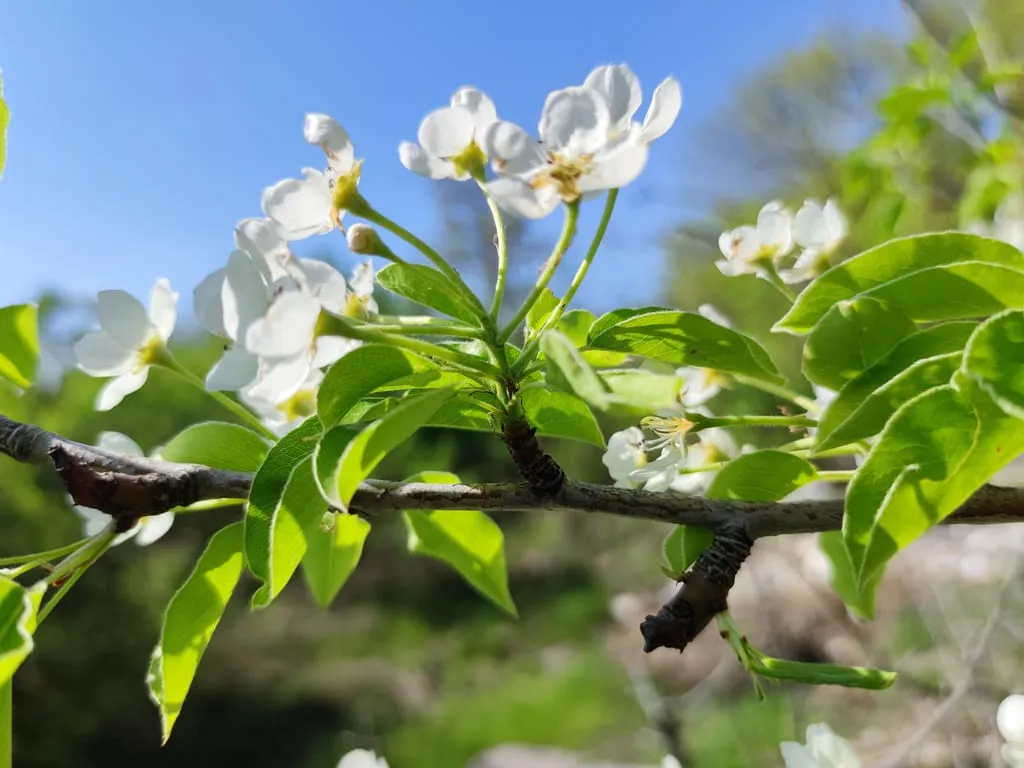
Image: "Груша обыкновенная", by Vasily Moryashkin, via iNaturalist, licensed under CC-BY. Source.