Grafting pair
excellent compatibilityMontmorency
on Mahaleb rootstock
- Compatibility
- Excellent
- Tree size
- Standard
- Mature height
- 15–20 ft
- Crop
- Sour Cherry
Compatibility and disease notes
Mahaleb is the standard sour-cherry rootstock; tolerates drought and well-drained soils. Susceptible to wet feet.
Overview
Montmorency on Mahaleb is the foundational sour cherry combination in North American orchards, carrying a track record of over a century in commercial and home settings. The pairing produces trees in the 15 to 20 foot range at maturity, large enough to bear substantial crops while remaining manageable with standard orchard equipment and ladders. Compatibility is rated excellent: the graft union forms reliably, callus bridging proceeds quickly, and long-term union integrity is rarely a concern.
Mahaleb (Prunus mahaleb) contributes drought tolerance and strong anchoring on well-drained soils. It performs best in the Upper Midwest, Northeast, and Great Lakes regions, where cold winters and loamy to sandy-loam soils align with its preferences. On heavy clay or chronically wet sites, the picture changes. Mahaleb roots are susceptible to crown rot where soils stay saturated for extended periods, and performance deteriorates accordingly. Site drainage is not a secondary consideration with this rootstock; it is the primary one.
Michigan's commercial tart cherry industry, among the most concentrated in the world, relies heavily on this combination, and Michigan State Tart Cherry Production reflects decades of regional field data on its performance. Home orchardists in the same regions can reasonably expect results consistent with commercial experience, provided drainage is adequate and the planting site receives full sun.
Best regions
Step-by-step grafting guide
Graft Montmorency onto Mahaleb in late winter to early spring, once rootstock buds begin to swell but before they break open. In the Great Lakes and Upper Midwest, that window typically falls between late March and mid-April depending on the season. Bench grafting in a garage or unheated outbuilding is often more reliable than field grafting at this stage because temperature and humidity are easier to manage.
Whip-and-tongue grafting is the standard technique for this combination. Collect scion wood during full dormancy in February, selecting pencil-diameter shoots with plump, healthy buds. Store in a sealed plastic bag with a slightly damp paper towel in a refrigerator until grafting day. Rootstock should match the scion in diameter for a clean whip-and-tongue fit; a slight mismatch toward a larger rootstock is workable with a cleft graft instead.
Tools needed: a sharp grafting knife disinfected with 70% isopropyl alcohol before each graft, Parafilm M or grafting rubber for wrapping, and grafting wax or a commercial sealing compound for exposed cuts.
Procedure for whip-and-tongue: cut matching 45-degree angled faces on scion and rootstock, each 1.5 to 2 inches long. Score a tongue cut through the center of each face. Interlock the tongues with cambium layers aligned on at least one side. Wrap firmly with Parafilm, stretching it slightly as you spiral upward. Seal any exposed cut surfaces.
Success indicators: scion buds should begin pushing within three to four weeks. Callus visible at the union margin by week four to six confirms a take. Leave the wrap in place and allow Parafilm to break down on its own rather than cutting it early.
Common failure modes
Wet soil is the most common cause of failure with Mahaleb rootstock, and it has nothing to do with the graft itself. Phytophthora crown rot infects Mahaleb roots on sites with poor drainage or heavy clay, killing the rootstock regardless of how cleanly the union formed. Trees planted in adequate drainage that later get surrounded by turf, berms, or mulch piled against the trunk can fail years after a successful graft take. Keep the root flare clear and the surrounding grade draining away from the tree.
Rootstock suckering is the second common problem. Mahaleb sends up vigorous suckers below the graft union, particularly after physical disturbance at the root zone from frost heaving, cultivation, or animal damage. Suckers emerging below the union are Mahaleb, not Montmorency, and grow fast enough to crowd out the scion if ignored. Inspect the base of the tree at least twice per growing season during the first five years and remove any suckers flush with their point of origin.
Delayed incompatibility, where union failure appears one to three years after a seemingly successful take, is uncommon with this pairing but does occur occasionally. It tends to show up as a sudden decline in a tree that appeared healthy, sometimes with a visible constriction at the union. There is no reliable remedy; the combination itself is not the cause in most cases, and replanting with fresh material on a different site usually succeeds.
Sources
Frequently asked questions
- Is Mahaleb rootstock suitable for heavy clay soils?
No. Mahaleb has essentially no tolerance for poorly drained or wet soils. Clay sites with standing water, even seasonally, create conditions favorable for crown rot. For heavy soils, Mazzard rootstock is the standard alternative, though it produces larger trees.
- How long before a Montmorency on Mahaleb tree bears fruit?
Bearing typically begins in year three to five after grafting. Standard-size trees on Mahaleb are slower to come into production than semi-dwarf combinations, but yields per tree once established are higher and the trees are longer-lived under favorable conditions.
- What is the best time of year to collect Montmorency scion wood?
Collect scion wood in mid to late February during full dormancy, after the coldest part of winter has passed but well before buds swell. Store refrigerated in a sealed bag with a slightly damp paper towel and graft within four to six weeks.
- Can Montmorency on Mahaleb be grown in zone 5?
Yes. Mahaleb rootstock is cold-hardy and well-suited to zone 5 conditions. The Upper Midwest and Great Lakes regions, which fall largely in zones 5 and 6, represent the core commercial and home-orchard range for this combination.
- How do I tell a rootstock sucker from a scion shoot?
Rootstock suckers on Mahaleb emerge below the graft union, often from the root flare or underground. Mahaleb leaf shape differs from Montmorency: Mahaleb leaves are smaller, rounder, and more glossy. Any vigorous shoot arising below the visible graft bead should be removed regardless of leaf appearance.
+−
+−
+−
+−
+−
Related
Related grafts
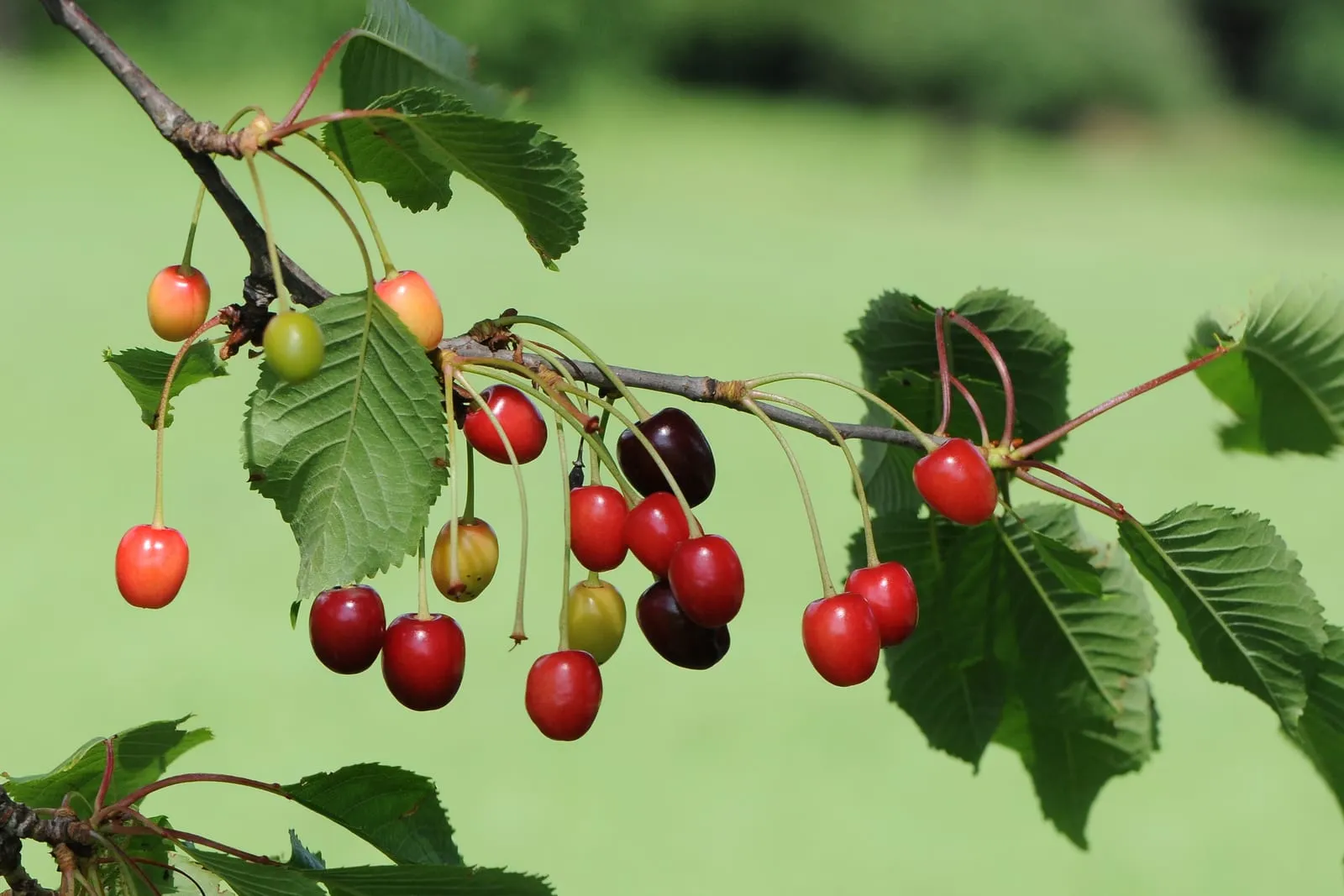
Image: "Sauerkirschenfrucht Prunus cerasus 2", by böhringer friedrich, via Wikimedia Commons, licensed under CC-BY. Source.
