Grafting pair
excellent compatibilityHoneycrisp
on MM.111 rootstock
- Compatibility
- Excellent
- Tree size
- Semi Dwarf
- Mature height
- 14–18 ft
- Crop
- Apple
Compatibility and disease notes
MM.111 has good fire-blight tolerance and crown-rot resistance. Honeycrisp on MM.111 is widely planted in the eastern US for low-input orchards.
Overview
Honeycrisp on MM.111 is the standard low-input combination for the eastern US. MM.111 is a vigorous semi-dwarfing rootstock that produces a tree 14 to 18 feet tall, doesn't require staking past the first two years, and tolerates a wider range of soils than the more popular dwarfs. Pair this with Honeycrisp's excellent eating quality and storage life and you have a backyard tree that produces serious quantities of high-value fruit.
The disease package is solid. MM.111 is fire-blight tolerant and crown-rot resistant, which matters in the humid east where both pressures are real. Honeycrisp's apple-scab susceptibility is the weakness in the combination; plan on a scab spray program or substitute Liberty if you want truly low-input. See the Cornell Apple Rootstock Guide for full performance data.
Best regions
Step-by-step grafting guide
Whip-and-tongue is the standard graft for Honeycrisp on MM.111 nursery stock. Time it for late February through early March, while both scion and rootstock are dormant.
- Collect scionwood in January from healthy current-year shoots, store wrapped in damp paper in a refrigerator at 32 to 40°F.
- Trim the rootstock 8 to 12 inches above the soil line at graft time, choosing a section of stem the same diameter as your scionwood (typically 1/4 to 3/8 inch).
- Make a smooth diagonal cut 1.5 to 2 inches long on both pieces. Cut a tongue (a downward slit on the rootstock cut, an upward slit on the scion) and interlock them.
- Match the cambium layer carefully on at least one side. Wrap with parafilm or grafting tape from below the union to above, sealing all cut surfaces.
- Wait 4 to 6 weeks. Buds should swell and shoot growth begin by mid-May. If wrap is impeding shoot growth, slit it carefully.
Common failure modes
Three common failures. First, mismatched cambium layers. The scion fails to take and the union dries out. Practice on dormant prunings before doing it on a real rootstock.
Second, late-season grafting. After bud swell on the rootstock, success rates drop sharply. Stay in the dormant window.
Third, vigor mismatch in poor soils. MM.111 wants reasonable drainage; in heavy wet soils, switch to G.41 or M.7 (with crown-rot caveats). Honeycrisp can also show bitter pit in calcium-deficient soils regardless of rootstock; soil amendment with gypsum and balanced calcium nutrition help.
Sources
Frequently asked questions
- How long until Honeycrisp on MM.111 produces?
Light crop in year 4, full production by year 6 to 7. MM.111 is later to bear than dwarf rootstocks like G.41 (year 2) but produces a longer-lived tree.
- Does Honeycrisp on MM.111 need staking?
Light staking for the first two years to keep the trunk straight. After that the tree is self-supporting; no permanent trellis needed unlike dwarf rootstocks.
+−
+−
Related
Related grafts
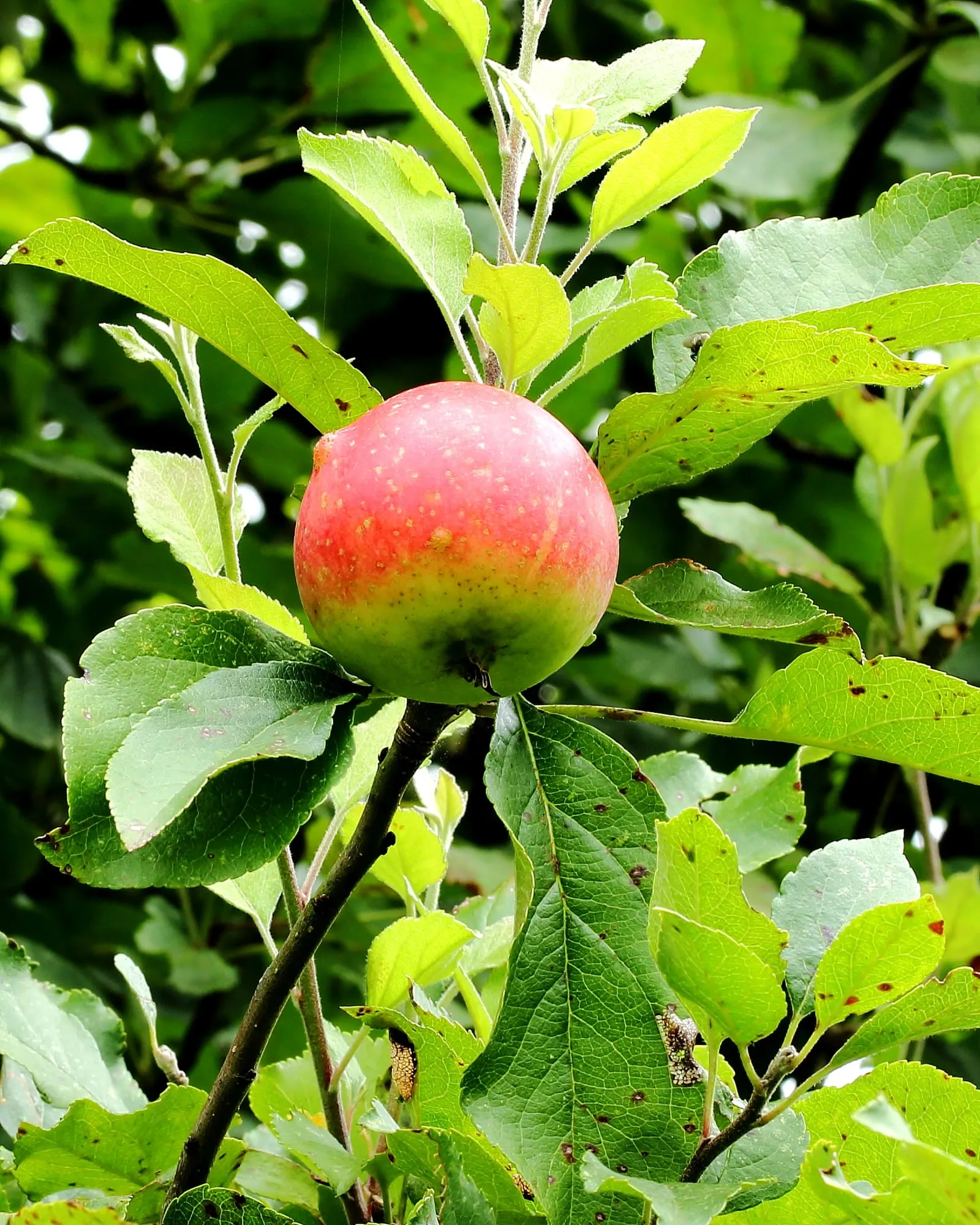
Image: "Malus domestica 'Stark's Earliest'. Locatie De Kruidhof 02", by Dominicus Johannes Bergsma, via Wikimedia Commons, licensed under CC-BY. Source.
