Grafting pair
good compatibilityLiberty
on M.7 rootstock
- Compatibility
- Good
- Tree size
- Semi Dwarf
- Mature height
- 12–16 ft
- Crop
- Apple
Compatibility and disease notes
M.7 is widely adapted but suckers and is susceptible to crown rot in wet sites. Liberty's disease resistance pairs well for low-spray orchards.
Overview
Liberty on M.7 is a practical semi-dwarf combination suited to backyard orchardists and small-scale commercial growers in the Northeast, Mid-Atlantic, and Southeast. The pairing produces trees reaching 12 to 16 feet at maturity, manageable for hand-picking without tall equipment when trained to a central leader or open-center form.
Liberty, released by Cornell in 1978, carries strong field resistance to apple scab, powdery mildew, cedar apple rust, and fire blight. M.7 is a widely adapted semi-dwarfing rootstock that establishes well without staking in most mineral soils. According to WSU Apple Rootstock Selection, M.7 is among the most broadly planted semi-dwarfing rootstocks in North America, valued for precocity and anchorage.
The combination fits low-spray orchard programs particularly well. Liberty's disease resistance reduces reliance on fungicide rotations, and M.7's tolerance for clay-heavy or imperfectly drained soils common in the Southeast and Mid-Atlantic makes it forgiving on sites where more demanding rootstocks struggle. The one site condition to avoid is standing water or sustained soil saturation; M.7's susceptibility to Phytophthora crown rot limits its value in those situations.
Best regions
Step-by-step grafting guide
Whip-and-tongue grafting is the standard approach for Liberty on M.7 when working with dormant bench-grafted material. The timing window is late winter, typically February through early March in zones 6 and 7, and early to mid-March in zones 4 and 5. Both scion and rootstock should be fully dormant with buds tight, not yet swelling.
Materials needed: a sharp, thin-bladed grafting knife; grafting tape or parafilm; scion wood collected in January or early February and stored wrapped in lightly damp paper inside a sealed bag at 34 to 38 degrees F; M.7 rootstock whips with a caliper of 5/16 to 3/8 inch. Scion and rootstock should match in diameter as closely as possible.
The cut: make a long, smooth, slightly angled slice through each piece, 1.5 to 2 inches in length. Follow with a tongue cut: a second, shorter cut made approximately one-third of the way down the face of the first cut, running parallel to the grain. Interlock the tongues and confirm that the cambium layers align on at least one side of the union. Wrap immediately with grafting tape, covering the full length of the cut surfaces without gaps.
Place grafted material in a humid environment at 65 to 75 degrees F for 7 to 10 days to encourage callusing, then move to cold storage or plant out once frost risk has passed. At 3 to 4 weeks, swelling and break of scion buds confirm a live union. A scion that shrivels without bud movement indicates union failure.
Common failure modes
Three failure modes account for most losses with this combination.
Suckering from M.7 rootstock is persistent. Suckers emerge at and below the graft union; if not removed at the point of origin rather than cut at soil level, they outcompete the Liberty scion and reduce fruit production. Monitoring below the union during the first three years is standard practice on this rootstock.
Crown rot is the second risk. M.7 has documented susceptibility to Phytophthora cactorum and P. cambivora. On sites with poorly drained soil, compacted clay, or low spots that collect water after rain, the rootstock can develop collar rot that girdles the tree within two to four years. Planting on a raised bed or mound mitigates this on marginal sites; in persistently wet soils, a more tolerant rootstock is the better choice.
Graft union failure from inadequate cambium contact is the third. Poor alignment, a dull knife producing torn rather than cut surfaces, or drying of cut surfaces during grafting all reduce callus formation. A success rate below 60 percent on an otherwise healthy batch typically points to technique rather than physiological incompatibility, since Liberty and M.7 are not known to exhibit true graft incompatibility.
Sources
Frequently asked questions
- Does Liberty on M.7 need a support stake?
M.7 has reasonable anchorage compared to more dwarfing rootstocks, but staking for the first two to three years is still advisable, particularly on sandy soils or sites with wind exposure. Once the root system establishes, most trees on M.7 become self-supporting.
- How long before a Liberty on M.7 tree bears fruit?
M.7 is considered a precocious rootstock. Expect light cropping in years 2 to 3 and a meaningful harvest by year 4 to 5, depending on training system and soil fertility. Central leader and spindle forms tend to come into bearing faster than open-center forms.
- Is Liberty on M.7 suitable for organic or low-spray production?
Yes. Liberty's resistance to scab, rust, and fire blight removes the primary spray drivers in humid climates. M.7's adaptability to heavier soils makes it a reasonable choice for sites that cannot be extensively amended. The main disease risk to manage is Phytophthora on wet sites, which is a site selection issue rather than a spray program issue.
- What spacing works for Liberty on M.7?
Typical spacing is 10 to 14 feet between trees and 16 to 18 feet between rows for an open-center or modified central leader system. Tighter spacing is possible with a trellised spindle system but requires consistent summer pruning to manage canopy density.
+−
+−
+−
+−
Related
Related grafts
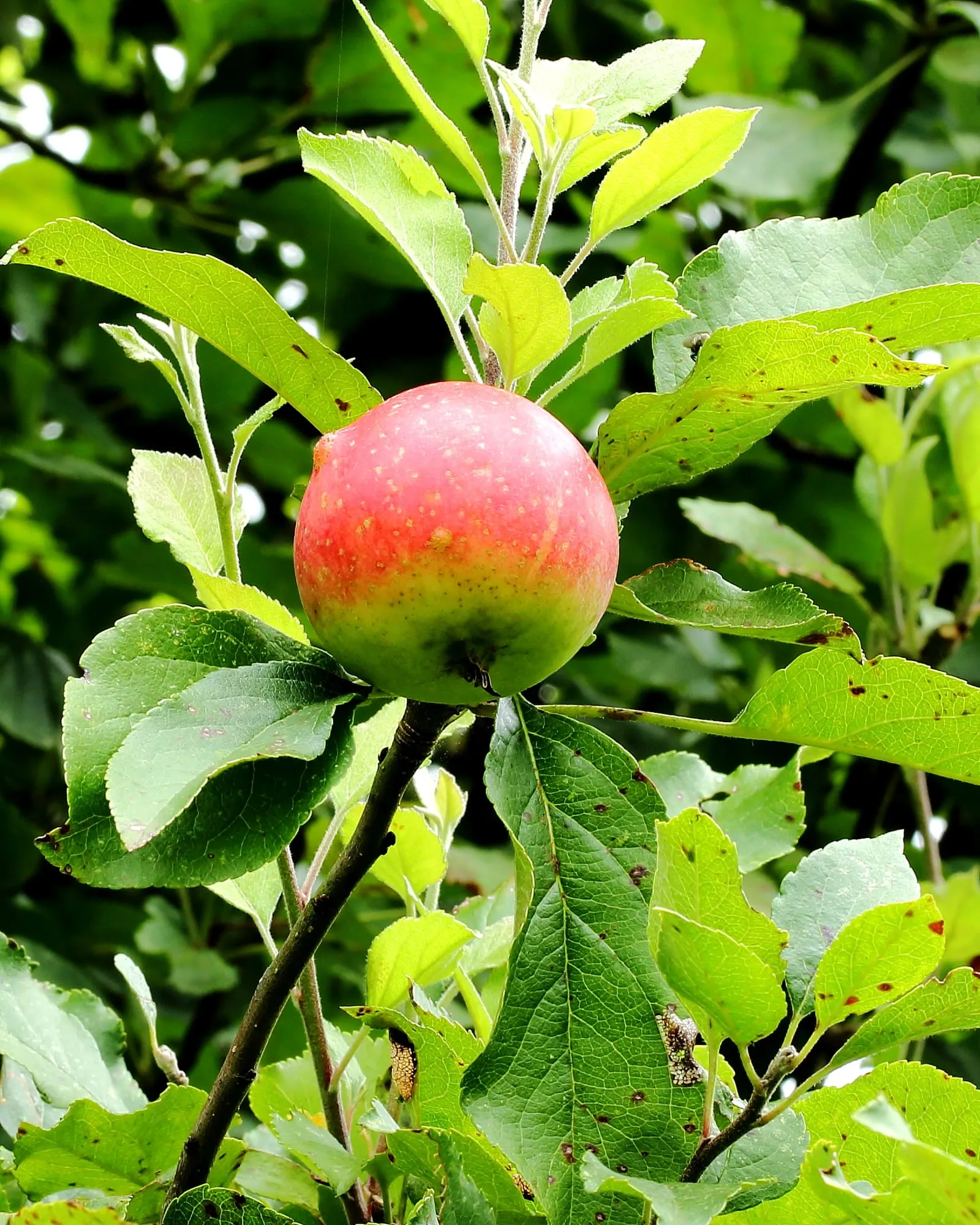
Image: "Malus domestica 'Stark's Earliest'. Locatie De Kruidhof 02", by Dominicus Johannes Bergsma, via Wikimedia Commons, licensed under CC-BY. Source.
