Grafting pair
excellent compatibilityItalian Prune
on Myrobalan rootstock
- Compatibility
- Excellent
- Tree size
- Standard
- Mature height
- 15–20 ft
- Crop
- European Plum
Compatibility and disease notes
Myrobalan tolerates heavier soils than St. Julien. Italian Prune is well-matched for cold-climate dual-purpose orchards.
Overview
Italian Prune (Prunus domestica) on Myrobalan (Prunus cerasifera) is a classic combination for cold-climate dual-purpose orchards where heavy or clay-prone soils complicate rootstock selection. The pairing rates as excellent for compatibility, producing a standard-size tree reaching 15 to 20 feet at maturity, which suits growers who prefer a traditional orchard structure with room for ladders and ground maintenance equipment underneath.
Myrobalan's principal advantage over alternatives such as St. Julien A is its tolerance of heavier, wetter soils that cause waterlogging stress in more sensitive rootstocks. This trait matters in the Pacific Northwest and parts of the Upper Midwest, where spring drainage is slow and soils remain saturated well into the grafting window. In the Northeast, the combination holds up through cold winters, with Myrobalan's deep root system providing reliable anchorage and reasonable cold hardiness.
According to the Oregon State Stone Fruit Rootstocks guide, Myrobalan is among the most vigorous plum-compatible rootstocks in production use, and Italian Prune is reliably productive on it across a range of elevations and climates. Growers producing both fresh-market and drying fruit favor this combination for its yield consistency over decades. The trade-off is tree size: at full standard height, management requires more labor than semi-dwarfing alternatives.
Best regions
Step-by-step grafting guide
When to graft: The most reliable window is late February through mid-March in the Pacific Northwest and Northeast, when both scion and rootstock are dormant but the rootstock is just beginning to stir. In the Upper Midwest, delay until early to mid-April once overnight temperatures hold reliably above 20°F. Grafting too early into a hard freeze stalls callus formation; grafting too late into active growth reduces success rates.
Technique: Whip-and-tongue is the preferred method for pencil-diameter Myrobalan seedling or clonal rootstock. Cleft grafting works for topworking established trees.
Tools needed: A sharp, thin-bladed grafting knife dedicated to whip-and-tongue cuts; grafting tape or parafilm-style stretch tape; grafting wax for any exposed cut faces; a clean cutting surface.
Scion preparation: Collect pencil-diameter scion wood from healthy Italian Prune growth from the previous season in January or early February, before any bud swell. Store in a sealed plastic bag with a slightly damp paper towel at 34 to 38°F. Do not freeze scion wood.
Making the cuts: On both rootstock stub and scion piece, cut a smooth diagonal face 1.5 to 2 inches long at matching angles. From the midpoint of each face, cut a locking tongue. Mate the two pieces so at least one side achieves cambium-to-cambium contact. Single-side cambium alignment is sufficient; both sides improve take rates.
Wrapping and follow-up: Wrap firmly from the base of the union to just above the topmost scion bud. Wax any exposed surfaces. Scion bud push at 3 to 5 weeks confirms a take. Remove wrapping at 6 to 8 weeks once the union is visibly callused.
Common failure modes
Suckering from the rootstock is the most persistent problem with Myrobalan. It produces vigorous root suckers, especially after soil disturbance or mowing damage to shallow roots. Suckers left unchecked can outcompete the scion within a season. Consistent removal throughout the growing season, particularly during the first three years, is not optional on this rootstock.
Insufficient cambium contact accounts for the majority of outright graft failures. Whip-and-tongue cuts that are too short (under 1 inch), poorly matched in angle, or made with a dull knife reduce the contact surface. A graft may push buds initially from scion reserves while appearing to have taken, then collapse once those reserves exhaust before a functional vascular connection forms. Sharpness of the knife and precision of the tongue interlock are the two most controllable variables.
Rootstock variability in seedling lots is a less obvious but real failure mode. Myrobalan seedling rootstocks show more variation in cold hardiness, soil adaptation, and vigor than clonal selections. Where available, clonal Myrobalan 29C reduces that unpredictability. Seedling lots from unverified sources can produce trees of inconsistent size and performance within the same planting.
Sources
Frequently asked questions
- Is Italian Prune compatible with Myrobalan rootstock?
Yes, the combination is rated excellent for compatibility. Italian Prune establishes reliably on Myrobalan and produces a standard-size tree at 15 to 20 feet. The Oregon State Stone Fruit Rootstocks guide lists Myrobalan among the most widely used plum-compatible rootstocks.
- What size tree does Italian Prune on Myrobalan produce?
Expect a standard-size tree reaching 15 to 20 feet at maturity without significant size-controlling pruning. Myrobalan is a vigorous rootstock and does not dwarf the scion. Growers with limited space should consider semi-dwarfing alternatives such as St. Julien A.
- Does Myrobalan rootstock tolerate wet or clay soils?
Myrobalan is notably more tolerant of heavy, poorly drained soils than St. Julien A or Marianna 2624. It is a common choice in the Pacific Northwest and Upper Midwest precisely because of that tolerance, though standing water through the growing season will stress any stone fruit rootstock.
- What is the best time of year to graft Italian Prune on Myrobalan?
Late February through mid-March in the Pacific Northwest and Northeast; early to mid-April in the Upper Midwest. Graft while both scion and rootstock are dormant but just before the rootstock pushes in spring. Cold snaps after grafting slow callus formation without necessarily killing a well-wrapped union.
- Why is my Myrobalan rootstock sending up suckers after grafting?
Suckering is a characteristic of Myrobalan, not a sign that something went wrong with the graft. Root disturbance from mowing, cultivation, or animal activity tends to trigger more vigorous suckering. Remove suckers as they appear rather than letting them develop, since established suckers are harder to remove without further root damage.
+−
+−
+−
+−
+−
Related
Related grafts
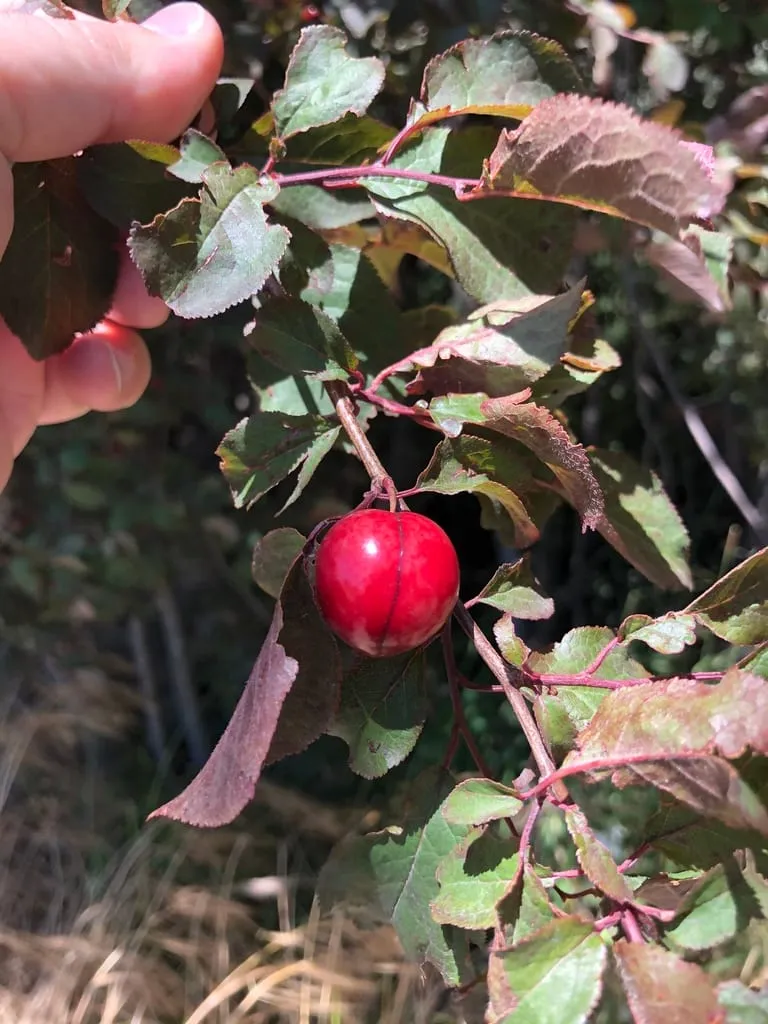
Image: "Plum", by Nathan Odgers, via iNaturalist, licensed under CC-BY. Source.