Grafting pair
excellent compatibilityStanley
on Myrobalan rootstock
- Compatibility
- Excellent
- Tree size
- Standard
- Mature height
- 15–20 ft
- Crop
- European Plum
Compatibility and disease notes
Myrobalan is the standard plum rootstock; tolerates heavy soils, broadly adapted. Suckers somewhat.
Overview
Stanley on Myrobalan is a classic, broadly adapted combination that produces a full-sized tree with excellent compatibility between scion and rootstock. Myrobalan (Prunus cerasifera) has been the standard plum rootstock in North America for generations, valued for its wide soil adaptability and particular tolerance of heavy clay conditions where other rootstocks struggle. The resulting trees reach 15 to 20 feet at maturity, well suited to home orchards and small-scale commercial plantings where full-size production is the goal.
Stanley is one of the most widely planted European freestone plums, prized for reliable crops of blue-black, dual-purpose fruit. Pairing it with Myrobalan reinforces the variety's natural tendency toward productive crops with minimal coddling. The combination performs well across the Northeast, Mid-Atlantic, and Midwest, regions where Stanley's moderate chill requirement and Myrobalan's cold hardiness align with local conditions.
According to Cornell Plum Rootstocks, Myrobalan rootstocks are among the most reliable choices for European plums in eastern North America, offering broad adaptability without the sensitivity to wet soils that affects some dwarfing alternatives.
Best regions
Step-by-step grafting guide
For Stanley on Myrobalan, cleft grafting is the most reliable method when working with rootstock stems 1/2 inch or larger in diameter. Whip-and-tongue grafting suits pencil-diameter material (3/8 to 5/8 inch) when scion and rootstock diameters can be closely matched.
Timing: Graft in late winter to early spring, when rootstock buds are just beginning to swell but have not yet broken. In the Northeast and Mid-Atlantic, this typically falls between late February and late March. Scion wood should be collected during full dormancy (December through January) and stored refrigerated in damp cloth or peat moss until graft day. Do not use scion wood that has begun to push buds.
Tools: Sharp grafting knife, pruning saw or loppers for cleft grafts, parafilm or grafting tape, and grafting wax or sealant for exposed wood surfaces. Sterilize all cutting edges between cuts with 70% isopropyl alcohol.
Cleft method: Make a level cross-cut on the rootstock. Split the stub 1.5 to 2 inches deep. Prepare two scion pieces, each with 2 to 3 dormant buds, shaped into a long tapered wedge. Insert scions at both edges of the cleft, aligning the cambium on at least one side of each scion. Wrap all exposed wood and seal with grafting wax.
Success criteria: Bud swell on the scion within 4 to 6 weeks indicates a successful union. Once the stronger scion shows sustained growth, remove the secondary scion cleanly to concentrate vigor.
Common failure modes
The most common failure with this combination is suckering from the Myrobalan rootstock. Myrobalan produces vigorous root suckers throughout the growing season; if left unchecked, suckers can outcompete the scion within a few years and revert the tree to an unproductive wild form. Remove any growth emerging from below the graft union promptly, cutting as close to the root as practical rather than simply breaking the sucker off at the soil surface.
The second failure mode is cambium misalignment during cleft grafting. Myrobalan stems can carry thick bark relative to pencil-sized scion wood, making it easy to seat the scion wedge too far inward. Even partial cambium contact will produce a weak, slow union prone to failure under wind stress or heavy crop loads. Orient the scion so the outer edge of the wedge is flush with the outer surface of the rootstock stem.
Cold injury to a newly formed union during the first winter is a lesser but real risk in the northern Midwest and upper Northeast, where hard freezes in March can damage a union before it has fully callused. Tree wrap or a plastic union guard through the first winter reduces this risk substantially.
Sources
Frequently asked questions
- Is Stanley compatible with Myrobalan rootstock?
Yes, the combination is rated excellent for compatibility. Myrobalan is the standard rootstock for European plums across North America and produces reliable unions with Stanley with no documented incompatibility issues.
- How large will a Stanley tree on Myrobalan grow?
Expect a standard-sized tree reaching 15 to 20 feet at maturity. Myrobalan does not provide dwarfing; site and prune accordingly if space is limited.
- When is the best time to graft Stanley on Myrobalan?
Late February through late March in most of the Northeast, Mid-Atlantic, and Midwest, when rootstock buds are just beginning to swell. Collect scion wood in December or January while fully dormant and refrigerate it until grafting.
- Does Myrobalan rootstock sucker badly?
Myrobalan is known to produce root suckers, which is its primary management drawback. Inspect the base of the tree several times per season and remove suckers at the root source rather than breaking them at soil level, which encourages re-sprouting.
- What soil conditions suit Myrobalan rootstock?
Myrobalan is broadly adapted and notably tolerant of heavy clay soils where other rootstocks decline. It handles moderate drainage issues better than most alternatives, making it a practical default choice across the eastern US.
+−
+−
+−
+−
+−
Related
Related grafts
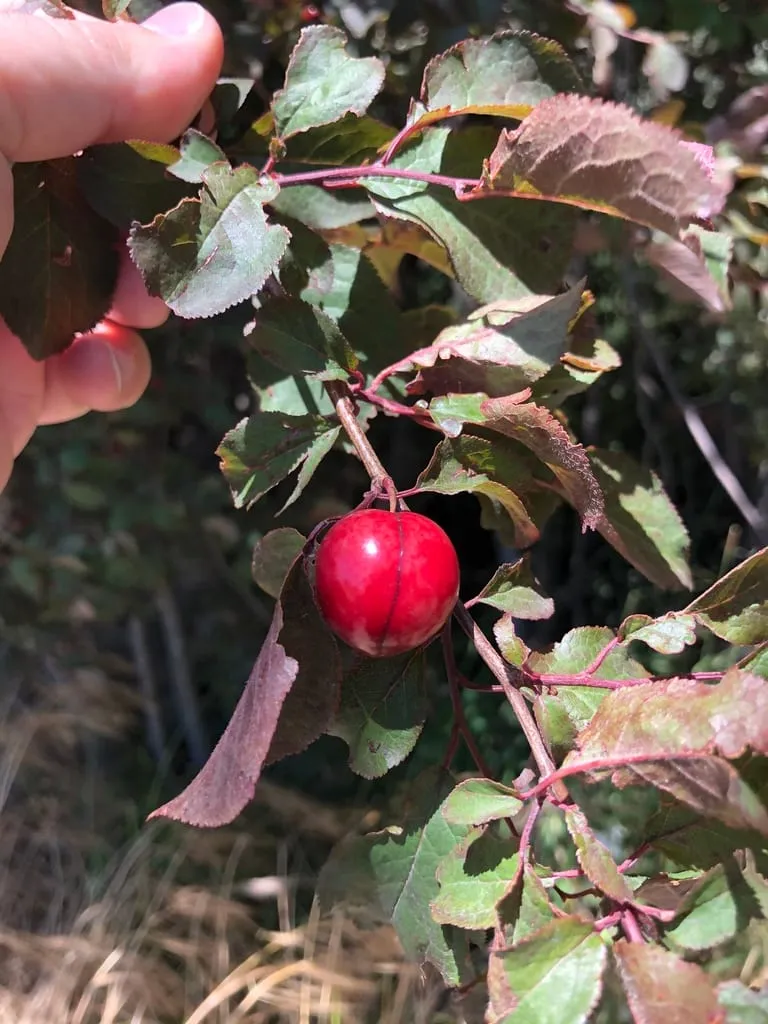
Image: "Plum", by Nathan Odgers, via iNaturalist, licensed under CC-BY. Source.