Grafting pair
excellent compatibilityRedhaven
on Krymsk 86 rootstock
- Compatibility
- Excellent
- Tree size
- Semi Dwarf
- Mature height
- 12–16 ft
- Crop
- Peach
Compatibility and disease notes
Krymsk 86 tolerates wet soils, cold-hardy, suitable for replant sites. Increasingly popular in eastern peach production.
Overview
Redhaven grafted onto Krymsk 86 is one of the more dependable combinations available for eastern peach producers working on difficult ground. The pairing carries an excellent compatibility rating, producing semi-dwarf trees that settle into the 12- to 16-foot range at maturity. That size suits hand-harvest operations without sacrificing the precocity Redhaven is known for.
Krymsk 86 tolerates wet, poorly drained soils better than most peach rootstocks, and its cold hardiness extends the range of viable planting sites in the Northeast and Upper South. On replant sites where peach tree short life syndrome or soil-borne pathogens have been a problem, Krymsk 86 consistently outperforms Lovell and Halford under comparable conditions. Cornell Stone Fruit Rootstocks identifies this rootstock as increasingly common in mid-Atlantic production systems, driven largely by its wet-soil and replant tolerance.
The combination is best matched to the Northeast, Mid-Atlantic, and Upper South, where heavier soils and cold winters are the norm. Growers on sandy, well-drained southeastern soils gain little advantage from Krymsk 86's drainage tolerance and may find other rootstocks more appropriate.
Best regions
Step-by-step grafting guide
Whip-and-tongue grafting during late winter dormancy produces the highest take rates when working with Krymsk 86 rootstock. Target the window from late February through mid-March in zones 6 and 7, when rootstock callus activity is beginning but neither stock nor scion has broken dormancy. In zone 5, delay until soil temperatures at root depth consistently exceed 40°F.
Collect Redhaven scion wood in January or early February before any bud swell. Wrap in slightly damp paper towels, seal in a plastic bag, and refrigerate at 34 to 38°F. Scion wood held beyond 60 days shows declining viability and should not be used.
Tools needed: a sharp grafting knife (freshly honed), grafting tape or rubber budding strips, and optionally a thin coat of grafting wax over the completed union. Disinfect the blade between cuts with 70% isopropyl alcohol, particularly if working multiple rootstocks.
For the whip-and-tongue cut: make a single smooth bevel cut of 1.5 to 2 inches on both scion and rootstock, then cut the interlocking tongue. Align cambium layers on at least one side. Full circumferential cambium contact is rarely achievable on bench grafts, but one-side alignment is sufficient for a viable union. Wrap firmly and completely, covering all exposed cut surfaces without gaps.
Success criteria: scion buds push within 3 to 5 weeks at ambient temperatures of 60 to 70°F. Visible callus bridging at the union within 2 weeks is a positive sign. Remove or slit the wrap once the union appears fully healed, typically 6 to 8 weeks post-graft.
Common failure modes
The most common failure is scion desiccation before the union calluses. Krymsk 86 forms callus reliably, but if scion wood was stored too long, collected after bud swell began, or wrapped loosely, the scion dries out before vascular connection establishes. This outpaces true graft incompatibility as the primary cause of failure by a wide margin.
Suckering from the rootstock is a persistent management issue, not a one-time problem. Krymsk 86 is vigorous, and suckers emerging below the graft union must be removed as soon as they appear. A sucker left to develop through a full growing season can redirect enough energy to suppress or eventually overtake a young scion.
On heavily infested replant sites, Krymsk 86's improved tolerance should not be mistaken for immunity. The rootstock reduces risk, but growers who skip pre-plant soil preparation on severely compromised ground still encounter reduced establishment rates and stunted early growth. Pre-plant fumigation or solarization remains advisable where replant disease history is severe.
Sources
Frequently asked questions
- When is the best time to graft Redhaven onto Krymsk 86?
Late February through mid-March is the target window in zones 6 and 7, grafting while both stock and scion are still fully dormant. In zone 5, wait until soil temperatures at root depth consistently reach 40°F. Grafting too early in cold, wet soil slows callus formation; grafting after bud swell on the scion dramatically reduces take rates.
- Does Redhaven on Krymsk 86 require staking?
Yes, particularly in the first two to three years. Krymsk 86 produces a less extensive anchor root system than seedling rootstocks, and semi-dwarf trees on this rootstock can lean or shift in wind-exposed sites. A sturdy stake or trellis wire at planting is standard practice in commercial plantings and advisable for home orchards as well.
- Is Krymsk 86 a good choice for a zone 5 site with poorly drained clay soil?
It is one of the better-adapted options for that combination. Krymsk 86's wet-soil tolerance and cold hardiness address the two main stressors on that type of site. That said, standing water for extended periods will stress any peach rootstock. Raised beds or tile drainage to move excess water away from the root zone improves outcomes on heavy clay.
- How large will a Redhaven tree on Krymsk 86 get at maturity?
Expect a mature height of 12 to 16 feet under typical management. Final size varies with soil fertility, irrigation, and pruning practices. Trees on high-fertility irrigated ground tend toward the upper end of that range; trees on lean, dry sites stay smaller.
+−
+−
+−
+−
Related
Related grafts
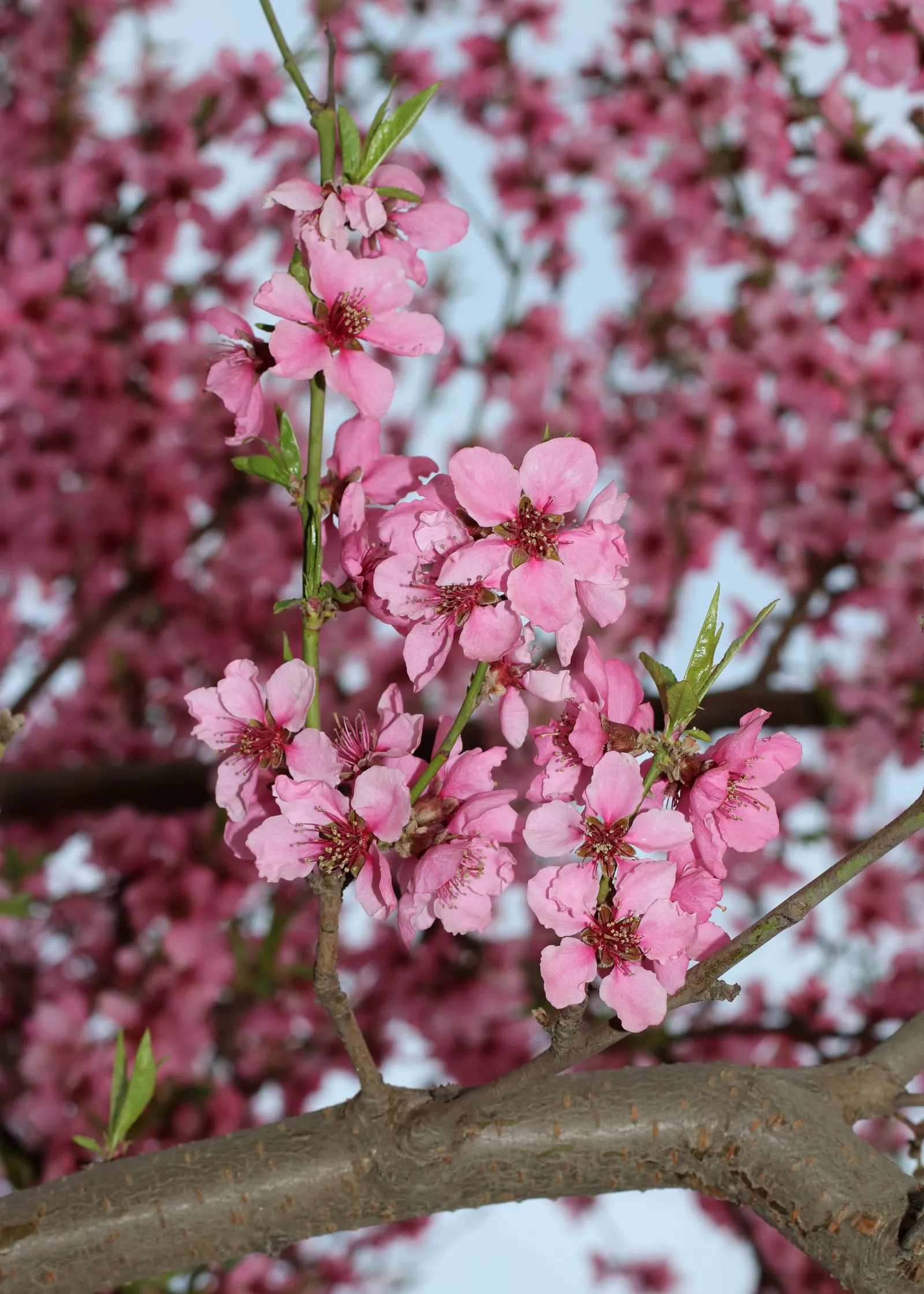
Image: "Peach flowers 2020 G1", by George Chernilevsky, via Wikimedia Commons, licensed under CC-BY. Source.
