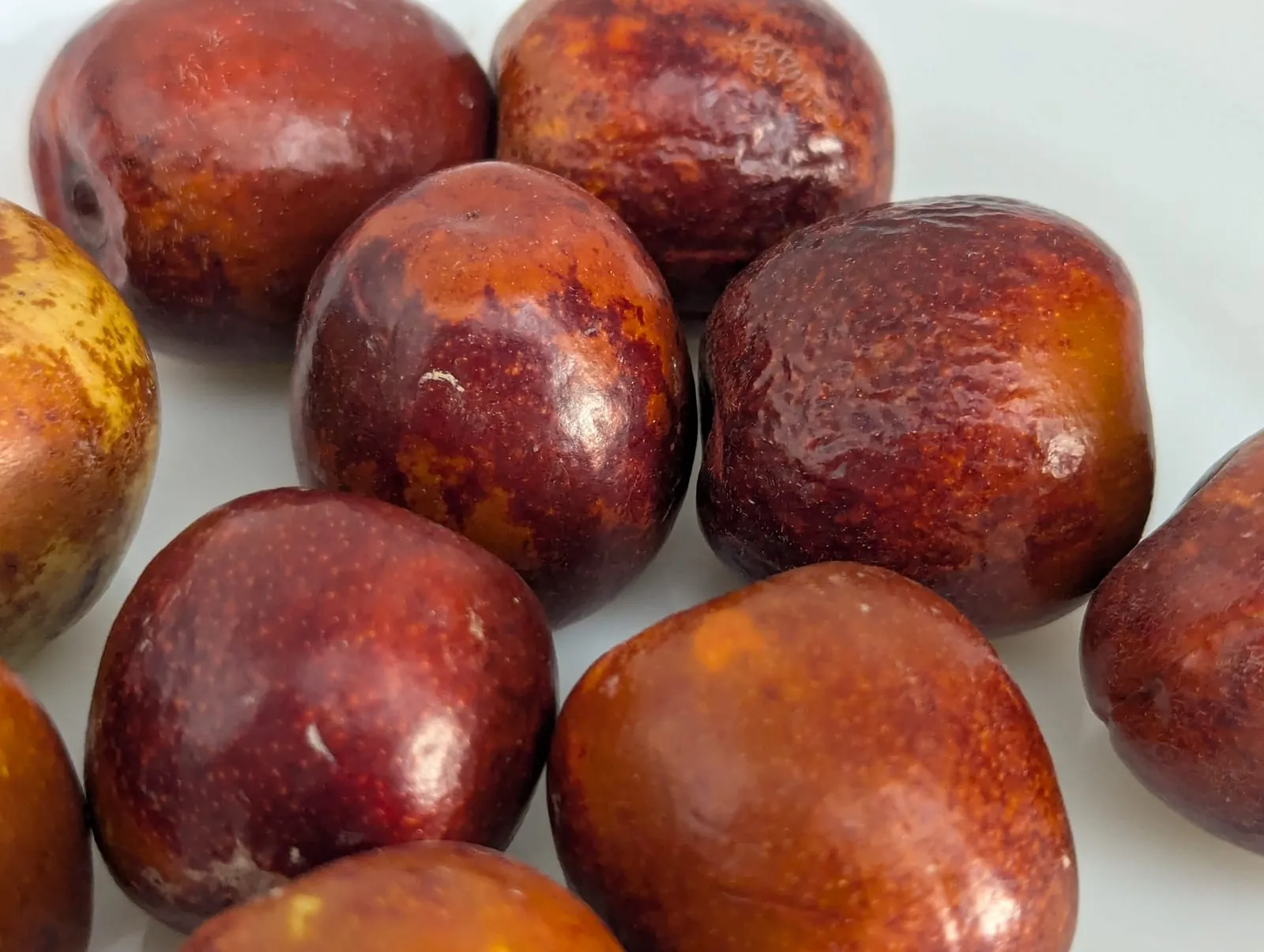
fruit tree
Jujube
Ziziphus jujuba
USDA hardiness range
- Zones
- 6a–9b
- Chill hours
- 50 to 200 below 45°F
- Days to harvest
- 150 to 200
- Sun
- Full
- Water
- Low
- Lifespan
- 100 years
Growing jujube
Jujube (Ziziphus jujuba) is one of the more underutilized fruit trees in the American home orchard. It thrives across zones 6a through 9b, tolerates drought that would stress most stone fruits, and produces reliably in heat that discourages other tree fruits. The low chill-hour requirement, somewhere between 50 and 200 hours depending on variety, makes jujube accessible to warm-climate growers who struggle to accumulate the 800 to 1,000 chill hours that apples and pears demand.
Where jujube struggles is instructive. The tree needs genuine summer heat to develop full sweetness in its fruit. In cool maritime climates, the fruit matures slowly or not at all, and flavor suffers even when the crop technically ripens. Zone 6a growers can succeed, but late spring frosts are a real risk because jujube breaks dormancy relatively early. The northern edge of the range rewards planting in sheltered microclimates with good air drainage.
The gap between a productive jujube planting and a disappointing one often comes down to two factors: sun exposure and patience. Jujube produces modestly in its first few years; trees planted in less-than-full-sun sites compound this with poor fruit set. Well-sited trees can produce for a century, making site selection a decision worth taking seriously.
Recommended varieties
See all 4 →4 cultivars for home growers, with notes on flavor, ripening, and disease resistance.
| Variety | Notes | Zone fit | Disease resistance |
|---|---|---|---|
| Li | Sweet, crisp like an apple when fresh; large round fruit. Eats out of hand, dries to a date-like sweetness. Most popular fresh-eating jujube. | | none noted |
| Lang | Sweet, crisp, apple-pear flavor when fresh; pear-shaped fruit. Productive, often the pollinator for Li. Excellent fresh and dried. | | none noted |
| Honey Jar | Extremely sweet, crisp, intense honey flavor; small fruit (cherry-sized). The connoisseur's jujube, prized variety, eats fresh in handfuls. | | none noted |
| Sugar Cane | Very sweet, crisp, large fruit; fresh eating champion with high sugar content. Heavy producer. | | none noted |
Soil and site requirements
Jujube tolerates poor soil better than almost any common fruit tree. It handles alkaline pH that would chlorose stone fruits, and grows reasonably well in thin, rocky, or sandy soils where other trees stall. That said, drainage is a firm requirement. Jujube roots do not tolerate prolonged saturation. Sites with standing water after rain should be ruled out or substantially amended before planting.
Soil pH flexibility is a genuine asset in regions with naturally alkaline soils, including much of the southern plains and intermountain west, areas that overlap well with jujube's optimal zone range. In acidic soils below roughly pH 5.5, growth can be sluggish, though this is less common on sites where jujube is typically grown.
Full sun is non-negotiable. Partial shade reduces fruit set noticeably and delays ripening in an already-long 150 to 200 day growing window. Spacing of 10 to 15 feet between trees supports adequate air circulation and allows the canopy to develop without crowding. Zone 6a and 6b plantings benefit from south-facing slopes or positions near heat-absorbing masonry walls to extend the effective growing season and reduce late-frost exposure.
Common challenges
Pollination and fruit set are the most common source of disappointment with jujube. Flowers are technically self-fertile, but fruit set improves substantially when two different varieties are planted within range of each other. Li and Lang are the standard pairing, with Lang widely considered to improve Li's crop load. Single-tree plantings of Li alone sometimes set adequately; Honey Jar in a solo planting often sets poorly. The simplest solution is to plant two varieties unless space is a hard constraint.
Summer heat and fruit flavor are closely related problems. Jujube needs accumulated heat to develop the sugars that make fresh fruit worth eating. In years with cool, cloudy summers, or on sites at the cooler edge of the range, fruit ripens late and may taste astringent or flat. This is not a disease; it is a heat deficit. Choosing an early-ripening variety like Honey Jar helps on marginal sites.
Fruit cracking near harvest occurs when late-season rain arrives after a dry period. The fruit absorbs water rapidly, the skin splits, and quality drops quickly. This is manageable but not fully preventable. Harvesting slightly early, when fruit transitions from green to yellow-green, reduces crack losses. Cracked fruit dries well and loses little quality if processed promptly, so the traditional dried preparation sidesteps this issue almost entirely.
Companion plants
Frequently asked questions
- How many chill hours does jujube need?
Jujube requires only 50 to 200 chill hours depending on variety. This is among the lowest requirements of any common fruit tree, which makes it practical for warm-climate growers in zones 6a through 9b who cannot reliably accumulate the chill totals that apples and pears demand.
- How long does it take a jujube tree to bear fruit?
From planting to first meaningful harvest typically runs 3 to 5 years. Once in production, the season from bloom to ripe fruit is 150 to 200 days. Trees continue to increase in productivity for many years; well-sited specimens remain productive for a century.
- What USDA hardiness zones support jujube?
Jujube is reliably productive in zones 6a through 9b. Zone 6a growers should prioritize sheltered sites with good frost drainage and expect some late-frost risk. In very warm zones above 9b, insufficient chill-hour accumulation can become a limiting factor for some varieties.
- Is jujube self-fertile, or does it need a second tree for pollination?
Jujube is self-fertile, but planting two varieties improves fruit set substantially. Li and Lang are the most common pairing, with Lang frequently used to improve Li's crop load. Honey Jar tends to set poorly when grown alone and benefits most from a second variety nearby.
- What diseases commonly affect jujube?
Jujube has an unusually clean disease profile for a fruit tree. It is not significantly susceptible to fire blight, brown rot, or powdery mildew. Witches' broom, caused by a phytoplasma, is the one disease of note, though it is uncommon in most of the United States and does not appear to be a routine concern for home growers.
- Which jujube variety is best for fresh eating?
Li is the most popular fresh-eating variety, offering large, round fruit with apple-like crispness at peak ripeness. Honey Jar is prized for intense sweetness but produces smaller, cherry-sized fruit. Lang performs well both fresh and dried and is often grown alongside Li as a pollinator.
- Why is the jujube fruit cracking before it is fully ripe?
Cracking is caused by rapid water uptake during or after a dry period, typically from late-summer or early-fall rain. The skin splits as the fruit swells. Harvesting slightly early, when fruit shifts from green to yellow-green rather than waiting for full color change, reduces losses. Cracked fruit dries well if processed quickly.
+−
+−
+−
+−
+−
+−
+−
Sources
Image: "Ziziphus jujuba (fruit)", by Ismael Olea, via Wikimedia Commons, licensed under CC-BY. Source.
.jpg)
Jujube by zone
Related