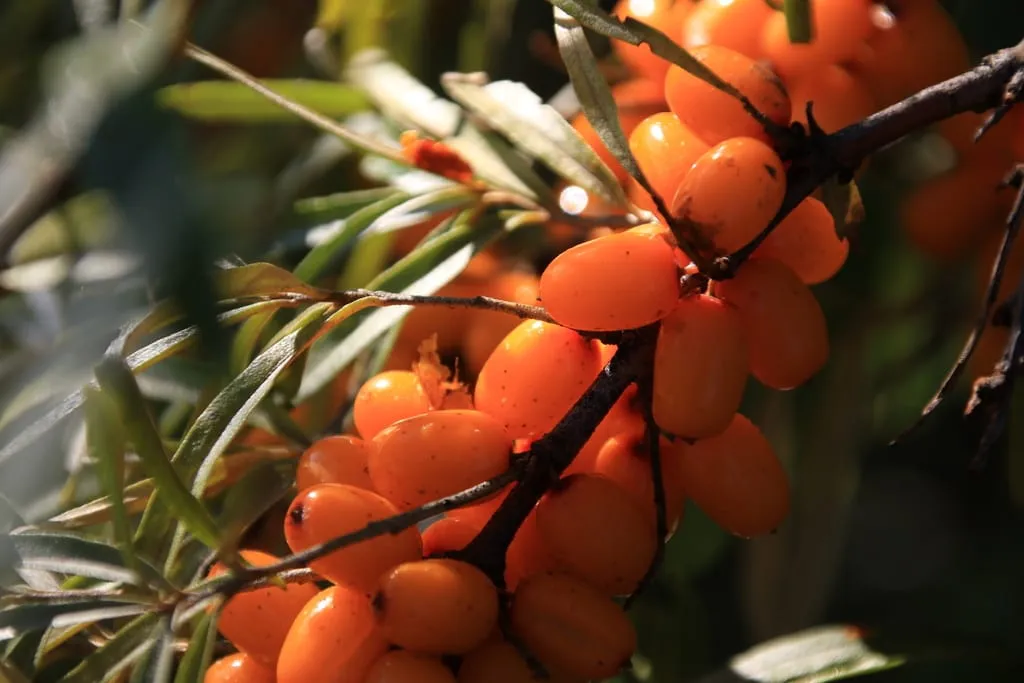
berry
Sea Buckthorn
Hippophae rhamnoides
USDA hardiness range
- Zones
- 3a–7a
- Days to harvest
- 100 to 130
- Sun
- Full
- Water
- Low
- Lifespan
- 50 years
Growing sea buckthorn
Sea buckthorn is one of the few fruiting shrubs that performs reliably in zones 3a through 6b, where winter temperatures routinely drop below -20°F and growing seasons are short. Hardy to zone 3a and documented to survive temperatures approaching -40°F, it tolerates cold that eliminates nearly every other fruit crop. Zone 7a represents the practical southern limit; summer heat accumulates adequately but winter chill can be inconsistent in warmer years, and plants may become irregular in their fruiting behavior. It is not a crop for mild-winter climates.
Once established, sea buckthorn is genuinely undemanding: it fixes atmospheric nitrogen through root-associated bacteria, tolerates drought, poor soils, and coastal salt exposure, and has a productive lifespan measured in decades. The 100-to-130-day harvest window means fruit typically ripens in late summer through early fall, varying by zone and elevation.
What separates productive plantings from unproductive ones is almost always the same issue: pollination. Sea buckthorn is dioecious, meaning individual plants are either male or female, and no female produces fruit without a nearby male. One male plant per six to eight females is the standard ratio. Growers who skip this step or lose their male plant mid-life get a healthy, vigorous, and completely fruitless planting. The other consistent failure point is harvest logistics, addressed below. Neither problem is hard to solve, but both require planning before the first plant goes in the ground.
Recommended varieties
See all 4 →4 cultivars for home growers, with notes on flavor, ripening, and disease resistance.
| Variety | Notes | Zone fit | Disease resistance |
|---|---|---|---|
| Botanica | Tart, bracingly acidic, complex citrus-passionfruit-pineapple flavor; juice, jam, syrup, oil. Russian-bred female with high yields. Requires a male pollinator (one male per 6-8 females). | | none noted |
| Frugana | Tart, juicy, large bright-orange berries; processing, oil extraction. German-bred female productive with reduced thorns compared to wild stock. | | none noted |
| Garden's Gift | Tart, large vibrant orange berries; juice and jam. Russian female with concentrated cluster, easier handharvest. Pair with male pollinator. | | none noted |
| Romeo (male) | Pollinator only, no fruit; provides pollen for female cultivars. Plant one male per 6-8 females. Vigorous nitrogen-fixing shrub useful as windbreak. | | none noted |
Soil and site requirements
Sea buckthorn tolerates a wide range of soil types, including gravelly, sandy, and nutrient-poor substrates that would stress most orchard crops. What it will not tolerate is poor drainage. Waterlogged soils and compacted clay cause root decline and eventual plant death on established specimens; this is the most common site-selection error. Sandy loam or well-drained loam is ideal. The plant fixes nitrogen through actinobacterial root nodules (Frankia sp.), so low-fertility soils are not a disqualifying factor.
Soil pH of 6.0 to 7.5 covers the workable range. Strongly alkaline soils above pH 8.0 reduce micronutrient availability and are not recommended. No amendment is needed for mildly acidic or neutral soils.
Full sun is required; six hours is the minimum, eight or more produces notably better yields and tighter fruit clusters. Space female plants 6 to 8 feet apart within rows, with rows 10 to 12 feet apart to allow airflow and equipment access. One or two male plants placed within 50 feet of the female block, upwind when wind direction is consistent, provides adequate pollen distribution.
Microclimate considerations matter most at the zone 7a southern edge and in the coldest zones. In zone 7a, south-facing slopes warm early in spring and increase the risk of premature bloom followed by late frost injury; east-facing or slightly north-facing exposures buffer this. In zones 3a and 4b, windbreaks on the prevailing cold-wind side reduce winter desiccation damage to exposed stems.
Common pests
Common challenges
The most frequent failure mode is absent or misidentified pollinators. Sea buckthorn is dioecious, and young plants sold as bare-root starts are not always reliably sexed at the nursery level. Named female cultivars (Botanica, Frugana, Garden's Gift) require at least one male plant within the planting. If the male is lost to winter injury or is inadvertently removed, the entire female block stops fruiting. Confirm plant sex before purchase, source the male from the same nursery as the females when possible, and replace any male that fails to leaf out in spring.
Harvesting is the second recurring problem, and it surprises most first-time growers. Berries ripen in a compressed window, adhere tightly to thorny branches, and rupture on contact, releasing acidic juice that stains clothing and skin. Hand-picking individual berries is slow enough that many growers abandon the harvest mid-way through. The practical approach used by experienced growers is to prune entire fruiting branches and briefly freeze them, which firms the berries enough to strip cleanly over a container. Plan the harvest method before planting.
Bird damage is a significant and predictable yield threat. Orange-fruited cultivars ripening in late summer attract birds as wild food sources decline, and unprotected plantings can lose a substantial portion of the crop in days. Netting is effective on young or compact plants but becomes difficult to manage on mature 8-to-10-foot specimens. Some growers harvest slightly early, before peak bird pressure, accepting some loss in flavor development. Planting within close visual range of the house or a frequently used structure reduces pressure modestly but does not eliminate it.
Frequently asked questions
- What chill-hour requirement does sea buckthorn have?
Sea buckthorn requires a cold winter to break dormancy reliably and set fruit, but exact chill-hour figures vary by cultivar and have not been standardized across the named Russian and German selections. Its zone range of 3a through 7a reflects a plant that needs real winter cold. Zone 7a is the southern limit where chill accumulation begins to be inconsistent. The University of Saskatchewan Sea Buckthorn program is the leading North American research source on variety-level cold requirements.
- How long does sea buckthorn take to produce fruit after planting?
Sea buckthorn typically begins fruiting 3 to 4 years after planting. Once in production, the window from flowering to harvest is 100 to 130 days depending on variety and climate, placing ripe fruit in late summer to early fall in most zones. Full production capacity is reached around year 5 to 6.
- What USDA hardiness zones are suitable for sea buckthorn?
Sea buckthorn grows in zones 3a through 7a. It is among the cold-hardiest fruiting shrubs available, tolerating temperatures down to approximately -40°F in zone 3a. Zone 7a is the practical southern limit; in warmer parts of zone 7 and beyond, insufficient winter chill leads to unreliable dormancy break and reduced fruiting.
- Does sea buckthorn need a pollinator plant?
Yes. Sea buckthorn is dioecious: plants are either male or female, and female plants produce no fruit without a nearby male. The standard ratio is one male per six to eight females. The male should be positioned within 50 feet of the female block and, where possible, upwind. All named female varieties including Botanica, Frugana, and Garden's Gift require a male pollinator.
- What diseases most commonly affect sea buckthorn?
Established sea buckthorn has low disease pressure overall. No significant fungal or bacterial disease complex is documented for the major named cultivars in North American production systems. The primary yield threat is bird damage rather than disease; birds are drawn heavily to the ripe orange berries in late summer.
- How drought-tolerant is sea buckthorn once established?
Sea buckthorn is genuinely drought-tolerant once established, which typically takes one to two full growing seasons. It tolerates dry, nutrient-poor soils and fixes its own nitrogen through root nodule bacteria. The one soil condition it cannot tolerate is poor drainage; waterlogged or compacted soils cause root decline regardless of drought tolerance elsewhere.
- How large does a mature sea buckthorn plant get?
Mature sea buckthorn shrubs typically reach 8 to 12 feet tall and 6 to 8 feet wide, though named cultivars like Frugana have been selected for more compact habit compared to wild-type plants. Unpruned plants develop thorny, spreading growth. Regular light pruning after harvest maintains plant height and improves access for future harvests.
+−
+−
+−
+−
+−
+−
+−
Sources
Image: "Облепиха", by Нурхайдарова Татьяна, via iNaturalist, licensed under CC-BY. Source.
Sea Buckthorn by zone
Related